



A “standard” sofa is not one fixed size. It is a range furniture makers have settled into: a three-seat sofa usually runs 72 to 96 inches long, 32 to 40 inches deep, and 30 to 36 inches high, with 84 inches the most common length. That range is what makes shopping confusing, because two sofas labeled “standard” can feel completely different.
Here is the part that actually matters: the three numbers on the tag tell you whether the sofa fits your room, but they tell you almost nothing about how it feels to sit on. Comfort comes from the seat dimensions (seat depth, seat height, seat width between the arms), and whether the sofa reaches your home at all comes down to one number almost nobody checks: the diagonal depth. This guide covers all of them, with ranges for loveseats, apartment sofas, three-seaters and deep lounge sofas.
Standard Sofa Dimensions at a Glance
| Sofa type | Overall length | Overall depth | Overall height | Seats |
|---|---|---|---|---|
| Loveseat | 48-72″ (122-183 cm) | 32-40″ (81-102 cm) | 30-36″ (76-91 cm) | 2 |
| Apartment sofa | 68-78″ (173-198 cm) | 32-36″ (81-91 cm) | 30-36″ (76-91 cm) | 2 |
| Three-seat sofa | 72-96″ (183-244 cm) | 32-40″ (81-102 cm) | 30-36″ (76-91 cm) | 3 |
| Deep / lounge sofa | 84-108″ (213-274 cm) | 40″+ (102+ cm) | 30-36″ (76-91 cm) | 3-4 |
The most common three-seat sofa in the US is about 84 inches (213 cm) long and 35 to 38 inches (89-97 cm) deep, according to Livingetc’s sofa dimensions guide; Dimensions.com puts the standard three-seat range at 72-96 inches and loveseats at 48-72 inches (Dimensions.com). These are working ranges, not an industry rule: measure the exact piece you are considering, since arm style and cushion construction move these numbers by several inches.
When people look up average couch dimensions, the three-seat row is usually what they mean: 72-96 inches long, 32-40 inches deep, and a sofa height of 30-36 inches from floor to top of the back.
The Anatomy of a Sofa Measurement
A spec sheet usually lists three numbers, but ten measurements matter. The first three decide room fit. The rest decide comfort, and whether the delivery crew can get the sofa through your door.
| Measurement | What it is | Typical range | Why it matters |
|---|---|---|---|
| Overall width (length) | Arm to arm, the widest point | 72-96″ (183-244 cm) for three-seaters | Determines wall fit and room proportion |
| Overall depth | Front edge of seat to back of frame | 32-40″ (81-102 cm) | Determines floor footprint and walkways |
| Overall height | Floor to top of back cushion | 30-36″ (76-91 cm) | Affects sightlines, e.g. under windows |
| Seat width | Usable sitting space between the arms | 60-80″ (152-203 cm) on a three-seater | Two 8″ arms eat 16″ off the overall width |
| Seat depth | Front of seat cushion to back cushion | 21-24″ (53-61 cm), typical ~22″ (56 cm) | The single biggest comfort factor |
| Seat height | Floor to top of seat cushion | 17-19″ (43-48 cm) | Affects how easy it is to sit and stand |
| Back height | Floor to top of back | 30-36″ (76-91 cm) | Shoulder and head support |
| Arm height | Floor to top of arm | 22-26″ (56-66 cm) | Decides what side table height works |
| Arm width | Thickness of each arm | 4-8″ (10-20 cm) | Slim arms seat more people in the same width |
| Diagonal depth | Top of back to bottom front, measured diagonally | ~44-54″ (112-137 cm) | The number that decides delivery fit |
Seat depth runs the comfort show. Standard seat depth is 21-24 inches, averaging about 22 inches. Shallower seats (21-22″) suit upright sitting and shorter people; deeper seats (23-24″) are for lounging and sitting cross-legged. If you mostly lounge, favor the deeper end of the range; if you sit upright to read or work, favor the shallower end.
Seat height is about your knees, not the sofa’s looks. Most sofa seats sit 17-19 inches off the floor. Lower feels relaxed; higher makes standing up easier, which matters for older household members. Once you know your seat height, you can match your coffee table height to the sofa so the tabletop lands level with or just below the cushion.
Arms are sneaky space thieves. An 84-inch sofa can offer only 68 inches of actual sitting room, because two wide arms eat a foot or more. Check seat width, not the headline number, when counting seats. Arms typically run 4-8 inches wide and 22-26 inches tall, so check our notes on end table height next to a sofa arm before pairing furniture.
Diagonal depth is the delivery number. It decides whether the sofa gets through your front door. Livingetc’s guide calls it “crucial” for doorways: the distance from the top back of the sofa to the bottom front (Livingetc’s sofa dimensions guide). The checklist below shows how to work with it. For L-shaped pieces, see our sectional sofa dimensions guide, where the footprint math is different.
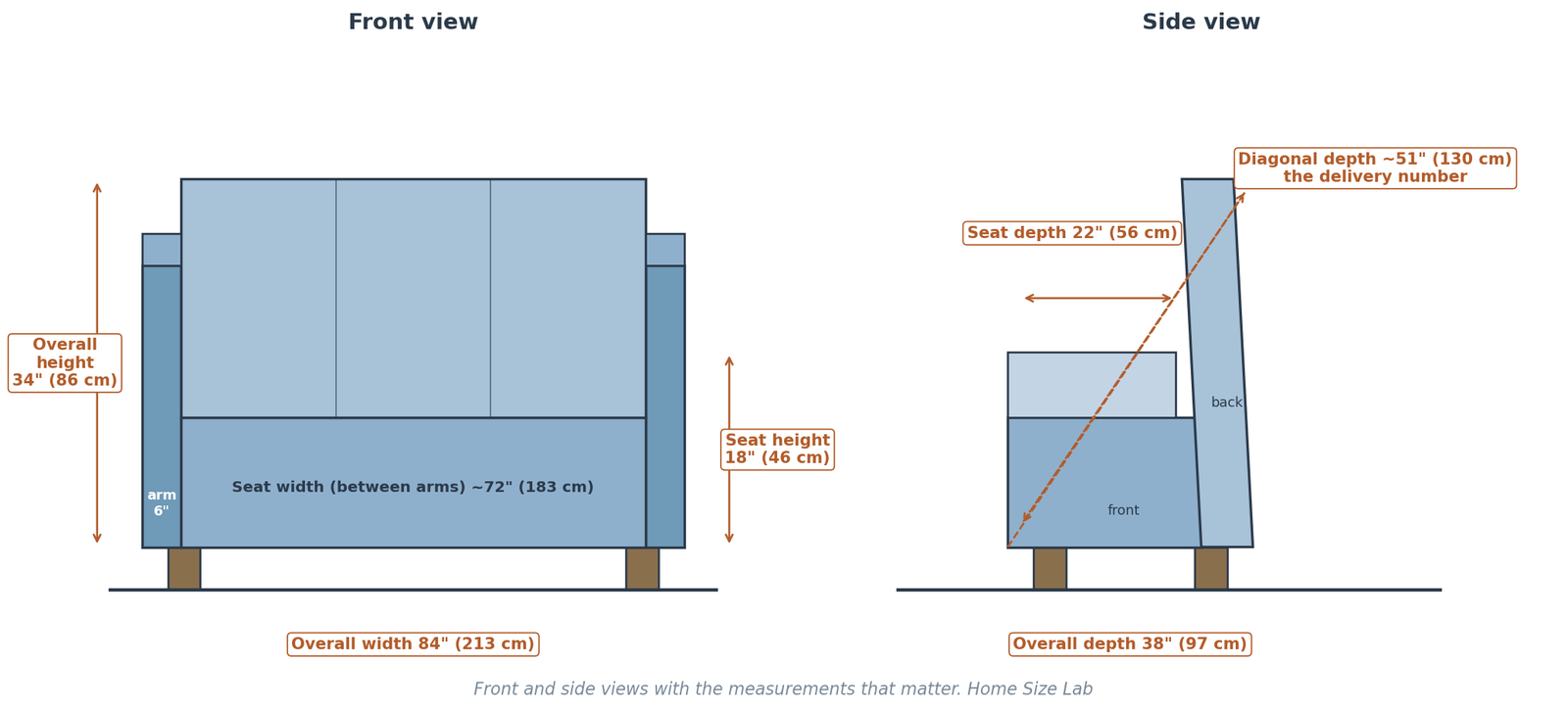
Ranges by Sofa Type
Loveseat (48-72″ long). Standard loveseat dimensions center on about 60 inches (152 cm), with depth in the 32-40 inch range. Loveseats suit 10 x 12 foot rooms and smaller, or work as a companion piece facing a full sofa. At the 72-inch end, two adults sit with room to spare; three will feel squeezed once the arms take their share.
Apartment sofa (68-78″ long). Shorter and usually shallower (32-36″ deep) than a full three-seater. This is the category to shop when your room is under about 150 square feet: the shorter length leaves room for walkways without dropping to a loveseat’s two-person capacity.
Three-seat sofa (72-96″ long). The default, and what most people mean by the standard 3 seat sofa size. At 84 inches, it seats three adults with roughly 24-28 inches of seat space each once you subtract the arms, and it anchors a standard 12 x 14 to 12 x 18 foot living room. As a proportion check, the sofa should take up about two-thirds of the wall it sits against.
Deep / lounge sofa (40″+ deep). Anything past 40 inches of overall depth is built for sprawling rather than perching, with seat depths of 24 inches and up. These suit tall households and dedicated lounging, but they demand floor space: a 44-inch-deep sofa in a 10-foot-deep room leaves almost nothing for a coffee table and a walkway.
The Delivery Route Checklist
More sofas get returned over delivery failures than comfort complaints. The sofa fits the room on paper, then will not turn the stairwell corner. Run this checklist before you order.
1. Measure the sofa’s diagonal depth. Almost no listing shows it, but it is the single most useful delivery number. Take overall depth and overall height, square each, add them, and take the square root. For a sofa 38 inches deep and 34 inches high, that is the square root of (1444 + 1156), about 51 inches (130 cm). That is the opening width the sofa needs when carried on its side. If your door is 36 inches wide, the sofa goes through on end or not at all. Narrow door? Learn how to tell if a couch fits through a 30-inch door first.
2. Measure every doorway, hallway and stair turn on the route. Measure width and height of the front door, interior doors, the hallway at its narrowest, and any stair turn, including ceiling clearance. Hallways and interior doors need to be wider than the sofa’s depth or height, depending on how it will be carried. Account for banisters, light fixtures, and anything that cannot move.
3. Check the elevator, if there is one. Apartment deliveries fail at the elevator more often than at the apartment door. Measure the elevator door width and interior diagonal, and confirm the building’s delivery time windows before the truck arrives.
4. Tape the footprint on your floor. Use painter’s tape to outline the sofa’s full length and depth where it will sit, then walk around it. This catches what numbers miss: the door swing hitting the arm, the walkway shrunk to 20 inches, the coffee table now out of reach. Leave 14 to 18 inches of gap between the sofa and coffee table inside that taped footprint, and keep main walkways at 30-36 inches.
5. Compare against the packaged dimensions, not the sofa dimensions. The shipping box is bigger than the sofa. If the listing gives packaged or shipping dimensions, those are the numbers your doorways have to beat.
Worked Examples
Example 1: Will an 84 x 38 x 34 sofa fit through a 36-inch door?
Its diagonal depth is the square root of (38 x 38 + 34 x 34), about 51 inches (130 cm), so a 36-inch (91 cm) door is far too narrow for it to go through on its side. The fallback is carrying it on end: the 84-inch length goes vertical, needing more than 84 inches of ceiling clearance in the hallway or foyer. That works with 8-foot (96-inch) ceilings, but not with a 7-foot ceiling or a low-hanging light at the turn. Note the width never mattered: depth and height are what doors test.
Example 2: Sizing a sofa for a 10-foot wall in a small living room.
Two-thirds of the wall is the guideline: 120 inches x 2/3 = 80 inches. An 84-inch standard sofa is slightly over but fine; a 72-inch apartment sofa is safer if the room also needs an accent chair and a walkway. Say you choose a 78-inch apartment sofa at 34 inches deep. The taped footprint is 78 x 34. Put 3 inches behind it for breathing room off the wall, 16 inches in front for coffee table reach, and the seating zone uses 53 inches of room depth. In a 12-foot-deep room (144 inches), that leaves 91 inches for everything else, which is comfortable. In a 10-foot-deep room (120 inches), 67 inches remain, which still works but means the walkway behind a floating sofa has to come out of that budget. For the full room-planning method, see our guide to sofa size for living room.
Where People Get It Wrong
Comparing overall width instead of seat width. Two 84-inch sofas can offer 68 or 76 inches of sitting room depending on arm design. If you are seating three adults, subtract both arm widths before you count seats.
Forgetting that cushions compress. Seat height and seat depth are measured uncompressed. Sit down and both shrink by an inch or two, which is why testing in person matters.
Buying depth for the room they wish they had. A deep 44-inch sofa feels wonderful in the showroom and eats a small living room alive. Tape the depth on the floor, not just the length.
Assuming the door is the only obstacle. The front door is usually the widest opening on the route. The failures happen at the second interior door, the stairwell turn, or the elevator. Measure the whole path.
Matching the sofa to the wall instead of the household. The two-thirds rule is about looks. Seat depth and seat height are about the people using it daily.
Skipping the diagonal math. This is the quiet one. Everything fits on paper, the tape outline looks right, and then the delivery crew stands in your hallway with a sofa that will not turn the corner. Five minutes with a calculator prevents it.
Frequently Asked Questions
What are standard sofa dimensions?
A standard three-seat sofa is typically 72-96 inches (183-244 cm) long, 32-40 inches (81-102 cm) deep, and 30-36 inches (76-91 cm) high, with 84 inches long being the most common single size. Loveseats run 48-72 inches long. Seat dimensions matter as much as the headline numbers: seat depth is usually 21-24 inches and seat height 17-19 inches.
How long is a three-seat couch?
Most three-seat couches are 72-96 inches long overall, and 84 inches (7 feet) is the most common length in the US. Keep in mind that the arms take up part of that: with typical 4-8 inch arms, an 84-inch sofa offers roughly 68-76 inches of actual sitting space, or about 23-25 inches per person.
What is average sofa depth?
Average overall sofa depth is 35-38 inches (89-97 cm), within a standard range of 32-40 inches. What most people mean by “depth” when they ask, though, is seat depth: the sitting surface from front edge to back cushion, which averages about 22 inches (56 cm) in a range of 21-24 inches. Deeper than 40 inches overall counts as a deep or lounge sofa.
How much smaller is a loveseat than a sofa?
A loveseat is roughly 2 feet shorter: loveseats run 48-72 inches long versus 72-96 for a three-seat sofa, with about 60 inches being the most common loveseat length. Depth and height are similar to a full sofa, so a loveseat saves length, not footprint depth.
What sofa size works for a small apartment?
For rooms under about 150 square feet, look at apartment sofas in the 68-78 inch range with 32-36 inch depth, or a loveseat at 60-72 inches. Slim arms and raised legs make either feel lighter in the room. Tape the full footprint before buying, since depth is what crowds a small room.
Measure the room, measure the route, and measure the seat, not just the tag. The three headline numbers tell you whether the sofa fits your wall. The seat depth tells you whether you will love sitting on it. And the diagonal depth tells you whether it will ever reach your living room at all.

11 Comments
Pingback: How to Measure Doorways and Hallways for Furniture Delivery - Home Size Lab
Pingback: How to Get a Couch Around a Tight Corner
Pingback: Sofa-to-Coffee-Table Distance: Minimum & Ideal
Pingback: Coffee Table Height vs. Sofa: The Right Match
Pingback: End Table Height vs. Sofa Arm: Sizing Guide
Pingback: Sectional Sofa Dimensions & Room-Fit Guide
Pingback: How to Choose the Right Sofa Size for Your Room
Pingback: Will a Couch Fit Through a 30-Inch Door?
Pingback: What Size Rug for Living Room? Sizes, Layouts & Diagrams
Pingback: Loveseat Dimensions: Standard Sizes (Chart)
Pingback: TV Stand Dimensions by Screen Size (Chart)