



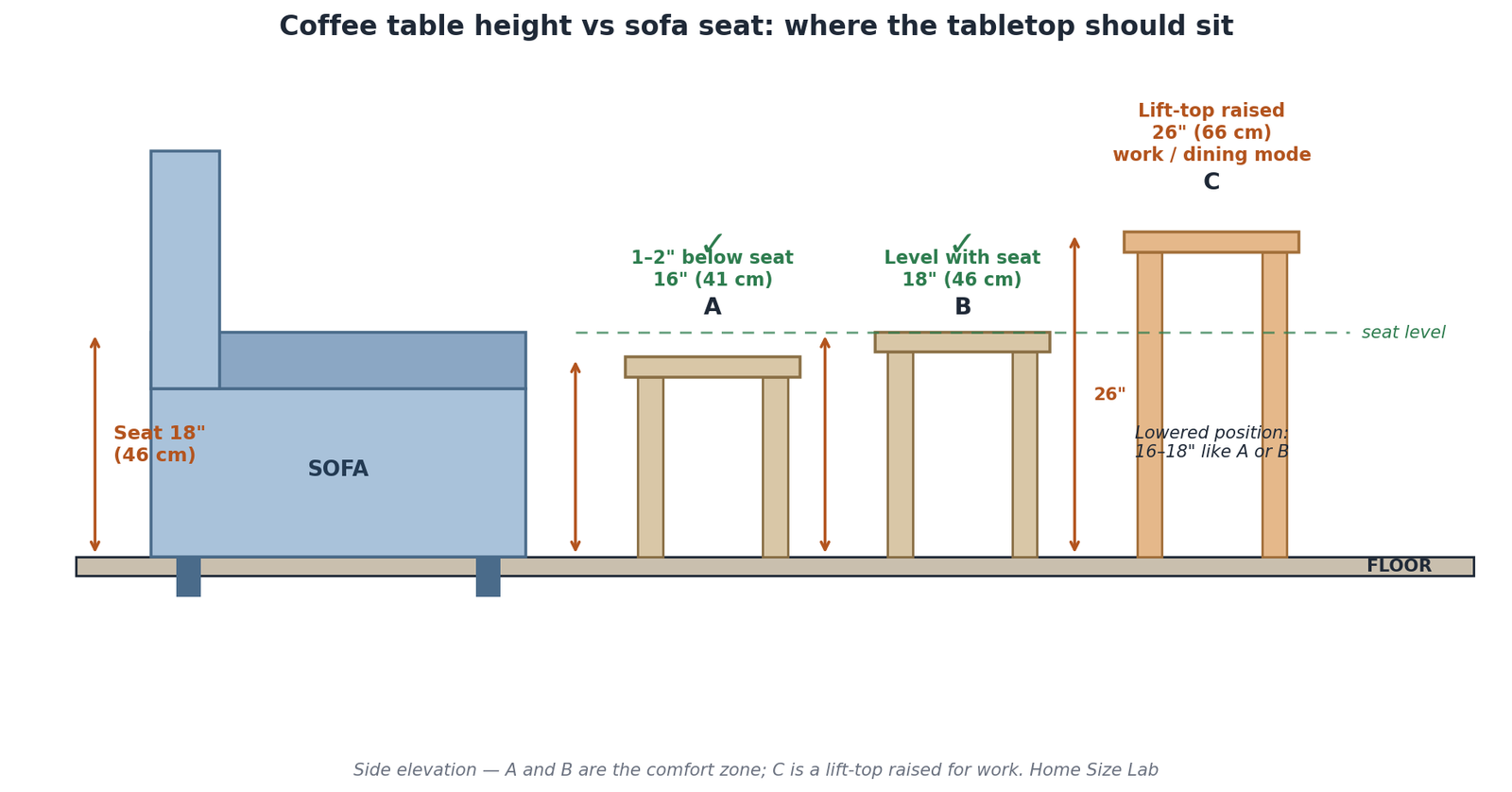
A coffee table should sit level with your sofa’s seat cushion, or up to 2 inches (5 cm) below it. Never above. That’s the whole rule: for a standard 17–18-inch seat, look for a table around 15–18 inches tall, and reaching for your drink stays effortless.
Get it wrong and your shoulder notices first. Too tall and you’re lifting your arm like you’re making a toast. Too short and you’re folding in half to set down a book.
Coffee Table Height vs Sofa: The Quick Answer
- The rule: The coffee tabletop should be level with or 1–2 inches lower than the top of the sofa seat cushion.
- The range: Most coffee tables are 14–18 inches (36–46 cm) tall; most sofa seats sit 17–19 inches (43–48 cm) off the floor.
- The hard line: A coffee table should never be higher than the seat height. Interior designer Ellie Christopher puts it bluntly in Southern Living: “I would never want the coffee table to be higher than the seat height of your sofa.”
- The exception: Lift-top tables and low-profile sofas play by adjusted numbers (covered below).
Standard Heights: Match Your Table to Your Seat
Don’t shop by the table alone. Shop by the pair: measure your sofa’s seat height first, then match.
| Sofa seat height | Matching coffee table height | Best for |
|---|---|---|
| 14–16″ (36–41 cm), low-profile | 14–16″ (36–41 cm) | Modern low sofas, platform seating |
| 17″ (43 cm), standard | 15–17″ (38–43 cm) | Most mainstream sofas |
| 18″ (46 cm), standard | 16–18″ (41–46 cm) | Traditional and transitional sofas |
| 19″ (48 cm), tall | 17–19″ (43–48 cm) | Tall-back, formal, or deep-seat sofas |
| Lift-top (lowered) | 16–18″ (41–46 cm) | Doubles as a work/dining surface when raised |
Interior designer Stefani Stein describes the same pairing this way in Livingetc: taller, more traditional seat heights feel balanced with an 18- or 19-inch coffee table, while lower-profile pieces pair better with a 14- to 16-inch table. Designer Sheena Murphy’s advice is even simpler: get the table as close to the seat height of the couch as you can.
Why Table Height Has Two Jobs: Reach and Looks
The rule exists for two separate reasons, and understanding both helps you make judgment calls.
Functional reach. When you’re sunk into a sofa, your forearm rests roughly level with the seat cushion. A tabletop at that same plane lets you slide a mug on or off with a lazy wrist motion. No lifting, no bending. Drop the table 4 or 5 inches below the seat and every reach becomes a small crunch. Raise it above the seat and your elbow has to hike up, which gets old by the second episode.
Visual proportion. A coffee table is the visual anchor of the seating arrangement. When it’s roughly level with the seat, the eye reads the sofa and table as one horizontal composition: calm and balanced. A table towering above the seat breaks that line and makes the arrangement look top-heavy; one sitting much lower looks disconnected, like it wandered in from another room.
Both jobs point to the same answer, which is why the rule is so durable. They also explain the exceptions: a purely decorative table in a formal room, where nobody puts feet or drinks on it, can break the rule for looks alone. Christopher herself allows this, as long as the surrounding seating is tall enough to balance it.
Lift-Top Tables and Low-Profile Sofas: The Exceptions
Lift-top coffee tables are the biggest exception, and they’re increasingly common. In the lowered position they should still follow the standard rule: 16–18 inches, level with or just under the seat. Raised, the top typically lands around 24–30 inches (61–76 cm), which is deliberate: that’s dining and laptop height. The thing to check is your seated ergonomics when raised. If you plan to work from the sofa, make sure the raised top clears your knees and sits at a comfortable typing height. Also check the sightline: a raised top shouldn’t block the TV for whoever’s sitting behind it.
Low-profile sofas (seat heights of 14–16 inches) need low tables to match. A standard 18-inch table next to a 15-inch seat looks like it’s looming, and functionally you’re reaching up to it, which defeats the whole point. This is the one scenario where a 14-inch table, which might look stubby elsewhere, is exactly right.
Ottomans used as coffee tables follow the same rule: the top of the ottoman (with a tray on it) should sit level with or just below the seat cushion. The bonus is that an ottoman doubles as extra seating, but only if it’s not noticeably taller than the sofa seat, or guests perch awkwardly.
Minimum vs Comfortable: Where the Inches Land
Think of the height match as a spectrum, not a single number:
- Minimum acceptable: Tabletop up to 2 inches (5 cm) below the seat cushion. Christopher’s own guideline is “about 2 inches shorter than the top of the seat cushion.” Below that, reach starts to suffer.
- Comfortable sweet spot: Level with the seat, or 1 inch below. This is where drinks, remotes, and books all feel effortless, and the visual line is cleanest.
- Avoid: Tabletop above the seat cushion. It’s uncomfortable for feet-up lounging and looks top-heavy. And more than 3 inches below the seat, where the table starts to feel like it’s in a different room.
Height is only half the comfort equation, though: the space between sofa and coffee table matters just as much. If you’re unsure how far a coffee table should sit from the sofa, our spacing guide walks through the ideal gap. A perfectly matched table still fails if you can’t swing your legs around it.
How to Measure Before You Buy
1. Measure the seat, not the sofa. Run a tape from the floor to the top of the seat cushion, not the arm, not the back. Press the cushion down slightly as you measure, because cushions compress 1–2 inches under body weight. That compressed height is the number you’re matching. Confirm the seat height you’re matching against with standard sofa dimensions.
2. Measure the table to the top surface. Floor to the highest point of the tabletop, including any bevel or raised edge. For lift-tops, measure both the lowered and raised positions.
3. Do the sit test. If you’re shopping in person, sit on a sofa of similar height and mimic reaching. Your wrist should stay roughly level, with no shoulder lift and no deep bend. Online shoppers can stack books on an existing table to simulate heights before committing.
4. Account for rugs. A thick rug can add an inch under the sofa while the table sits on bare floor (or vice versa). Measure both pieces in their final positions, rug included.
Common Mistakes to Avoid
Matching the arm height instead of the seat. Sofa arms run 24–28 inches high. Pairing a coffee table to that number gives you a side table, not a coffee table. Always measure from the seat cushion.
Forgetting cushion compression. A plush 19-inch seat sinks to 17 under weight. If you matched your table to the uncompressed number, your “level” table is now 2 inches high. Measure compressed.
Buying the table before the sofa. The sofa is the fixed point: its seat height is much harder to change than a table choice. Finalize seating first, then shop the table to match.
Ignoring the raised position on lift-tops. People check the lowered height and forget to check the raised one against their knees and the TV sightline. Measure both.
Going tall to “fill” a big room. A cavernous living room tempts people toward a chunky 20-inch table for visual weight. But height isn’t the tool for that. Footprint is. A longer or wider table at the right height fills the room without breaking the reach rule.
Frequently Asked Questions
Should a coffee table be higher or lower than the sofa?
Lower, or level, but never higher. The tabletop should sit at the same height as the seat cushion or up to 2 inches below it. Above the seat, the table becomes uncomfortable to use and looks out of proportion.
How many inches below the seat should a coffee table be?
One to two inches is the standard guidance. Level with the cushion is the most comfortable; 2 inches below is the widely accepted maximum before reach starts to feel awkward. Designer Keren Richter’s version is simply to keep the table “a similar height to your seating.”
Is 20 inches too high for a coffee table?
Usually, yes, but not always. Coffee tables are typically 14–18 inches tall, and 20 inches overshoots a standard 17–18-inch seat. It can work if your sofa is taller (19 inches or more), where a 20-inch table lands within the level-or-slightly-below window. Southern Living’s design advice notes exactly this: a 20-inch table can work with a taller couch, and the extra height suits activities like board games.
Can I use an ottoman instead of a coffee table?
Yes, and the height rule doesn’t change: the ottoman’s top should sit level with or just below the seat cushion. Add a sturdy tray and it holds drinks as well as any table, with the bonus of extra seating.
Does the rule change for sectionals?
No. Measure the seat height of the section you’ll sit on most (it can vary across a sectional) and match the table to that. With large sectionals, consider two smaller tables instead of one giant one. The height rule applies to each.
Get the height right and the coffee table disappears into the background of a good evening: everything within reach, nothing in the way. Start with your sofa’s seat height, stay level or a touch below, and let the exceptions (lift-tops, low sofas) earn their inches deliberately. Side tables follow the same logic — see our guide to end table height vs sofa.

4 Comments
Pingback: Standard Sofa Dimensions: Length, Depth & Height
Pingback: Couch-to-TV Distance Chart by Screen Size
Pingback: Desk Dimensions: Standard Sizes by Use (Chart)
Pingback: Standard Coffee Table Dimensions - Home Size Lab