



A standard full futon mattress measures 54 by 75 inches. Folded as a sofa it takes about 58 by 38 inches of floor; unfolded as a bed it needs 58 by 75 inches, nearly twice the floor area. That sofa-to-bed jump, not the mattress size alone, decides whether a futon fits your room.
What a futon is, and why it has two footprints
A futon is a foldable mattress on a frame that converts between a sofa and a bed. In sofa mode the mattress folds in half: one half forms the seat, the other forms the backrest. In bed mode the whole mattress lies flat. That is the whole sizing story. Every other number in this guide follows from it, and it is also why futon shopping confuses people: a listing gives you one set of dimensions, but you live with two.
Definition: a standard futon follows standard US bed sizes when unfolded. A twin futon mattress is 38 by 75 inches, a full is 54 by 75, a queen is 60 by 80, and a king is 76 by 80. The frame adds width for its sides and arms; the mattress size is what the bedding fits.
Standard futon mattress sizes
Futon mattresses follow the same width and length as standard American bed sizes, which is why standard sheets fit them. Twin futons are sometimes listed at 39 inches wide instead of 38; that one inch is rounding between makers, not a different size.
| Size | Mattress (in) | Mattress (cm) | Sleeps | Best for |
|---|---|---|---|---|
| Twin | 38 x 75 | 96.5 x 190.5 | 1 | Dorm rooms, kids rooms, tight corners |
| Full (double) | 54 x 75 | 137.2 x 190.5 | 1 comfortably, 2 snugly | Guest rooms, studios, home offices |
| Queen | 60 x 80 | 152.4 x 203.2 | 2 | Couples, nightly guest use |
| King | 76 x 80 | 193.0 x 203.2 | 2 | Large rooms, family guest space |
King futons are the rare exception. They exist, usually on tri-fold frames, but they are bulky as a sofa and hard to find, so treat king as a special order rather than a standard buy.
Sofa mode vs bed mode: the footprint table
Here is the gap no size chart closes: the same futon occupies two different rectangles. The table below uses a bi-fold frame with no arms, so frame width equals mattress width plus 4 inches (2 inches of frame on each side). Sofa depth is half the mattress length, because the mattress folds in half. Bed depth is the full mattress length. Arms add width only; each arm adds 4 to 8 inches, so a full futon with 6 inch arms measures 70 inches wide instead of 58.
| Size | Sofa mode (W x D) | Sofa floor area | Bed mode (W x D) | Bed floor area | Bed-to-sofa ratio |
|---|---|---|---|---|---|
| Twin | 42 x 37.5 in | 10.9 sq ft | 42 x 75 in | 21.9 sq ft | 2.0x |
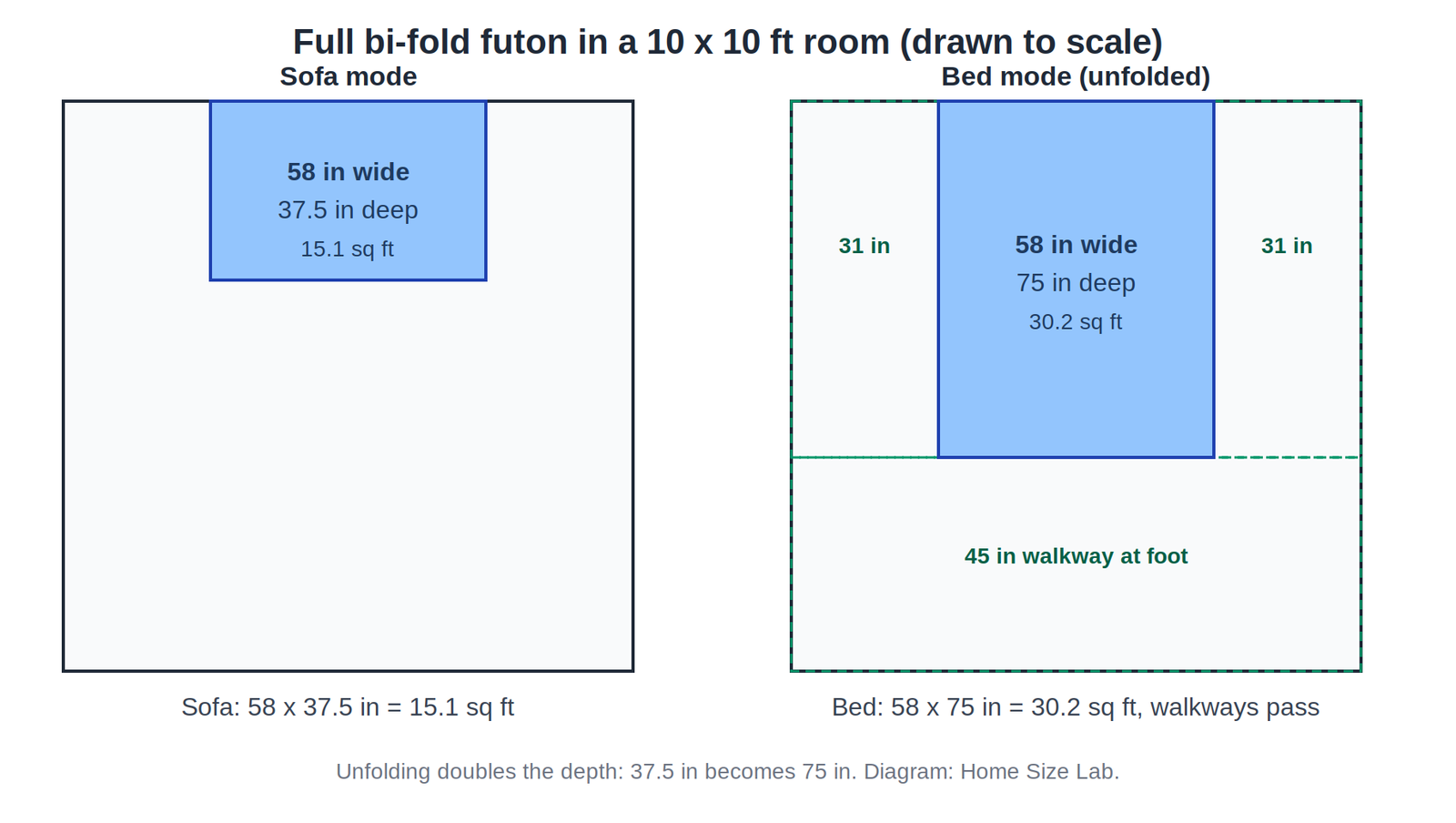
| Full | 58 x 37.5 in | 15.1 sq ft | 58 x 75 in | 30.2 sq ft | 2.0x |
| Queen | 64 x 40 in | 17.8 sq ft | 64 x 80 in | 35.6 sq ft | 2.0x |
| King | 80 x 40 in | 22.2 sq ft | 80 x 80 in | 44.4 sq ft | 2.0x |
The ratio is exactly 2.0x for every size, because unfolding doubles the depth while the width stays the same. A futon that looks compact against the wall in the store needs twice its sofa depth once it is a bed. Plan the room for the bed, not the sofa.
How much room you need to unfold a futon
Room depth is the binding constraint, because the bed extends straight out from the wall. The walkway standard used across this site’s bedroom guides is 24 inches minimum and 30 inches comfortable at the foot of a bed, taken from the clearance guide linked below. Room depth needed equals bed depth plus foot walkway.
| Size | Bed depth | Minimum room depth (bed + 24 in) | Comfortable room depth (bed + 30 in) |
|---|---|---|---|
| Twin | 75 in | 99 in (8 ft 3 in) | 105 in (8 ft 9 in) |
| Full | 75 in | 99 in (8 ft 3 in) | 105 in (8 ft 9 in) |
| Queen | 80 in | 104 in (8 ft 8 in) | 110 in (9 ft 2 in) |
| King | 80 in | 104 in (8 ft 8 in) | 110 in (9 ft 2 in) |
Room width follows the same logic: frame width plus a walkway on each open side. A full futon at 58 inches wide needs 106 inches (8 ft 10 in) of wall for minimum 24 inch walkways on both sides, and 118 inches (9 ft 10 in) for comfortable 30 inch walkways.
Worked example: a full bi-fold futon in a 10 by 10 foot room. As a bed it is 58 inches wide in a 120 inch room, leaving (120 minus 58) divided by 2, which is 31 inches of walkway on each side. At the foot, 120 minus 75 leaves 45 inches. Every walkway clears the comfortable tier, which is why a 10 by 10 room is the sweet spot for a full futon. The same room with a queen gives 28 inch sides and 40 inches at the foot: it passes the minimum but sits below the comfortable tier on the sides. A king in the same room gives only 20 inch sides and fails the 24 inch minimum outright, so a king futon wants a room at least 11 feet wide.
The clearance numbers above come from the same 24 inch minimum used for beds generally. For the full walkway rules, including dresser drawer space and door swing arcs that share these inches, see our guide to space around a bed.
Bi-fold vs tri-fold vs click-clack
Not every futon folds the same way, and the fold type changes the numbers.
Bi-fold. The classic futon frame. The mattress folds once, into seat and back. Sofa depth is about half the mattress length, bed depth is the full length. This is the frame the tables above describe, and the one to buy when you want a standard-size sleeping surface.
Tri-fold. The mattress folds twice, into three sections. Sofa depth drops to about one third of the mattress length, roughly 25 inches, but the folded stack is thicker and heavier. Kings are usually tri-fold, because a 76 inch wide bi-fold is awkward to fold. Bed depth is still the full mattress length once unfolded.
Click-clack. A sofa bed mechanism, not a traditional futon frame. The backrest clicks down flat to meet the seat, and the mattress is sized to the sofa rather than to a standard bed. One popular armless model lists sofa dimensions of 66.5 by 30 inches and bed dimensions of 66.5 by 38 inches: a sleeping surface far smaller than a standard full bed, and standard full sheets will not fit it. If the listing gives sofa and bed dimensions but no standard bed size name, you are looking at a click-clack, and you should shop it by its own numbers, not by this guide’s tables.
Frame width: measure this before you buy a mattress
The most common futon sizing mistake is ordering a mattress by the sofa’s overall width. Overall width includes the arms. What the mattress needs is the back width: the distance from one inside arm edge to the other along the back, where the mattress sits in sofa mode. Typical back widths run about 72 to 75 inches for a full frame and 77 to 80 inches for a queen frame, and comparing that number against the mattress length is the simplest check that a replacement mattress will fit. Measure the frame, not the tag.
Frame styles move the width by a lot. An armless full frame is about 58 inches wide. Add 6 inch arms on each side and the same mattress sits in a 70 inch sofa. That is why two listings for a “full futon” can differ by a foot: same mattress, different arms. Always confirm whether a listed width includes arms before comparing two models.
Futon mattress thickness
Thickness is the second number that matters, after width and length. Thicker is more comfortable for sleeping and harder to fold, and very thick mattresses can strain a bi-fold frame’s hinges.
| Thickness | Feel | Best for |
|---|---|---|
| 6 in | Firm, light, folds easily | Occasional guests, kids, tight budgets |
| 8 in | Standard balance of comfort and fold | Regular guest use, the default pick |
| 10 to 12 in | Closest to a real mattress | Nightly sleeping, if the frame is rated for it |
Check the frame’s rated mattress thickness before buying a 10 inch or thicker mattress. A mattress the frame cannot fold will not stay folded, and a sofa that will not stay a sofa is a bad purchase. For nightly sleeping, an 8 inch mattress on a solid wood or steel frame is the reliable combination; below 6 inches, plan on a topper for adult guests.
What size futon fits your room
Match the size to the room you actually have, not the room you wish you had. Small rooms reward the smaller sizes twice over: less sofa width and less unfolded depth.
| Room size | Recommended futon | Why |
|---|---|---|
| Under 9 x 10 ft | Twin | The only size that keeps 24 inch walkways in a very small room |
| 9 x 10 ft to 10 x 10 ft | Full | 25 to 31 inch sides and 45 inches at the foot, minimum to comfortable tier |
| 10 x 12 ft or larger | Queen | Couples fit, with room for nightstands on the long wall |
| 12 x 14 ft or larger | King | The only room where a king keeps its walkways |
Room size itself is the other half of this decision. If you are unsure whether your room counts as small, standard, or large, our guide to average bedroom size defines the brackets with the arithmetic behind them, so you can place your room before you place the futon.
Where futons sit among fold-out beds
A futon is one kind of fold-out bed, and it is not the same as the other two common kinds. A sleeper sofa hides a fold-out mattress inside a fixed sofa frame; its open bed needs roughly 90 inches of clear floor in front of the sofa, and the mattress is usually shorter than a standard bed. The full sleeper sofa numbers live on our standard sofa dimensions guide, which owns that intent. A wall bed folds down from a cabinet fixed to the wall instead of folding out from a sofa frame; that is a different footprint problem, covered in our murphy bed dimensions guide. This page owns futon intent only: foldable mattress plus frame, sofa mode and bed mode, and the clearance to unfold it.
Frequently asked questions
How much room do you need to unfold a futon?
Room depth equal to the bed depth plus a 24 inch walkway at the foot, minimum. That is 99 inches (8 ft 3 in) for a twin or full and 104 inches (8 ft 8 in) for a queen or king. Add 6 inches for the comfortable 30 inch walkway. Measure from the wall the futon sits against to the nearest furniture or opposite wall, and keep that whole depth clear: the bed cannot unfold into a coffee table.
What size futon fits a small room?
A full fits a 9 by 10 room with 25 inch sides and 45 inches at the foot, and a twin fits anything smaller. A queen in a 10 by 10 room passes the walkway minimums but leaves only 28 inches on the sides, below the comfortable tier, and a king fails the minimum outright. When in doubt, size down: a futon that is too big for the room is uncomfortable in both modes.
Can you put a regular mattress on a futon frame?
No, not usefully. A regular mattress does not fold, so it cannot become the backrest in sofa mode. Futon mattresses are built in layers that bend at the fold. You can lay a regular mattress on a futon frame in bed mode only, but then the frame stops being a sofa, which defeats the purchase.
Do futon mattresses come in standard bed sizes?
Traditional bi-fold and tri-fold futon mattresses do: twin 38 by 75, full 54 by 75, queen 60 by 80, king 76 by 80 inches, so standard sheets fit. Click-clack sofa beds are the exception: their mattresses are sized to the sofa, not to a bed standard, so check the listing’s own sofa and bed dimensions instead of assuming a bed size.
How thick should a futon mattress be?
8 inches for most buyers: the standard balance of sleeping comfort and easy folding. Choose 6 inches for occasional use or a tight budget, and 10 to 12 inches only for nightly sleeping on a frame rated for that thickness. Below 6 inches, add a topper for adult guests.
Sources
- Dimensions.com futon and sleeper sofa dimensions drawings (twin 38 x 75, full 54 x 75, queen 60 x 80, king 76 x 80 inches)
- Eachnight futon mattress sizes and dimensions guide (room-size recommendations; bi-fold sofa depth about half the mattress length, queen sofa about 40 inches from the wall; king futons usually tri-fold)
- Sleepology guide to futon mattress sizes (twin 38 to 39 by 75, full 54 by 75, queen 60 by 80, king about 76 by 80; frame back widths about 72 to 75 inches full and 77 to 80 inches queen)
- EngineerFix guide to futon length and frame sizes (full 54 by 75 as the most common size; queen adds 5 inches of length over full)
- OJ Commerce futon sofa sizing guide (full sofa width 75 to 85 inches and queen 85 to 95 inches on armed frames, showing how arms widen the same mattress)
- DHP Aiden metal futon frame product listing (full-size frame listed at 76.5 by 30 inches as a sofa and 71.5 by 52 inches as a bed, showing why a listing’s own numbers beat any generic table)
