



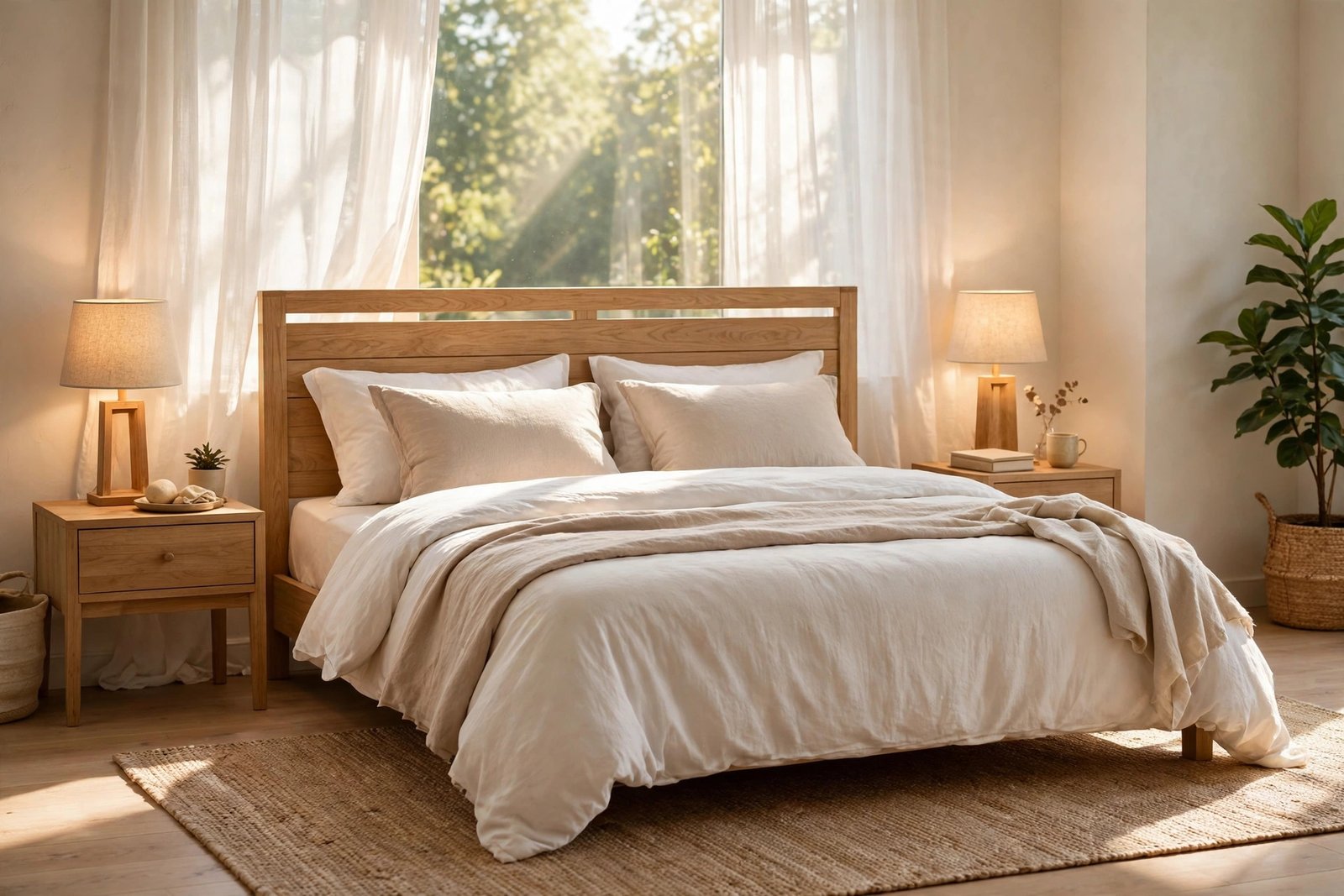
Pick a king size bed over a queen when two sleepers want separation and the room keeps a 24 inch walkway on both sides of the frame. Pick a queen when the room is 10 by 10 feet, when the budget matters, or when 30 inches per sleeper is enough. A king mattress is 76 by 80 inches and a queen is 60 by 80, and the 16 inch width gap decides the sleep and the fit.
Mattress catalogs answer this question with comfort language. This page answers it with two tests you can run at home: how much width each sleeper actually gets, and how much walkway your room keeps after the frame goes in. A bed that passes both tests is the right size. A bed that fails either one will annoy you every day.
King vs queen at a glance
| Measure | Queen | King | Difference |
|---|---|---|---|
| Mattress | 60 x 80 in (152.4 x 203.2 cm) | 76 x 80 in (193.0 x 203.2 cm) | 16 in wider, same length |
| Sleeping surface | 4,800 sq in (33.3 sq ft) | 6,080 sq in (42.2 sq ft) | 1,280 sq in more, about 27% |
| Width per sleeper, two sleepers | 30 in | 38 in | 8 in more each |
| Representative frame | 64 x 84 in | 82 x 86 in | 18 in wider, 2 in longer |
| Frame floor area | 37.3 sq ft | 49.0 sq ft | 11.7 sq ft more floor |
| Minimum room | 10 x 10 ft | 10 x 12 ft | One room size up |
| Comfortable room | 10 x 12 ft | 12 x 12 ft | One room size up |
The frame figures are the representative frames declared in our king bed dimensions and queen bed dimensions guides, and every room verdict below is calculated from them. Plan from the frame, not the mattress: the frame is what your walls, nightstands and walkways actually meet.
The difference is width, not length
A king and a queen are the same 80 inches long. Every one of the 16 extra inches is width, which is why the choice is about sideways room, never legroom. An 80 inch mattress suits sleepers up to about 6 feet 4 inches tall, allowing roughly 4 inches of pillow clearance above the head.
That has one consequence shoppers miss. If the taller sleeper is the problem, a king solves nothing: it adds width to a bed that was already long enough. The longer bed is the California king at 72 by 84 inches, narrower than a standard king and 4 inches longer. For every king variant laid out in feet, see king size bed dimensions in feet.
Space per sleeper: 38 vs 30 inches
Split between two people, a king gives each sleeper 38 inches of width, which is the full width of a twin mattress each. A queen gives each sleeper 30 inches. The 8 inch gap per person is the whole comfort argument, and it lands differently depending on how you sleep.
The king earns that width when one partner is a restless sleeper, when you go to bed at different times and the later arrival disturbs the earlier one, when a child or a dog regularly joins the bed. It also earns it when one of you sleeps warm and wants air between bodies. In those cases 30 inches stops being a number and starts being the reason someone wakes up.
The queen holds up fine when both of you sleep still and close, and it is generous for one person: a solo sleeper on a queen gets the full 60 inches, more than most people use. Couples who have shared a queen for years without a complaint are not missing anything. They are simply not the sleepers the extra 16 inches are for.
Room fit: the same three rooms, two verdicts
The method is subtraction. Tape the room, subtract the frame, then check what is left against the 24 inch side walkway minimum and the 30 inch foot minimum used across this site’s bedroom guides. Here is the same three rooms with both frames centered, headboard on the longer wall where there is one.
| Room | King frame 82 x 86 in | Queen frame 64 x 84 in | Verdict |
|---|---|---|---|
| 10 x 10 ft | Sides 19 in, foot 34 in | Sides 28 in, foot 36 in | Queen |
| 10 x 12 ft | Sides 31 in, foot 34 in | Sides 40 in, foot 36 in | Either; the king leaves no dresser |
| 12 x 12 ft | Sides 31 in, foot 58 in | Sides 40 in, foot 60 in | Either; the king is comfortable |
Worked example: the 10 by 10 room. The room is 120 by 120 inches. A centered king frame leaves (120 minus 82) divided by 2, which is 19 inches each side, below the 24 inch minimum. The foot passes at 34 inches (120 minus 86), but the sides are where you climb in, make the bed and open nightstand drawers, so the king fails where it matters. The queen frame leaves (120 minus 64) divided by 2, or 28 inches each side, and 36 inches at the foot. Both pass.
Nightstands settle the same room. Two 20 inch nightstands beside a king need 82 plus 20 plus 20, which is 122 inches of head wall. A 10 foot wall offers 120. They do not fit. Beside a queen, two 18 inch nightstands need 64 plus 18 plus 18, which is 100 inches, leaving 20 inches of wall to spare.
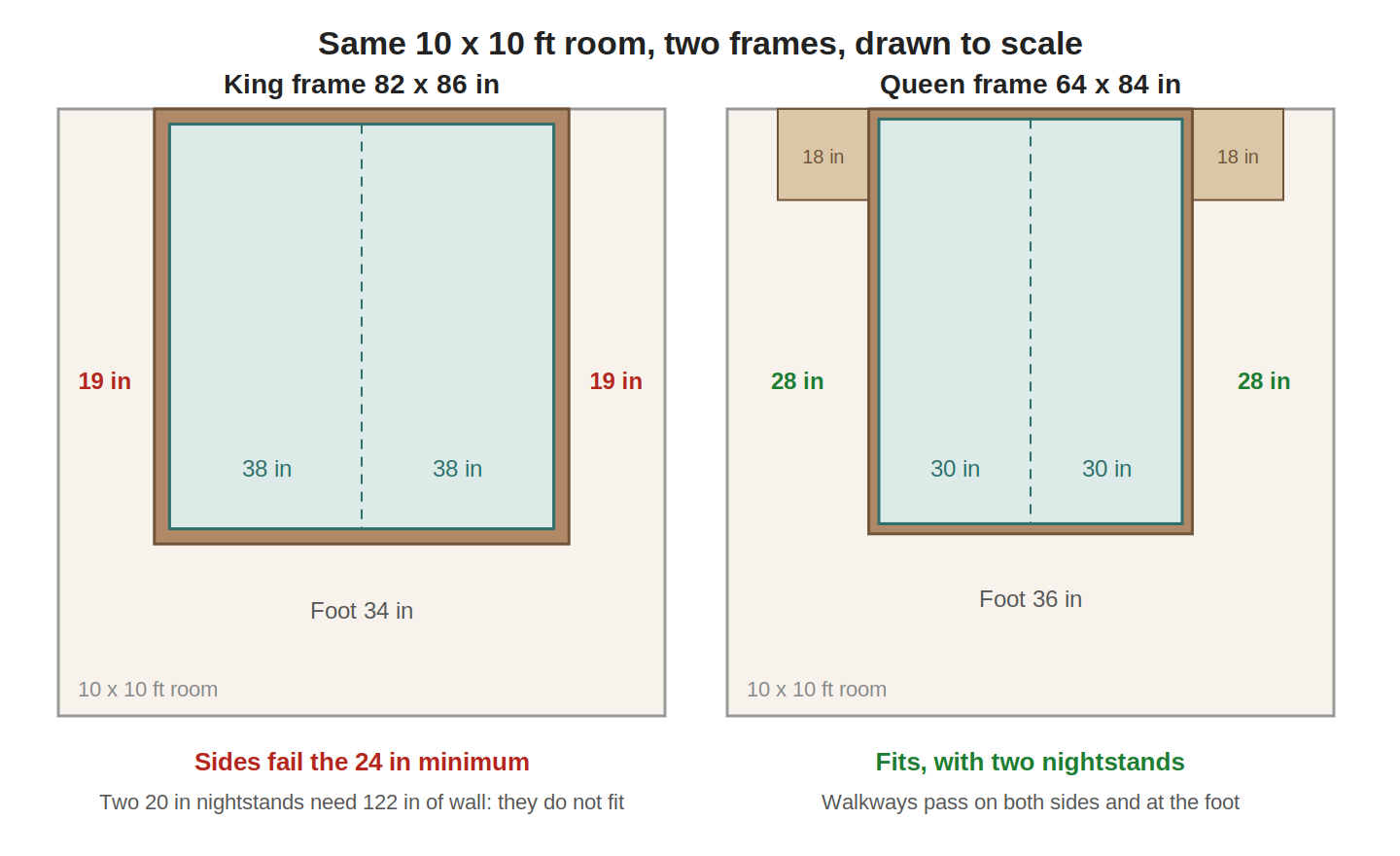
In the 10 by 12 room both beds pass, and the difference moves to furniture. The king’s 34 inch foot zone cannot hold a dresser: an 18 inch deep dresser there leaves 34 minus 18, or 16 inches of drawer clearance, against the 36 inches drawers need. The queen in a 12 by 12 room has a 60 inch foot zone, so the same dresser leaves 42 inches and passes. The king only reaches that comfort at 12 by 12 feet, where its foot zone opens to 58 inches.
When a queen is enough
A queen is the right answer more often than mattress marketing suggests. Choose it when your room is 10 by 10 feet or smaller, because the walkway math above leaves no honest way to fit a king. Choose it for a guest room, where visitors stay a few nights and the saved floor space serves the room all year. Choose it when one person sleeps in the bed most nights, or when you and your partner sleep close and still.
Budget is a real factor too. The mattress, the frame and every piece of bedding cost less in queen, and queen bedding comes in the widest range of styles and price points of any size. A queen is also the easier bed to live with across moves: it is lighter, its frame rails are shorter, and it fits more of the rooms you might move to next.
When a king fails the room
A king fails in ways that have nothing to do with the mattress. It fails when the side walkways drop under 24 inches, as they do in a 10 by 10 room, because every bed making and every nightstand drawer becomes a squeeze. It fails when the head wall cannot take the frame plus two nightstands, which is any wall under 122 inches for standard 20 inch nightstands.
It also fails quietly in a 10 by 12 room. It passes the walkway test but takes the dresser with it, and it fails on proportion: the 82 by 86 inch frame covers 49 percent of a 10 by 10 room and 41 percent of a 10 by 12. When two fifths of the floor is bed, the room reads as a bed with walls, whatever the tape measure allows.
Add a door that swings into the foot zone and the working space shrinks again. If your subtraction produces any of these, the queen is not the compromise. It is the correct size.
Split king: the compromise with its own tradeoffs
A split king is two twin XL mattresses, 38 by 80 inches each, side by side in one king frame, making the same 76 by 80 inch surface. It is the version worth considering when the two of you disagree: each side can be a different firmness, adjustable bases can raise one side without moving the other, and a restless sleeper disturbs only their own half.
The tradeoffs are a shallow valley where the mattresses meet, which some couples feel when they sleep in the middle, and doubled bedding work at the bottom layer: two twin XL fitted sheets under one king flat sheet and duvet. If the disagreement is about firmness or bedtime routines rather than total width, a split king solves it without asking the room for anything extra.
What else changes when you switch
Moving from a queen to a king changes more than the mattress. The frame footprint grows by 18 inches of width and 11.7 square feet of floor. Every fitted sheet, duvet cover and pillow sized for the queen stays behind: a king fitted sheet is cut for a 76 by 80 inch mattress, and a king flat sheet runs 108 by 102 inches to keep a workable drop on both sides. In the same product line, king bedding typically costs more than queen, so price the full switch, mattress, frame and two sets of bedding, not the mattress tag alone.
FAQs
Is a king bed worth it for a couple?
It is worth it when both tests pass: at least one of you needs more than 30 inches of personal width, and the room keeps 24 inch side walkways after the frame. If either test fails, a queen sleeps just as well and leaves a better room.
Can a king bed fit in a 10 by 10 room?
Physically, yes: the frame fits with room to spare at the foot. Practically, no: the side walkways come out at 19 inches, below the 24 inch minimum, and two standard nightstands need 2 more inches of head wall than the room has. A queen is the right size for a 10 by 10 room.
Does a king bed help if I am tall?
No. A king is the same 80 inches long as a queen, so it adds nothing for height. Sleepers over about 6 feet 4 inches need length instead: the California king, at 72 by 84 inches, trades 4 inches of width for 4 inches of length.
Is a split king the same size as a king?
Yes. Two twin XL mattresses at 38 by 80 inches each sit side by side to make the same 76 by 80 inch sleeping surface as a standard king, inside the same frame footprint.
The two-question verdict
Ask two questions and the choice makes itself. First, the sleepers: does either of you regularly need more than 30 inches of width? Second, the room: after subtracting an 82 by 86 inch frame, do both sides keep at least 24 inches? Two yeses mean a king. Any no means a queen, and the queen is not the smaller prize. It is the bed that fits the life and the room you actually have.
Sources
- King bed dimensions guide: used for the king mattress, declared frame and room figures.
- Queen bed dimensions guide: used for the queen mattress, declared frame and room figures.
- Whisper Linens, King vs Queen Bed: used to cross-check the standard sizes, per-sleeper widths and the bedding switch.
- Naluda Magazine, Queen vs King Mattress: used to cross-check the size difference and room guidance.
