



Standard bathroom sink dimensions for a single basin run 16 to 24 inches wide and 12 to 20 inches front to back, with the bowl 5 to 8 inches deep. The catch is that the listed size describes the fixture, not the washing area. The bowl inside runs about 2 inches smaller in each direction, and every mount type, undermount, vessel, drop-in, pedestal, wall-mount and trough, spends those inches differently. This guide works from manufacturer spec sheets, so the numbers below are drawn dimensions, not rounded listing copy.
Definition: bathroom sink dimensions are the overall width and front-to-back depth of the fixture, the interior width and depth of its bowl, the bowl depth from rim to drain, and the rim height above the finished floor. A sink fits when all five numbers fit: the bowl on the counter, the drain over the plumbing, the faucet stream over the bowl, and the rim at a height your arms expect.
Every figure below is a finished measurement. Widths and depths are in inches, with centimeters in the main chart. Where a size comes from a named model’s specification sheet, the model is named, because nominal sizes and drawn sizes are not the same thing, as the next section shows.
Bathroom sink sizes at a glance: the chart by type
The chart below is the planning table for the whole guide. Width and front-to-back are the overall fixture size. Bowl depth is the interior, measured from the rim down to the drain. Rim height is covered in its own section further down, because each type builds it differently.
| Sink type | Overall width | Front to back | Bowl depth | Minimum sensible fit |
|---|---|---|---|---|
| Undermount | 16 to 24 in (41 to 61 cm) | 12 to 18 in (30 to 46 cm) | 5 to 8 in | 24 in vanity |
| Drop-in (self-rimming) | 16 to 24 in (41 to 61 cm) | 14 to 20 in (36 to 51 cm) | 5 to 8 in | 24 in vanity |
| Vessel, round | 14 to 20 in diameter (36 to 51 cm) | Same as width | 4 to 7 in tall | 24 in vanity |
| Vessel, rectangular | 18 to 24 in (46 to 61 cm) | 12 to 18 in (30 to 46 cm) | 4 to 6 in tall | 30 in vanity |
| Semi-recessed | 18 to 24 in (46 to 61 cm) | 15 to 18 in (38 to 46 cm) | 5 to 7 in | 16 to 18 in deep vanity |
| Pedestal | 19 to 30 in (48 to 76 cm) | 16 to 24 in (41 to 61 cm) | 5 to 7 in | No cabinet; wall only |
| Wall-mount | 12 to 24 in (30 to 61 cm) | 10 to 20 in (25 to 51 cm) | 5 to 8 in | No cabinet; wall only |
| Trough (single or double) | 30 to 72 in (76 to 183 cm) | 14 to 20 in (36 to 51 cm) | 4 to 6 in | 36 in vanity and up |
Two patterns in the chart matter more than any single row. First, the front-to-back column is what your counter depth has to swallow: on a standard 21 to 22 inch vanity top, a basin of 14 to 18 inches front to back leaves 3 to 4 inches of deck behind it for the faucet. Second, bowl depth barely moves across types, 5 to 8 inches almost everywhere, while width doubles from the smallest wall-mount to a trough. Shopping by width alone misses the two numbers that decide daily use: bowl depth and rim height.
The bowl is smaller than the box: overall size vs bowl size
Manufacturers sell a sink by its overall footprint. You wash in the bowl. The difference is the wall thickness, the rim or flange, and the slope of the bowl walls, and on real spec sheets it is consistent: the bowl runs about 2 inches narrower than the fixture, sometimes a little more.
| Model (spec sheet) | Sold as | Overall drawn size | Bowl interior | Bowl depth |
|---|---|---|---|---|
| Kohler Caxton K-2210, oval undermount | 19-1/4 in | 19-3/8 by 16-3/16 in | 17 by 14 in | 4-7/16 in |
| Kohler Caxton K-20000, rectangle undermount | 20-1/2 in | 20-1/4 by 15-5/8 in | 17-5/8 by 13-1/8 in | 5-5/16 in |
| Kohler Caxton K-2211, oval undermount | 21-1/4 in | 21-1/4 by 17-1/4 in | 19 by 15 in | 5-7/8 in |
| Toto LT542G, rectangle undercounter | 19 in basin | 20-7/8 by 14-3/8 in | 19 by 12-3/8 in | About 8 in fixture height |
| Kohler Vox Round K-14800, vessel | 16-1/2 in | 16-1/2 in diameter | 15-1/2 in diameter | Rim 5-5/16 in above counter |
Read the Caxton rectangle row slowly, because it is the whole lesson. The listing says 20-1/2 inches. The drawing says the fixture is 20-1/4 inches wide. The bowl you actually wash in is 17-5/8 inches wide, a full 2-5/8 inches less than the headline number. The Toto makes the same point from the other direction: it is sold by its 19 inch basin, yet the fixture needs 20-7/8 inches of clear width under the counter.
The practical rule: when a product page gives one size, assume it is the overall size, and subtract about 2 inches to estimate the bowl. When the bowl size is what matters, for two people sharing, for washing a baby, for soaking anything, only the spec sheet’s bowl line counts.
Undermount and drop-in sinks: sizes that hide under the counter line
Undermount and drop-in basins cover most vanity bathrooms, and their size bands overlap almost completely: 16 to 24 inches wide, with ovals running shorter front to back than rectangles. Common drawn sizes repeat across brands: ovals at about 17 by 14, 19 by 15 and 20 by 16 inches overall, rectangles at about 18 by 12, 20 by 15 and 22 by 16. Compact undermounts for powder rooms drop to 13 by 10 inches.
The two types part company at the cutout. A drop-in sink carries a rim that sits on the counter and covers the cut edge, so the cutout is smaller than the fixture and forgiving of a rough cut. An undermount clamps beneath the counter and exposes the cut edge, so the cutout follows the bowl outline from the manufacturer’s template. Never cut either hole from the nominal size: the Caxton above is sold as 20-1/2 inches and drawn at 20-1/4, and a cutout made to the listing number is a countertop remade.
One more number belongs to both types: the drain hole is 1-3/4 inches on every Kohler, American Standard and Toto lavatory in this guide, and the tailpiece below it is 1-1/4 inches outside diameter. Drain position varies, center on most ovals, rear-set on many rectangles, and a rear drain buys back a little cabinet room below the bowl.
Vessel sinks: the bowl sits on top, so height becomes a size
A vessel changes which dimension matters. Width still runs 14 to 20 inches for round bowls and 18 to 24 for rectangular ones, but the bowl’s height above the counter, typically 4 to 7 inches, becomes a working dimension because it sets the rim height and the faucet.
The Kohler Vox Round is a useful reference point: 16-1/2 inches across, a 15-1/2 inch bowl, and a rim that stands 5-5/16 inches above the counter. Kohler’s own installation note for that sink tells the installer to choose a faucet that directs the stream to the center of the bowl and to mount the spout high enough to clear the rim with at least a 1 inch air gap. Vessel faucets are built to that math, with spout heights around 8 to 9 inches, well above a standard deck faucet.
Shallower vessels splash. A bowl only 4 inches tall gives the falling stream very little wall to hit before it reaches the drain area, which is why low-profile vessels pair best with faucets that arc the water down into the bowl rather than across it. The rim-height consequences of stacking a bowl on a full-height counter are real, and they are worked through with the rim table below.
Pedestal and wall-mount sinks: sizes with no cabinet at all
Pedestal sinks are sold as a matched basin and column, so the rim height is fixed at the factory. Most run 22 to 24 inches wide, 18 to 20 inches front to back, and 33 to 36 inches tall.
Spec sheets agree closely: American Standard’s Evolution 24 measures 24 by 19 inches with a rim at 34-1/2 inches and a bowl 19-3/4 by 12 inches, 6 inches deep. The Ravenna is 24-1/4 by 20 at 34 inches tall. Kohler’s Veer 24 is 24 by 18-1/4 inches and the tallest of the three at 35-1/2 inches, with a 5-13/16 inch bowl. Compact and corner pedestals drop to 16 to 19 inches wide for powder rooms.
Wall-mount sinks trade the column for open floor. Compact models run 12 to 20 inches wide and project only 10 to 12 inches from the wall, which is why they answer the tightest powder rooms; the layouts for those rooms are in our powder room dimensions guide. Barrier-free models are bigger: American Standard’s Lucerne measures 20-1/2 by 18-1/4 inches with a 15 by 10 inch bowl, 6-3/4 inches deep, and its spec sheet mounts the rim at exactly 34 inches from the finished floor. Because the height is set on site, a wall-mount is the one type where rim height is a decision, not a purchase.
Semi-recessed sinks split the difference: the back half sits in the counter, the front half projects past the cabinet. At 18 to 24 inches wide and 15 to 18 inches front to back, they let a shallow 16 to 18 inch vanity carry a nearly full-size bowl, at the cost of the counter edge in front.
Trough sinks: one long basin, sized by the faucet count
A trough is a single elongated basin, usually rectangular and shallower than a standard bowl at 4 to 6 inches deep. Single-user troughs run 30 to 48 inches long. Two-faucet troughs run 48 to 72 inches, and their sizing rule is the faucet spacing, not the basin: on a 48 inch trough the two faucets land about 24 inches apart, which is snug for two adults; at 60 inches they land about 30 inches apart; at 72 inches, about 36.
Leave at least 2 inches of counter beyond each end of the basin, so a 48 inch trough wants a 54 to 60 inch top. Most troughs carry one drain for the whole basin; two drains appear on the longest models.
Bowl depth and water depth are not the same number
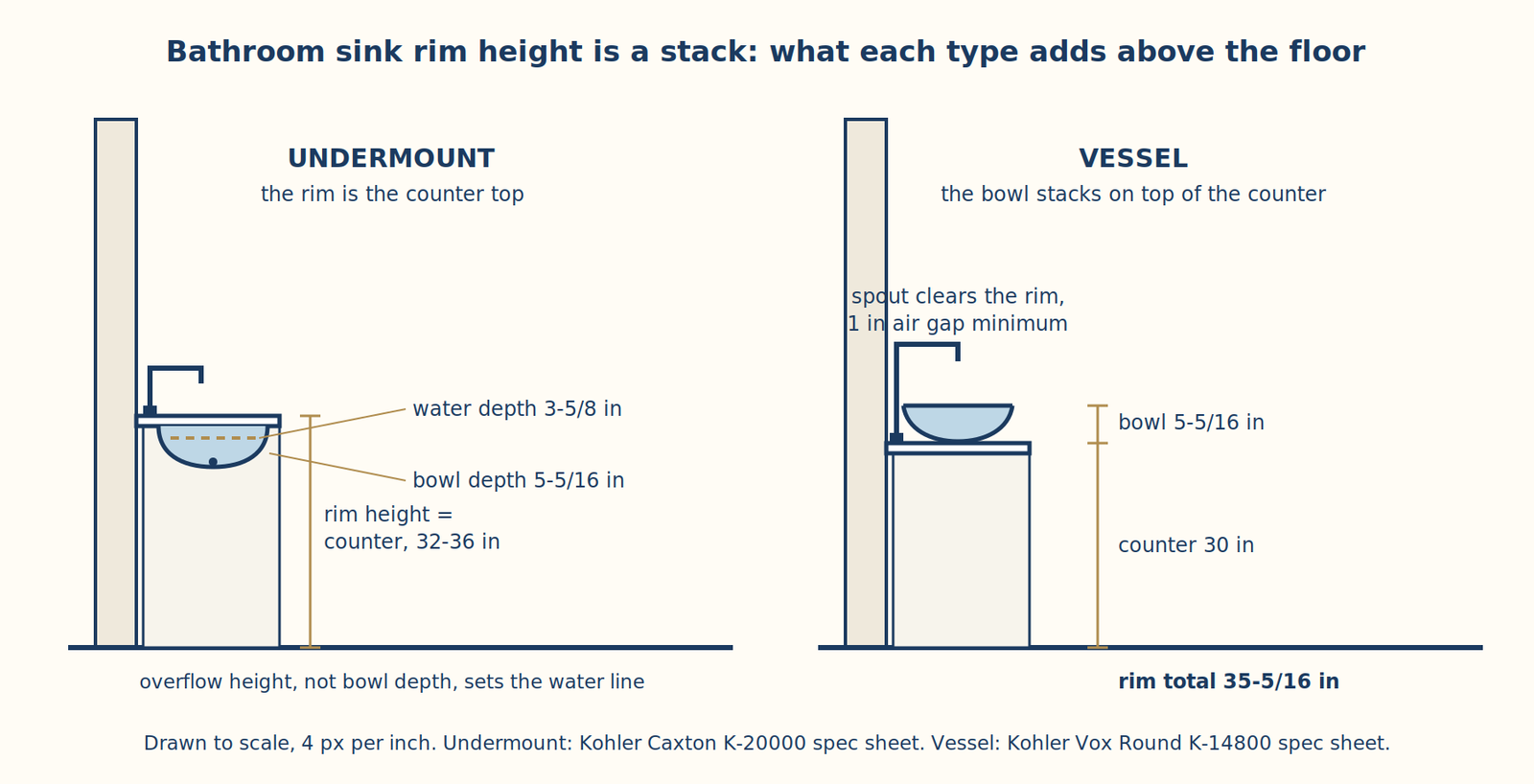
Bowl depth is measured from the rim to the drain. Water depth is measured from the drain to the overflow slot, and the overflow always sits below the rim. The Caxton rectangle makes the gap concrete: its bowl is 5-5/16 inches deep, but its rated water depth is only 3-5/8 inches. Fill it to the overflow and you have less than 4 inches of water in a bowl that spec sheets call 5-5/16 deep.
For daily use the working bands are simple. Bowls of 5 to 8 inches contain the stream from a standard faucet without fuss. Below about 5 inches, expect splash, especially with a high-arc faucet or a rear-set drain that pushes the stream against the back wall. Above 8 inches is rare in lavatories and belongs to utility sinks. When you compare two sinks, compare water depth if the sheet lists it; it is the honest version of bowl depth.
Rim height above the floor, by type
Rim height is the number your wrists judge. Each type builds it from different parts, which is why a single “standard sink height” does not exist.
| Sink type | What sets the rim | Typical rim height |
|---|---|---|
| Undermount | Counter height; bowl hangs below | 32 to 36 in |
| Drop-in | Counter height plus a rim of about 1/2 to 3/4 in | 32 to 36 in |
| Vessel | Counter height plus bowl height above counter | 34 to 38 in unless the counter drops |
| Pedestal | The column; fixed at the factory | 33 to 36 in |
| Wall-mount | Set at installation | 32 to 36 in; 34 in maximum for accessible installs |
The vessel row is the trap. Stack a 5-5/16 inch bowl on a 36 inch comfort-height counter and the rim lands at 41-5/16 inches, elbow height for most adults. The same bowl on a 30 inch counter lands at 35-5/16 inches, squarely in the comfortable band, which is the arithmetic in the diagram above. The counter-height tiers themselves, and the full vessel subtraction worked as a cabinet decision, live in our bathroom vanity dimensions guide; the point here is only that a vessel’s rim height is a sum you choose, not a size you buy.
For accessible bathrooms the rim rules tighten: the front rim may sit no higher than 34 inches, with at least 27 inches of clear knee space below it. The Lucerne spec sheet above is drawn to exactly that 34 inch line, and Toto’s undercounter sheets carry the same 34 inch counter check.
Faucet reach and hole spread: the basin-side math
The sink decides the faucet as much as the faucet decides the sink. Three numbers have to agree.
Hole spread. Faucet holes come in three patterns: a single hole; three holes on 4 inch centers, which take a centerset faucet; and three holes on 8 inch centers, which take a widespread faucet with separate handles. Undermount and vessel basins usually have no holes at all, so the spread is drilled in the counter or the faucet mounts on the wall. Count the holes before you shop for either piece.
Spout reach. Reach is the horizontal distance from the center of the faucet base to the water stream, and the target is the drain. For most bathroom sinks a reach of 4 to 8 inches lands the stream where it belongs; as a check, the stream should fall within the middle band of the bowl, roughly 25 to 50 percent of the bowl’s front-to-back depth measured from its back edge. On a 14 inch bowl that is a landing zone 3-1/2 to 7 inches in from the back, which a standard 5 to 7 inch reach hits from a deck position just behind the bowl.
Spout height over a vessel. The outlet must clear the rim with at least a 1 inch air gap, per the ASME rule Kohler prints on the Vox sheet. Add the bowl’s above-counter height to that inch and you get the minimum outlet height above the counter: 6-5/16 inches for the Vox Round. Vessel faucets, at 8 to 9 inches of spout height, clear it with room to spare; a standard faucet at 4 to 5 inches does not clear it at all.
Single vs double: the largest basin that actually fits
Cabinet width is covered in the vanity guide; this section answers the basin question inside it: given a double vanity, how wide can each bowl be? Two rules bind. Each basin’s centerline needs 15 inches from the side wall with at least 4 inches from the basin edge to that wall, and the two centerlines need 30 inches between them with at least 4 inches between the basin edges.
On a 60 inch vanity, run the wall rule first. A centerline 15 inches from the wall, minus the 4 inch edge clearance, leaves 11 inches of half-width, so each basin can be at most 22 inches wide. The centerline rule alone would allow 26 inches (30 between centers minus the 4 inch gap), so the wall is the binding constraint. In practice, two 19 inch basins work beautifully: centered 15 and 45 inches along the counter, they span 5-1/2 to 24-1/2 and 35-1/2 to 54-1/2 inches, leaving 5-1/2 inches at each wall and an 11 inch counter bridge between the bowls.
On a 72 inch vanity the centers can spread to the recommended 36 inches apart, 18 inches from each wall, and the same math allows basins up to 28 inches wide. Nobody needs a 28 inch lavatory bowl; the useful reading is that 20 to 22 inch basins, the top of the standard band, fit a 72 with counter to spare, while they are the ceiling on a 60. For the room these doubles usually sit in, our bathroom dimensions guide works out the full-bath layouts around them.
How to measure a bathroom sink
- Measure the overall width, left to right at the widest point, including any rim or flange.
- Measure the front-to-back depth the same way, wall side to front edge.
- Measure the bowl interior: width and front-to-back at the rim, inside wall to inside wall.
- Measure bowl depth with a straightedge across the rim and a ruler down to the drain.
- Note the drain position, center or rear-set, and its distance from the back edge of the bowl.
- Count the faucet holes and measure the spread between the outer holes, center to center.
- Measure the rim height from the finished floor, and for a vessel, the bowl height above the counter separately.
Common mistakes
- Buying by the nominal size: A sink sold as 20-1/2 inches can draw at 20-1/4 overall with a 17-5/8 inch bowl. Size the washing area from the bowl line of the spec sheet, not the listing headline.
- Cutting the counter from the listing: Cutouts follow the manufacturer’s template. A quarter inch of nominal shrinkage is normal in fired ceramic and is exactly what templates exist to absorb.
- Stacking a vessel on a full-height counter: Bowl height adds to counter height. A 5 to 6 inch bowl on a 36 inch counter puts the rim past 41 inches.
- Pairing a short faucet with a deep bowl: If the reach cannot put the stream near the drain, the water climbs the back wall of the bowl and splashes. Check reach against bowl depth front to back, not against the counter.
- Forcing two wide basins into a 60 inch vanity: Above 22 inches each, the pair breaks the side-wall clearance no matter how the counter is cut. Drop to 17 to 19 inch basins or step up to a 72.
Frequently asked questions
What is the standard size of a bathroom sink?
A standard single bathroom sink is 16 to 24 inches wide and 12 to 20 inches front to back, with a bowl 5 to 8 inches deep. The most common drawn sizes are ovals near 19 by 15 inches and rectangles near 20 by 15 inches overall, with bowls about 2 inches smaller in each direction.
How deep should a bathroom sink bowl be?
Between 5 and 8 inches from rim to drain suits nearly every bathroom. Shallower bowls splash more, and the usable water depth is always less than the bowl depth, because the overflow sits below the rim: a bowl rated 5-5/16 inches deep may hold only 3-5/8 inches of water.
What size sink fits a 36 inch vanity?
An overall basin up to about 22 inches wide, which means a bowl of roughly 19 to 20 inches. A 30 inch vanity tops out near a 21 inch basin, and a 24 inch vanity near 19 inches, because the basin, its mounting clips and the faucet deck all have to share the counter.
What is the standard bathroom sink drain size?
The drain hole is 1-3/4 inches on standard lavatories from Kohler, American Standard and Toto, and the drain tailpiece below it is 1-1/4 inches in outside diameter. A replacement drain assembly has to match both numbers, and sinks without an overflow need a drain made for a no-overflow bowl.
How tall is a pedestal sink?
Most pedestal sinks stand 33 to 36 inches tall at the rim. Current spec sheets cluster tightly: 34 inches for American Standard’s Ravenna, 34-1/2 for its Evolution 24, and 35-1/2 for Kohler’s Veer 24. Unlike a wall-mount, the height cannot be adjusted at installation.
How far should a faucet reach over a bathroom sink?
Far enough for the stream to land near the drain, which takes a reach of 4 to 8 inches on most sinks. Check it against the bowl: the stream should land within the middle band of the bowl’s front-to-back depth. Over a vessel, the spout must also clear the rim by at least 1 inch, which is why vessel faucets run taller, with spout heights around 8 to 9 inches.
Sources
- Kohler Caxton undermount specification sheets, via DG Floors’ Caxton size comparison: used for the Caxton models’ overall sizes, bowl interiors, bowl depths and overflow data.
- Kohler Caxton Rectangle K-20000 specification sheet (PDF): used for the rectangle’s bowl depth of 5-5/16 inches, water depth of 3-5/8 inches and 1-3/4 inch drain hole.
- Kohler Vox Round K-14800 vessel specification sheet (PDF): used for the 16-1/2 inch diameter, 5-5/16 inch rim height above counter and the spout clearance note.
- Kohler Veer 24 pedestal sink, Kohler product page: used for the 24 by 18-1/4 inch size, 35-1/2 inch height and bowl depth.
- American Standard Evolution 24 pedestal sink specification sheet (PDF): used for the 24 by 19 inch size, 34-1/2 inch height and bowl dimensions.
- American Standard Ravenna pedestal sink specification sheet (PDF): used for the 24-1/4 by 20 inch size, 34 inch height and bowl dimensions.
- American Standard Lucerne wall-hung lavatory specification sheet (PDF): used for the 20-1/2 by 18-1/4 inch size, bowl size and 34 inch rim mounting height.
- Toto LT542G undercounter lavatory specification sheet (PDF): used for the 20-7/8 by 14-3/8 inch overall size, 19 by 12-3/8 inch basin and ADA counter check.
- MICAWA, Bathroom Sink Sizes and Vanity Cutout Chart: used for the by-type size bands in the opening chart.
- Family Handyman, How to Choose the Right Size Sink for Your Bathroom: used as an independent check on size bands by shape and type.
- DG Floors, Vanity Sink Sizes: Undermount, Vessel and Drop-In: used for common drawn sizes by type and the vanity-width to sink-width pairings.
- Home and Tower, How to Choose a Bathroom Faucet: used for hole spreads, spout reach targets and vessel faucet clearance.
- The Sink Boutique, Trough Bathroom Sink Buying Guide: used for trough lengths and trough-to-vanity sizing.
- MarbleSinkCo, Marble Trough Sink: Sizes, Weight, Drains and Cost: used for trough faucet spacing at 48, 60 and 72 inches and trough bowl depth.
