



Most microwave dimensions follow a few fixed frames. Countertop models run 17 to 24.5 inches wide by capacity class, over-the-range models are built for a 30-inch opening and stand about 17 inches tall, and a low profile microwave cuts that height to about 10-1/3 inches, buying back roughly 7 inches of clearance above the cooktop. Match the frame first, then check cavity height and turntable size.
Microwave dimensions at a glance
Every size below is an exterior size with the door closed, in inches. Width is what separates the countertop classes; height is what separates the over-the-range classes.
| Type | Width | Depth | Height | Capacity | Fit rule |
|---|---|---|---|---|---|
| Countertop, compact | 17 to 19 in | 13 to 16 in | 10 to 11.5 in | 0.5 to 0.9 cu ft | Dorms, offices, RVs; plates up to 10 in |
| Countertop, mid-size | 20 to 22 in | 15 to 19 in | 12 to 13 in | 1.0 to 1.6 cu ft | The household standard; 12 in plates fit |
| Countertop, large | 22 to 24.5 in | 19 to 22 in | 13 to 13.6 in | 1.8 to 2.2 cu ft | 9 by 13 in dishes and big platters |
| Over-the-range, standard | 29-7/8 in | 15 to 18 in | 16 to 18 in | 1.6 to 2.1 cu ft | Fits a 30 in cabinet opening |
| Over-the-range, low profile | 29-7/8 to 30 in | 18 to 19-1/8 in | 10-1/4 to 12 in | 1.1 cu ft (leading models) | Fits a 30 in opening with a 12 in minimum cutout height |
| Built-in (with trim kit) | 24, 27 or 30 in frame | 20 to 25 in | 17 to 22 in | 1.0 to 2.2 cu ft | Cutout is smaller than the frame; see below |
| Microwave drawer | 24 or 30 in | 23-1/2 in cutout depth | 15-7/8 in face | 1.2 cu ft | One standard cutout serves both widths |
Two habits govern everything below. Plan the space, not the box: openings, clearances, and door swings decide fit, and the unit is always a little smaller than the space it needs. And treat capacity as a hint only, because two microwaves with the same rating can have different interiors.
Countertop microwave dimensions
Countertop models split into three classes by width and capacity. Compacts (0.5 to 0.9 cubic feet) suit one person or a dorm counter. Mid-size models (1.0 to 1.6 cubic feet) are the default family choice and swallow a 12-inch dinner plate. Large models (1.8 to 2.2 cubic feet) add the interior width for a 9 by 13 inch casserole: a representative 2.2 cubic foot model measures 17.8 inches wide inside, against about 13.9 inches inside a 1.1 cubic foot mid-size.
The clearance that actually decides fit
A countertop microwave also needs air. Manufacturers agree on the sides and disagree on the top, which is why the manual matters more than any chart:
| Clearance | Minimum | Source of the rule |
|---|---|---|
| Each side | 3 inches | Panasonic, Toshiba, and GE guidance all land here |
| Back | 1 inch | GE countertop clearance guidance |
| Top | 1 to 12 inches, brand dependent | Panasonic asks 1 in; GE asks 3 in; Toshiba asks 12 in |
| Door front to counter edge | 3 inches back | Panasonic and GE, to stop tipping when the door is pulled |
Run the under-cabinet test before you buy. The standard gap between a countertop and the bottom of the wall cabinets is 18 inches. A mid-size microwave 12-7/8 inches tall leaves 18 minus 12.875, which is 5-1/8 inches, above it. That passes a 1-inch or 3-inch top rule and fails a 12-inch top rule outright: the same microwave fits for one brand and breaks its own manual’s rule for another, at the exact same height.
Width works the same way: a 21-3/4 inch mid-size unit plus 3 inches of air on each side needs 27-3/4 inches of clear counter run.
Over-the-range microwave dimensions and the 66-inch rule
Over-the-range models are the most standardized microwaves sold. The opening between the cabinets is 30 inches wide, and the unit is built 29-7/8 inches wide to fill it. The subtraction is worth doing once: 30 minus 29.875 leaves 0.125 inches of total slack, about 1/16 inch per side. There is no spare width to absorb a cabinet that was framed narrow, so measure the opening at the front and the back before ordering.
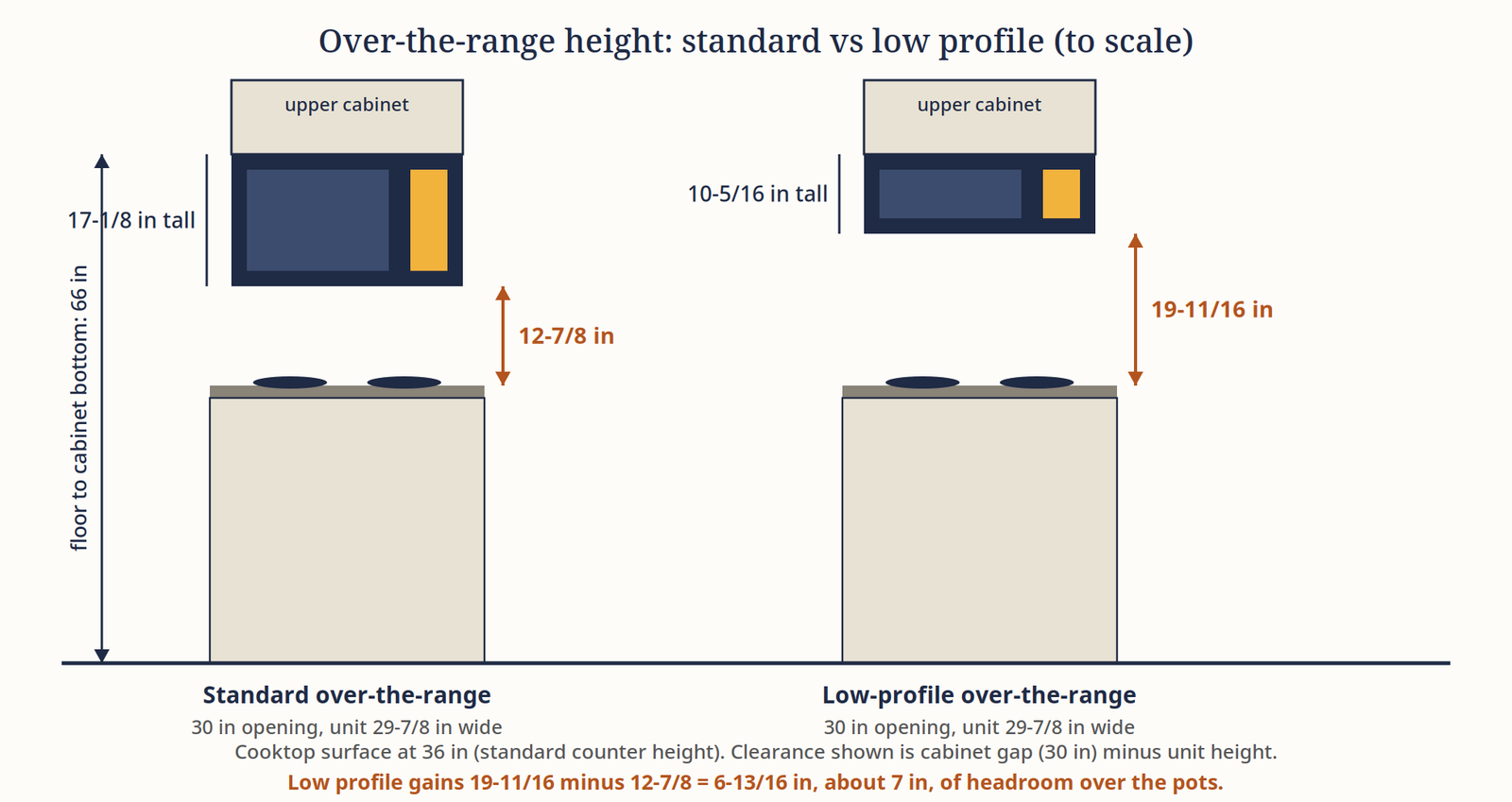
Installation height follows two numbers from the manufacturers’ own instructions. The bottom of the cabinet above the range should sit at least 30 inches above the cooking surface, and the top of the microwave should land at 66 inches or more from the floor. On a standard 36-inch counter, those two rules describe the same kitchen: 36 plus 30 puts the cabinet bottom at 66 inches. Upper cabinets deeper than about 13 inches can crowd the door swing, and GE caps standard cabinet depth at 13 inches (15 with a bump-out kit).
Depth runs 15 to 18 inches with the door closed and 42 to 45 inches with the door open at 90 degrees, sweeping out over the cooktop and into the walkway, so check it against your aisle width. These numbers come straight out of standard kitchen cabinet dimensions: a 30-inch range base below, a 30-inch upper cabinet above, and a 36-inch counter height tying them together.
Low profile microwave dimensions: the 7-inch trade
A low profile microwave is an over-the-range model rebuilt to the height of an under-cabinet hood. Instead of 16 to 18 inches tall, it stands about 10-1/4 to 12 inches tall, still in the same 30-inch opening. Whirlpool’s version lists a minimum cutout of 30 by 12 inches and is sold with a fit guarantee for existing standard cutouts.
What the shorter box buys you
Run the subtraction inside the standard 30-inch cabinet gap (cabinet bottom at 66 inches, cooktop at 36 inches):
Standard model: 30 in gap minus 17-1/8 in unit = 12-7/8 in above the cooktop
Low profile model: 30 in gap minus 10-5/16 in unit = 19-11/16 in above the cooktop
That is the whole case for the type. A stockpot or a tall pasta pot that cannot slide under a standard microwave’s 12-7/8 inches clears a low profile model’s 19-11/16 inches easily. The gain is 19.6875 minus 12.875, which is 6-13/16 inches, about 7 inches of working headroom over the burners.
What it costs you
The shorter box holds less, and the limit is height, not volume. Capacity drops to 1.1 cubic feet on the leading models (1.1 on the spec-sheet-verified models, up to 1.3 in some retailer listings) against 1.6 to 2.1 for standard models. More important is the cavity: Whirlpool’s low profile interior is 19 inches wide, 15 inches deep, and only 7 inches tall. Samsung’s slim model is tighter still at 6-15/16 inches of interior height. A tall travel mug, an upright baby bottle, or a deep casserole with a lid can fail a cavity that the cubic-foot rating made sound generous.
The box also grows in the other direction. Low profile models run 18 to 19-1/8 inches deep, deeper than most standard models, so the cavity still fits a 12-inch turntable, and the front reaches further over the front burners.
| Low profile model | Width | Depth | Height | Capacity | Interior height |
|---|---|---|---|---|---|
| Whirlpool WML55011HS | 29-7/8 in | 18 in | 10-5/16 in | 1.1 cu ft | 7 in |
| Samsung ME11A7710DS | 29-7/8 in | 19-1/8 in | 10-3/4 in | 1.1 cu ft | 6-15/16 in |
| KitchenAid KMLS311H | 30 in | 18 in | 10-1/4 in | 1.1 cu ft | Not published |
Verdict: choose low profile when pot clearance is your daily frustration and your reheating is plates, bowls, and mugs under 7 inches tall. Keep the standard height for tall or covered dishes.
Built-in and microwave drawer dimensions
Built-in microwaves are named for their trim frame, 24, 27, or 30 inches wide, but the cabinet cutout is smaller than the frame and it is the cutout you build. GE’s trim kit instructions for both its 27-inch and 30-inch kits specify the same hole: 25-1/2 inches wide by 16-3/4 inches high, with a minimum depth of 19-1/2 inches when the outlet sits outside the cabinet and 22 inches when it sits inside. A frame that “matches” your cabinet width proves nothing about the hole behind it.
Microwave drawers hide under the counter and load from the top, so there is no turntable and no door swing. The useful fact is how standardized they are: Sharp, Bosch, and Frigidaire 24-inch drawers all share a cutout of 22-1/8 inches wide by 15-9/16 inches high by 23-1/2 inches deep, and the 30-inch versions keep the same height and depth while widening the cutout. Capacity is 1.2 cubic feet across the class.
That 23-1/2 inch depth sits inside standard base cabinets, which is why drawers are the natural island microwave: check the cabinet run against our kitchen island dimensions guide before committing the island layout.
Capacity and turntable size: check the cavity, not the label
Capacity ratings come from the interior box, and you can audit any of them with a calculator. Whirlpool’s low profile interior measures 19 by 15 by 7 inches: 19 times 15 times 7 is 1,995 cubic inches, and 1,995 divided by 1,728 is 1.15 cubic feet, rated and sold as 1.1. A representative 1.6 cubic foot countertop model measures 16.63 by 16.75 by 10.25 inches inside, which works out to 1.65 cubic feet before the rating rounds it down. Ratings are honest but rounded, so compare interior width and height between finalists, not the badge.
Turntable diameter sets your plate limit:
| Turntable | Found on | Largest plate that rotates freely |
|---|---|---|
| 10.6 to 10.75 in | Compact countertop | 10 in plate |
| 12 to 12.4 in | Low profile, mid-size countertop | 12 in plate, snug in compacts |
| 13.6 to 14.2 in | Family countertop | 13 in plate or small platter |
| 16 to 16.5 in | Large countertop | 9 by 13 in dish, large platters |
The plate also has to clear the cavity walls while it turns. Compact interiors are only about 12-1/4 inches wide, so a 12-inch pizza fits a mid-size microwave and physically cannot rotate in a compact, whatever the turntable size claims. For a household of three or four reheating standard dinner plates, 1.2 to 1.6 cubic feet with a turntable of 12.4 inches or more covers nearly everything; go to 2.0 cubic feet when a 9 by 13 inch dish is a weekly event.
How to measure for a microwave
- Measure the frame first: the cabinet opening for over-the-range and built-in models, the counter run and the counter-to-cabinet height for countertop models, the base cabinet for a drawer.
- Measure the opening in two places, front and back or top and bottom, and plan from the smaller reading; cabinets are rarely perfectly square.
- Add the clearances to the unit size before you compare: 3 inches per side and the brand’s top clearance for countertop models.
- Check the door swing: countertop doors add roughly 10 to 19 inches of depth when open, and over-the-range doors reach 42 to 45 inches from the wall.
- For over-the-range models, run the height subtraction: cabinet bottom height minus unit height gives the bottom edge; subtract the 36-inch cooktop to get your pot clearance.
- Test your largest dish against the interior width, interior height, and turntable diameter, not against the capacity rating.
- Cross-check the old unit last. It confirms the class, but the opening governs, exactly as it does with refrigerator dimensions, where the unit is likewise smaller than the space it needs.
Common mistakes
- Buying on cubic feet alone. Two 1.6 cubic foot models can differ by an inch of interior height, which is the difference between a covered casserole fitting and not fitting.
- Measuring the old unit instead of the opening. The old unit is smaller than its opening by design; a replacement ordered to the unit’s size can arrive too small for the trim or too tight to slide.
- Skipping the top clearance. Top clearance runs from 1 inch to 12 inches depending on brand, so a microwave that fits the shelf can still break its own manual’s ventilation rule.
- Assuming low profile means small everywhere. Low profile models are shorter but deeper than standard over-the-range models, and the depth lands over your front burners.
- Forgetting the open door. A microwave that fits its shelf with the door closed may block a walkway or a cabinet door once the door swings out.
Frequently asked questions
What is the standard size of a microwave?
For a countertop model, the standard household size is 1.2 to 1.6 cubic feet, roughly 21 to 22 inches wide, 17 to 19 inches deep, and 12 to 13 inches high. Over-the-range models standardize harder: 29-7/8 inches wide in a 30-inch opening, about 17 inches tall, and 1.6 to 2.1 cubic feet.
How much space does a microwave need around it?
Plan on 3 inches of open space on each side and about 1 inch at the back for a countertop model. Space above is brand dependent, from 1 inch (Panasonic) to 3 inches (GE) to 12 inches (Toshiba), so check the owner’s manual for the model you are buying before you measure the shelf.
What size microwave fits a 12-inch pizza?
A mid-size countertop model or larger: look for a turntable of at least 12.4 inches and an interior width of 14 inches or more so the pizza can rotate without catching the walls. Compact models, with interiors about 12-1/4 inches wide, are too narrow even when their turntable looks close.
How high should an over-the-range microwave be above the stove?
Manufacturers set the frame, not the unit: the cabinet bottom goes at least 30 inches above the cooking surface, which puts the top of the microwave at 66 inches or more from the floor on a standard counter. The unit then hangs down into that gap, leaving 12-7/8 inches above the cooktop for a standard model or 19-11/16 inches for a low profile model.
Is a low profile microwave big enough?
For plates, bowls, and mugs, yes: the leading models hold 1.1 cubic feet with a 12-inch turntable, the same plate capacity as a mid-size countertop model. The limit is interior height, 7 inches on the Whirlpool and 6-15/16 inches on the Samsung, so tall mugs, upright bottles, and deep lidded casseroles are the items to measure before you commit.
What size microwave do I need for a family of four?
A 1.4 to 1.6 cubic foot countertop model, or a standard over-the-range model at 1.6 to 2.1 cubic feet, covers family reheating and standard casseroles. Step up to 2.0 cubic feet or more only if a 9 by 13 inch dish or a large platter goes in weekly; the extra size is interior width, and it is wasted on dinner plates.
Sources
- KitchenAid, Microwave Sizes: How to Measure a Microwave: used for the type-by-type size chart ranges, including the low profile row.
- Maytag, Microwave Sizes: A Guide to Common Dimensions: used for countertop, over-the-range, and built-in ranges and capacity notes.
- Home Depot, How to Measure Microwaves: used for door-open depths and built-in depth ranges.
- Whirlpool WML55011HS specification listings: used for the low profile model’s exterior, interior, and turntable dimensions.
- Samsung ME11A7710DS specification listings: used for the slim model’s exterior and cavity dimensions.
- GE trim kit installation instructions for JX7227 and JX7230: used for the built-in cutout dimensions.
- Sharp microwave drawer installation manual: used for the drawer cutout dimensions and cabinet minimums.
- Product Bible, Microwave Sizes Guide: used for manufacturer spec tables across countertop classes.
- Product Bible, Microwave Clearance Requirements by Brand: used for per-brand clearance rules quoted from owner manuals, including the GE and Whirlpool over-the-range installation figures.
