


Washing Machine Dimensions: Standard Sizes & How to Check the Fit
A standard washing machine measures 27 inches wide and 39 inches tall. Depth depends on the type: 27 to 33 inches for a front-load washer, 25 to 28 inches for a top-load washer. But the cabinet size is only half the question. With hose clearance behind and door swing in front, a “27-inch-deep” washer really needs about 55 inches of room. This guide gives you the full dimensions chart plus the fit math to check your space before the delivery truck arrives.
What are standard washing machine dimensions?
Standard washing machine dimensions are 27 inches wide, 39 inches tall, and 27 to 33 inches deep for a full-size front-load washer, or 27 inches wide, 42 to 44 inches tall, and 25 to 28 inches deep for a full-size top-load washer. Compact washers measure about 24 by 34 by 24 inches. These are cabinet dimensions only. Plan extra space for hoses behind the machine and door swing in front.
Washing machine dimensions chart
Every washing machine dimensions chart below gives width, height, and depth in inches. Width is nearly identical across all full-size types; height and depth are what change.
| Washer type | Width | Height | Depth (cabinet) |
|---|---|---|---|
| Standard front-load | 27 in | 39 in | 27-33 in |
| Standard top-load | 27 in | 42-44 in | 25-28 in |
| Compact | 24 in | 33-34 in | 24 in |
| Stackable pair (washer + dryer) | 27 in | 75-77 in | 30-34 in |
| Washer-dryer combo (all-in-one) | 27 in | 39 in | 30-34 in |
Standard front-load washing machine dimensions
A standard front-load washer is 27 inches wide, 39 inches tall, and 27 to 33 inches deep, with most models landing around 31 inches deep. That 27-inch width is the number the whole industry converged on: two machines side by side take 54 inches, which fits the standard 60-inch laundry alcove with room to spare.
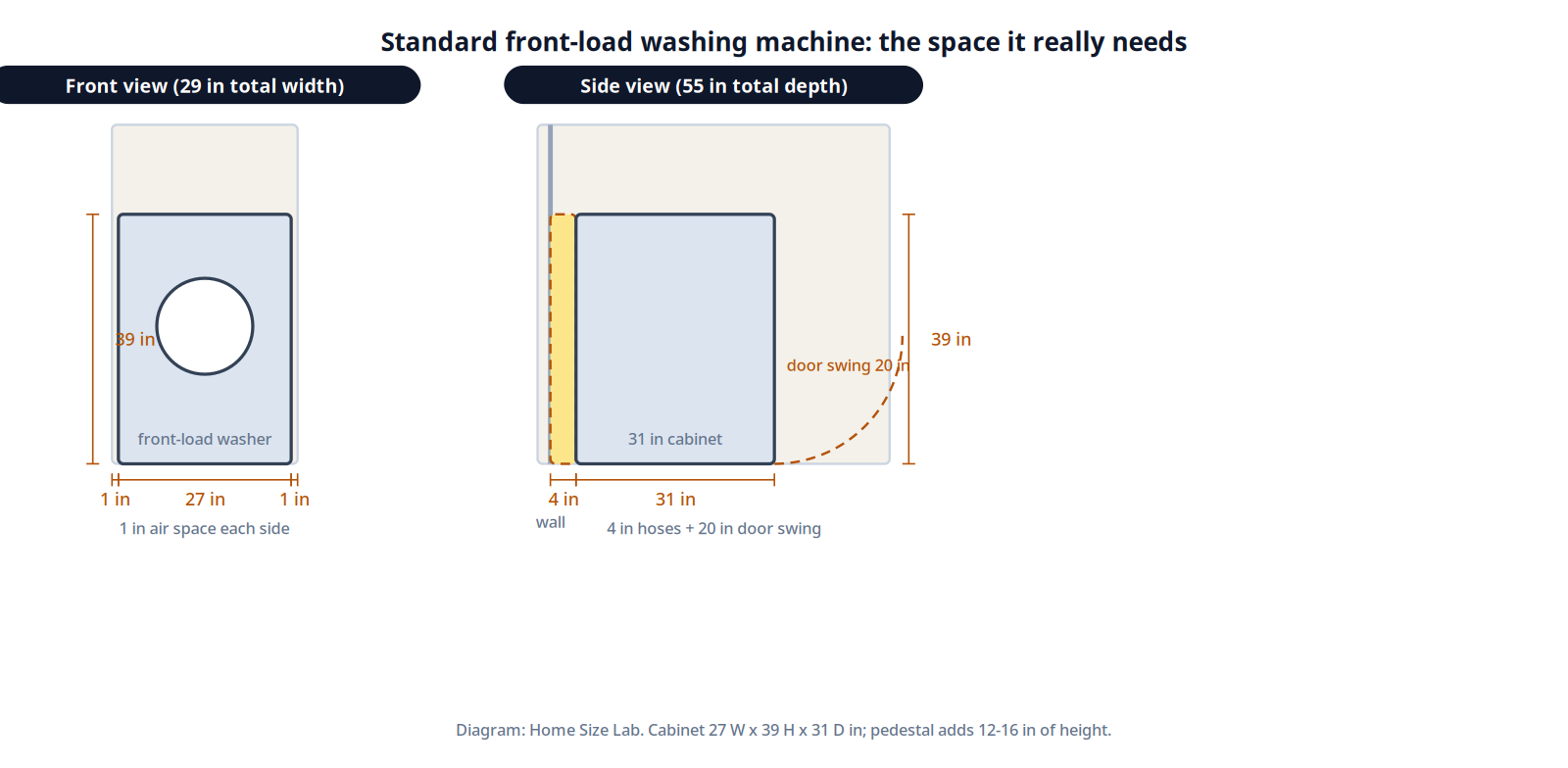
The published depth is the cabinet only. The door swings out in front, and the hoses need room behind. Home Depot’s dimensions guide puts open-door clearance at 20 inches minimum, and TCL’s measurements show a front-loader reaching 54 to 57 inches of total depth with the door fully open. For planning, use 31 inches of cabinet plus 4 inches for hoses: 35 inches of permanent footprint, and keep 20 inches of clear floor in front for loading.
Standard top-load washing machine dimensions
A standard top-load washer is 27 inches wide, 42 to 44 inches tall with the lid closed, and 25 to 28 inches deep. It is taller than a front-loader because the drum hangs below the lid line, but shallower front to back.
The number that surprises buyers is the open-lid height. Allow 24 inches of clearance above the machine for the lid to open fully. A 44-inch washer with the lid up needs 68 inches of vertical space. That rules out top-loaders under low cabinets or shelves mounted less than about 70 inches off the floor. Measure from the floor to the underside of the shelf, not to the shelf’s top edge.
Compact washing machine dimensions
A compact washer measures about 24 inches wide, 34 inches tall, and 24 inches deep, roughly the footprint of a dishwasher. Compact machines suit apartments, in-law suites, and any laundry nook where a full-size 27-inch machine will not fit.
The tradeoff is capacity, not just size: a compact drum holds roughly half the laundry of a full-size machine. If the space allows a full-size footprint, it usually washes more per load for similar energy use. Choose compact when the space decides for you, not as a default.
Stackable washer and dryer dimensions
A stacked washer-dryer pair measures 27 inches wide, 75 to 77 inches tall, and 30 to 34 inches deep. Stacking trades floor space for height: the pair occupies the same 27-by-31-inch floor footprint as one machine.
Height is the constraint to check. With 75 inches of machine plus a few inches of working room, you need about 80 inches of clear vertical space. Also confirm the dryer vents correctly in the stacked position and that you can reach the dryer controls. If anyone using the laundry cannot comfortably reach 75 inches, a side-by-side layout is the better fit.
The clearances that actually matter
Cabinet dimensions get the machine into the room. Clearances keep it working quietly and serviceable for years. These are the numbers installers plan around.
| Clearance | Rule | Why |
|---|---|---|
| Sides | 1 in each side | Air circulation and less vibration transfer to walls |
| Behind | 4-6 in | Water hoses and drain line need a gentle bend, not a kink |
| Front (front-load) | 20 in minimum | Door swing for loading and unloading |
| Above (top-load) | 24 in minimum | Lid opens fully without hitting shelves |
| Ventilation | 1 in minimum at sides | Heat and moisture dissipate instead of building up |
Two quick calculations. A 27-inch front-loader really needs 29 inches of width (27 + 1 + 1). It really needs 35 inches of depth before you open the door (31 + 4 for hoses). If your laundry nook is exactly 28 inches wide, the machine fits only if you accept tighter side clearance, and you should expect more vibration noise. The diagram below shows the full installed footprint.
Pedestal height math
A pedestal raises the washer 12 to 16 inches, which saves your back when loading a front-loader. LG’s own pedestal measures 13.9 inches, a typical value.
The math: 39 inches of washer plus 13.9 inches of pedestal equals 52.9 inches, call it 53 inches of total height. Two consequences. First, the controls move up too, which most people like. Second, a top-load washer on a pedestal becomes impractical: 44 inches plus 14 inches puts the lid opening near 58 inches, out of comfortable reach. Pedestals pair with front-loaders, not top-loaders.
Will it fit? The delivery-path checklist
The most common washing machine delivery failure is not the laundry room. It is the hallway, the stairwell, or the front door. A 27-inch-wide machine fits through most interior doors, but the delivery path has to be clear the whole way. Work through these steps before delivery day.
- Measure the machine’s smallest dimension. For a front-loader that is the 27-inch width. For a top-loader going through a tight turn, it may be the 25-inch depth carried sideways.
- Measure every doorway, hallway, and stairwell on the path. The narrowest point decides. LG’s installation guidance calls for a minimum 30 inches of clear width through stairs and doorways.
- Subtract the door itself. A door that only opens 90 degrees eats 1 to 2 inches of the opening. Removing the door from its hinges buys that space back.
- Check the turns. A machine that fits a straight hallway can still get stuck at a 90-degree turn into the laundry room. Measure the diagonal: the machine’s width plus depth must clear the corner.
- Measure the final space. Confirm width, depth, and height of the installation spot, including the 4-inch hose zone behind and the door-swing zone in front.
- Check the floor. The floor must be level within about 1 inch of slope, and upper floors need to be sturdy enough for a machine that weighs 180 to 250 pounds and vibrates.
If any point on the path is under 30 inches and cannot be widened, tell the retailer before the delivery date. Our guide to measuring furniture for doorways covers the full measuring method with a tape and a helper.
For tight turns specifically, the same pivot-and-angle technique that gets a couch around a corner works for a washer: our guide to moving a couch around a corner explains the geometry.
Laundry closet fit
A standard reach-in closet is 24 inches deep, which will not hold a standard washer. A 27-inch-deep machine plus 4 inches of hoses needs at least 31 inches of closet depth. For closet laundry, a compact 24-inch machine or a purpose-built laundry closet is the realistic option; our guide to standard closet depth covers closet sizing in detail.
Frequently asked questions
Can a washing machine fit through a standard 30-inch door?
Usually, yes. A standard 27-inch-wide washer passes through a 30-inch doorway with about 3 inches to spare. If the door itself intrudes into the opening, remove it from its hinges first. Measure the actual clear opening, not the door slab.
How much space do you need behind a washing machine?
Leave 4 to 6 inches behind the washer for the water inlet hoses and drain line. Hoses need a gentle bend; a sharp kink restricts flow and wears the hose faster. Manufacturer guidance, including LG’s, specifies at least 4 inches.
Do you need clearance on the sides of a washer?
Yes, about 1 inch on each side. The gap allows air circulation and keeps vibration from transferring into the walls. Some machines are tested for zero side clearance, but 1 inch per side reduces noise and makes future servicing easier.
What is the depth of a washing machine with the door open?
A front-load washer with the door fully open reaches 54 to 57 inches of total depth, measured from the wall. That is roughly 31 inches of cabinet plus 4 inches of hoses plus 20 inches of door swing. Keep that zone clear of anything you need to walk past while loading.
How tall is a washing machine on a pedestal?
About 53 inches. A 39-inch front-load washer on a typical 14-inch pedestal totals 53 inches. Check that this still fits under any shelf or cabinet above the laundry area before you buy the pedestal.
Sources
- Home Depot, Washer and Dryer Dimensions: front-load, top-load, and stackable dimensions with door and clearance guidance
- Lowe’s, Washer Sizes Buying Guide: average washer dimensions and measuring tips
- TCL, Washing Machine Dimensions: top-load, front-load, and compact measurements with door-open depth
- PC Outlet, Dimensions of Washing Machines: type-by-type dimension table and door swing guidance
- Best Buy Q&A, LG answers: 4-inch hose clearance and 1-inch side clearance guidance
- Engineer Fix, How Much Does a Standard Washer Weigh: front-load weight range of 180 to 250 pounds
