




A standard queen bed mattress measures 60 inches wide by 80 inches long, which is 5 feet by 6 feet 8 inches and 33.3 square feet of sleeping surface. The frame around it is bigger, about 64 by 84 inches, and that framed footprint is the number your room actually feels. This guide gives both, with the exact room math for a queen in real bedrooms.
Definition: a queen bed is the most popular standard bed size for couples, built around a 60 by 80 inch mattress. It sleeps two adults at 30 inches of width each, and it is the smallest standard size that most couples find comfortable. A queen is 6 inches wider and 5 inches longer than a full, and 16 inches narrower than a king at the same 80 inch length.
How big is a queen size bed
A queen size bed is 60 by 80 inches, 33.3 square feet of mattress. Split between two sleepers, each person gets 30 inches of width, which is 3 inches more than the 27 inches each person gets on a full. For scale, a full covers 28.1 square feet and a king covers 42.2, so a queen gives a couple about 18.5 percent more sleeping surface than a full and about 21 percent less than a king.
How wide is a queen size bed
A queen bed mattress is 60 inches wide, or 5 feet (152.4 cm). The frame around it runs wider, typically about 61 to 66 inches, because the side rails and posts add 1 to 6 inches in total. Our declared representative frame is 64 inches wide, which sits inside that range and matches real spec sheets.
Finished mattresses can run about half an inch to an inch off the chart size by maker, so measure your exact frame before ordering fitted sheets.
How long is a queen size bed
A queen bed mattress is 80 inches long, or 6 feet 8 inches (203.2 cm). The frame runs longer, typically 82 to 86 inches, because the headboard and footboard add length at each end. Our declared representative frame is 84 inches long.
That 4 inch gap between mattress length and frame length is the number buyers most often forget: an 80 inch mattress does not mean an 80 inch bed, and a wall that fits the mattress may not fit the frame.
How long is a queen bed
A queen bed is 80 inches long, and that length suits sleepers up to about 6 feet 4 inches tall. The rule is simple: subtract about 4 inches for pillow clearance, and 80 minus 4 leaves 76 inches, or 6 feet 4 inches. Taller sleepers who need more legroom should look at a California king, which is 84 inches long, instead of a wider king, which is still 80 inches long.
How big is a queen bed
A queen bed is 60 by 80 inches as a mattress and 64 by 84 inches as a frame, which is 37.3 square feet of floor against 33.3 for the mattress alone. The frame adds 4 inches of width and 4 inches of length, or 4.0 square feet, which is 12 percent more floor than the mattress chart shows. Measure the room against the 64 by 84 inch frame, not the 60 by 80 inch mattress.
Queen bed dimensions chart: mattress vs frame
Mattress sizes are the industry standard, agreed across every major size chart. Every maker trims its frame a little differently, so the chart below fixes one representative queen frame, the same one used in all the room math that follows, and prints the full published range next to it.
| Size | Mattress (in) | Mattress (cm) | Mattress (ft) | Frame (L x W) | Frame floor area |
|---|---|---|---|---|---|
| Queen | 60 x 80 | 152.4 x 203.2 | 5 ft 0 in x 6 ft 8 in | 64 x 84 in | 37.3 sq ft |
| California queen | 60 x 84 | 152.4 x 213.4 | 5 ft 0 in x 7 ft 0 in | 64 x 88 in | 39.1 sq ft |
| Olympic queen | 66 x 80 | 167.6 x 203.2 | 5 ft 6 in x 6 ft 8 in | 70 x 84 in | 40.8 sq ft |
| Split queen | Two 30 x 80 | 76.2 x 203.2 each | 2 ft 6 in x 6 ft 8 in each | 64 x 84 in | 37.3 sq ft |
| Short queen (RV) | 60 x 75 | 152.4 x 190.5 | 5 ft 0 in x 6 ft 3 in | 64 x 79 in | 35.1 sq ft |
Published queen frames run 82 to 86 inches long and about 61 to 66 inches wide. The declared 64 by 84 inch frame sits inside both ranges: it is 4 inches wider and 4 inches longer than the mattress it holds, or about 2 inches of rail on each side and 2 inches of headboard and footboard at each end. The California queen, Olympic queen, and short queen frames are derived from the same plus-4 rule, because no single published frame range covers those variants; the standard queen frame is the one the rest of this guide calculates from.
For comparison, the next sizes are a full at 54 by 75 inches (28.1 sq ft), 6 inches narrower and 5 inches shorter than a queen, a twin at 38 by 75 inches (19.8 sq ft), and a king at 76 by 80 inches (42.2 sq ft), 16 inches wider than a queen at the same length. Full, twin, and king frame and room numbers belong to their own guides, so this page states only the mattress sizes for the comparison.
Queen bed frame dimensions: the numbers your room feels
A mattress size tells you what you sleep on. A frame size tells you what fits in the room, what the delivery crew carries, and how high you sit. Real spec sheets show how tight the frame range is.
| Model | Type | Overall size (L x W x H) |
|---|---|---|
| IKEA MALM, queen | Wood frame with headboard | 83 1/8 x 66 1/8 x 39 3/8 in |
| Zinus Allen, queen | Wood platform with headboard | 82 x 60.7 x 35.4 in |
| Zinus Brock, queen | Metal and wood platform, low profile | 82.8 x 63.9 x 31.2 in |
| Zinus Linda, queen | Wood platform with headboard | 82.3 x 63 x 41.3 in |
| Ashley Bellaby, queen | Panel bed | 85 x 64.5 x 55 in |
Lengths cluster at 82 to 85 inches, widths at about 61 to 66 inches, and overall heights at 31 to 55 inches. The Zinus Allen lists 60.7 inches wide because its side rails sit nearly flush with the mattress edge, while the MALM runs 66 1/8 inches wide with thicker posts and rails. The declared 64 by 84 inch frame is the honest middle of that spread, not an outlier in either direction. Queen frames in this range are typically rated for 700 pounds including mattress and sleepers, per the Zinus spec sheets, so check the rating on your exact model if the bed will carry two adults plus children or pets.
Frame height. Overall height is set by the headboard, and queen headboards run from the high 30s on low platform frames to the mid 50s on panel beds. The MALM headboard is 39 3/8 inches, the Zinus Linda is 41.3 inches, and the Bellaby panel headboard is about 55 inches. The standard queen panel in our dedicated headboard guide is 48 to 54 inches tall, so a platform frame headboard sits noticeably lower than a panel bed headboard. The footboard is much lower, about 20 inches on the Bellaby, which is why a queen reads as a low bed from the foot end. Full headboard sizing, including how headboard width and height change by bed size, belongs to that guide.
Frame footprints by style, platform against panel against sleigh, are worked through size by size on our king bed frame dimensions guide, which owns that table for the cluster, so this page does not restate it.
Platform height and finished height. The sleeping surface height equals platform height plus mattress thickness. Platform frames run 7 to 14 inches tall: Zinus lists a 7 inch low platform on the Brock and a 12 inch platform on the Allen and Linda, with 8 to 12 inches of underbed clearance on its taller models. Adult mattresses run 8 to 12 inches thick. The finished height therefore runs 15 to 26 inches, and the table shows the combinations that matter.
| Platform | Mattress | Finished height | Feel |
|---|---|---|---|
| 7 in (low) | 8 in | 15 in | Very low, easy for kids, hard on knees for adults |
| 7 in (low) | 10 in | 17 in | Low profile, pairs with a thick mattress |
| 7 in (low) | 12 in | 19 in | Low platform, high mattress, a balanced low setup |
| 14 in (standard) | 8 in | 22 in | Standard sit height, easy to get in and out of |
| 14 in (standard) | 10 in | 24 in | The common setup, a normal chair-like height |
| 14 in (standard) | 12 in | 26 in | High, best for taller sleepers |
The 14 inch platform plus a 10 inch mattress, 24 inches finished, is the default to plan around. A box spring changes the math: a standard queen box spring measures 60 by 80 inches, the same as the mattress, and a 7 inch rail plus a standard 9 inch box spring plus a 10 inch mattress gives 26 inches finished, while a 5 inch low-profile box spring gives 22 inches, a 4 inch swing. Check the finished height against your nightstand height before you buy, because a mattress top far above or below the nightstand makes the lamp and the phone hard to reach.
Queen vs full: the 750 square inch decision
Queen and full are the two sizes shoppers confuse most, because both sleep two people on paper. The difference is 6 inches of width and 5 inches of length, which is 750 square inches, or 18.5 percent more sleeping surface. On a full, two sleepers get 27 inches each, while a queen gives each sleeper 30 inches. That 3 inches per person is the difference between elbows touching all night and a comfortable sleep. A full still wins in one case: a single sleeper in a small room, where the smaller frame leaves more walkway on each side than a queen in the same room.
How long is a full size bed
A full size bed is 75 inches long, or 6 feet 3 inches (190.5 cm). That is 5 inches shorter than a queen at 80 inches, which is why taller sleepers outgrow a full before they outgrow its width: a full suits sleepers up to about 5 feet 11 inches, allowing the same 4 inches of pillow clearance, while a queen suits sleepers up to about 6 feet 4 inches.
How much room does a queen bed need
The minimum room size for a queen bed is 10 by 10 feet, or 120 by 120 inches. That figure is the consensus across the room-planning guides, and it is also the size where the frame math still passes: the 64 by 84 inch frame leaves 28 inch side walkways and 36 inches at the foot, both above the 24 inch walkway minimum. A 10 by 12 foot room is the comfortable size, and a 9 by 10 foot room only works with the bed pushed to the wall.
Measure in this order:
- Tape the room wall to wall, then subtract the frame, not the mattress: 64 by 84 inches.
- Check the sides against the 24 inch walkway minimum from the bedroom clearance standard.
- Check the foot the same way, then place the dresser and nightstand in the leftover inches.
- Check the door swing last, because a 30 inch door arc can eat the foot zone.
Worked example 1: queen frame in a 10 by 10 foot room. The room is 120 by 120 inches. Centered, the side walkways are (120 minus 64) divided by 2, which is 28 inches each side, and the foot is 36 inches (120 minus 84). Both clear the 24 inch minimum, and two 18 inch nightstands fit on the head wall with room to spare: 64 plus 18 plus 18 is 100 inches against a 120 inch wall, leaving 20 inches. The diagram below draws this exact layout to scale.
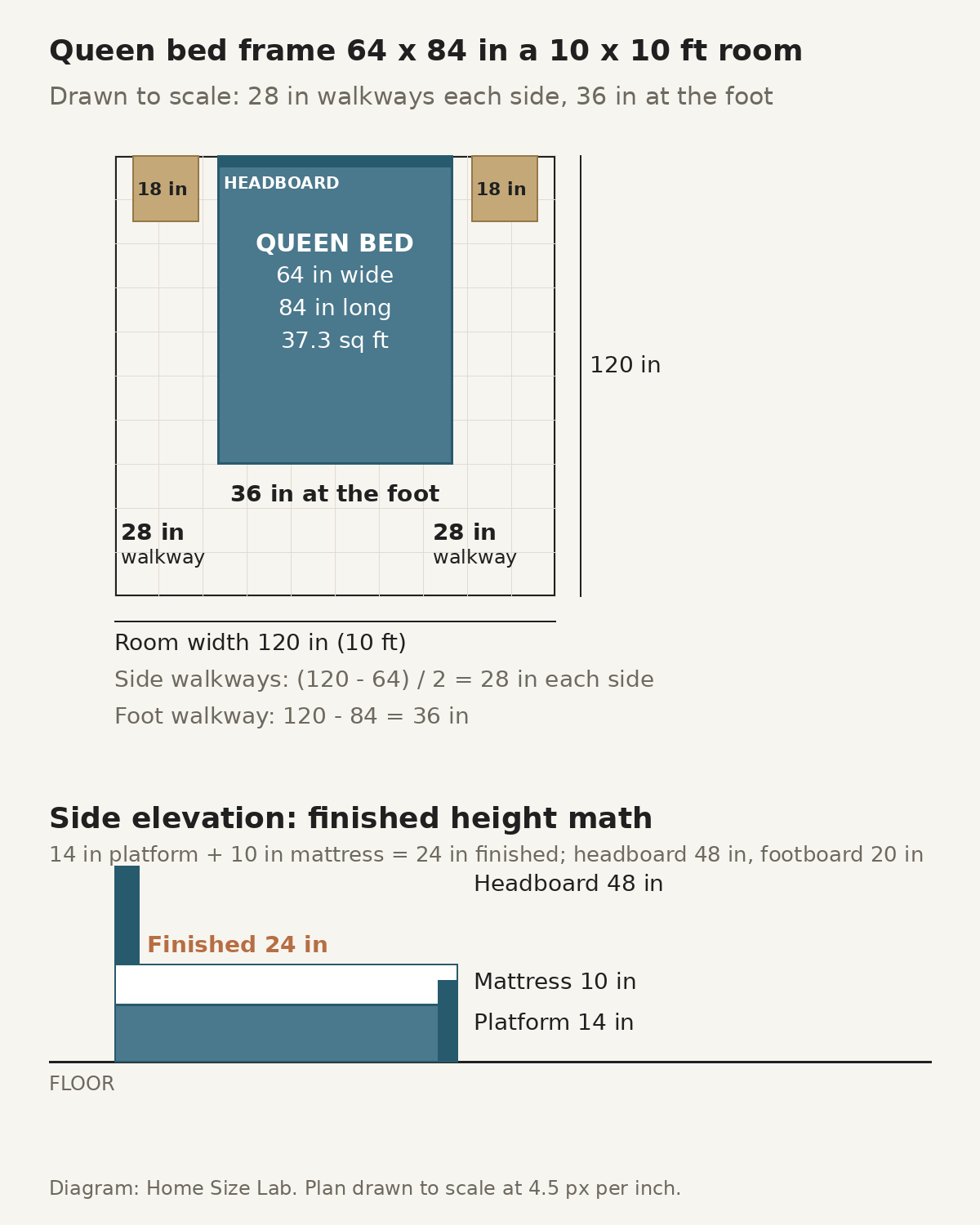
Worked example 2: queen frame in a 10 by 12 foot room. The room is 120 by 144 inches with the bed on the 12 foot wall. Centered, the side walkways are (144 minus 64) divided by 2, which is 40 inches each side, and the foot is 36 inches (120 minus 84). This is the comfortable queen room: 40 inch sides take a dresser on the long wall, two nightstands, and a bench at the foot with clearance to spare.
Worked example 3: queen frame in a 9 by 10 foot room. The room is 108 by 120 inches. Centered, the side walkways are (108 minus 64) divided by 2, which is 22 inches each side, below the 24 inch minimum. Pushed to the wall, the bed takes a 2 inch tuck gap on one side and leaves 42 inches open on the other (108 minus 64 minus 2), with 36 inches at the foot (120 minus 84). Verdict: a queen squeezes into a 9 by 10 room only against the wall, for sleepers who accept one closed side.
Worked example 4: queen frame in a 12 by 12 foot room. The room is 144 by 144 inches. Centered, the side walkways are (144 minus 64) divided by 2, which is 40 inches each side, and the foot is 60 inches (144 minus 84). A standard 18 inch deep dresser at the foot leaves 42 inches of drawer clearance (60 minus 18), which passes the 36 inch minimum with room to spare. This is the room where a queen stops needing tradeoffs.
The walkway standard in these examples is the same 24 inch minimum used across this site’s bedroom guides. For the full walkway rules, including what happens when a door swing or a dresser shares those inches, see our guide to space around a bed.
Room size itself is the other half of this decision. For the full room-size verdicts by room, including what a dresser and a desk do to each layout, see our guide to bedroom size for a queen bed. A queen frame covers 37 percent of a 10 by 10 room (37.3 of 100 sq ft), 31 percent of a 10 by 12 room, and 26 percent of a 12 by 12 room. The mattress alone covers 33 percent of the 10 by 10 room, which is why the frame number, not the mattress number, is the one to plan from.
The dresser trap. A standard 18 inch deep dresser needs 36 inches of drawer pull-out space in front of it. In the 10 by 10 example the foot zone is 36 inches, so a dresser at the foot leaves only 18 inches of drawer clearance (36 minus 18), which fails. Put the dresser on the long wall in the 10 by 12 room instead, where the 40 inch side walkway leaves 22 inches past the dresser, which is tight but workable for a low-traffic wall, or move up to a 12 by 12 room, where the 60 inch foot zone leaves 42 inches.
Delivery check. A queen mattress is 60 inches wide, so it will not fit flat through a standard 30 inch interior door. It goes through on its long edge, where the 80 inch edge matches a standard 80 inch door height, so expect to tilt it through the doorway or lift the door off its hinges for about an inch or two more. Measure the hallway turns too: the frame rails are 84 inches long, and a tight landing can stop a delivery that the doorway allowed.
Where a queen bed sits among other beds
A queen is the middle size that other standard beds are measured against, and the comparisons below stay on this page only as far as they help you choose.
A twin takes the same 80 inch length in its XL form but only 38 inches of width, so it sleeps one person where a queen sleeps two. The full twin bed frame numbers, including the twin XL comparison, live on our twin bed dimensions guide. A king is 16 inches wider than a queen at the same 80 inch length, giving each sleeper 38 inches instead of 30, and its full mattress and room numbers belong to the king bed dimensions guide. A headboard for a queen is 62 inches wide, 2 inches wider than the mattress, and the width rule, heights, and mounting types live on our headboard dimensions guide. A California king is 4 inches narrower and 4 inches longer than a standard king, and a split queen is two 30 by 80 inch halves in one queen frame, so it fits the same 64 by 84 inch footprint and suits adjustable bases, with each half taking its own fitted sheet.
Frequently asked questions
What is the standard size of a queen bed?
A queen bed mattress is 60 by 80 inches (152.4 by 203.2 cm), or 5 feet by 6 feet 8 inches. The frame around it typically measures 64 by 84 inches overall, with a headboard 48 to 54 inches tall on a standard panel bed. Queen is the most popular standard bed size for couples.
How wide is a queen bed frame?
Typically about 61 to 66 inches wide, against a 60 inch mattress. The declared representative frame in this guide is 64 inches wide. Measure your exact model before ordering, because flush-rail frames can run as narrow as 60.7 inches and thick-post frames as wide as 66 1/8 inches.
How long is a queen bed frame?
Typically 82 to 86 inches long, against an 80 inch mattress. The declared representative frame in this guide is 84 inches long. A California queen frame runs about 4 inches longer, about 88 inches.
Can two people sleep comfortably on a queen bed?
Yes, for most couples. Each sleeper gets 30 inches of width, which is the same as a twin mattress each. Couples who move a lot, share with children or pets, or want more space should step up to a king, which gives each sleeper 38 inches.
What size room do you need for a queen bed?
A 10 by 10 foot room is the minimum, and it works with the bed centered: 28 inch side walkways and 36 inches at the foot. A 10 by 12 foot room is the comfortable size, with 40 inch sides. A 9 by 10 room only works with the bed pushed against the wall.
What size sheets fit a queen bed?
A queen fitted sheet is 60 by 80 inches and a queen flat sheet is 90 by 102 inches. The flat sheet gives 15 inches of drop on each side and 22 inches at the foot. A queen fitted sheet will not fit a California queen mattress, which is 84 inches long, so check the label.
How tall is a queen bed?
Overall height is set by the headboard, typically 48 to 54 inches on a standard panel bed, lower on platform frames. The sleeping surface height is platform height plus mattress thickness: a 14 inch platform with a 10 inch mattress gives a 24 inch finished height, while a 7 inch low platform with an 8 inch mattress gives 15 inches.
Is a queen bed the same as a full bed?
No. A queen is 60 by 80 inches and a full is 54 by 75 inches, so a queen is 6 inches wider, 5 inches longer, and 750 square inches bigger. A full suits one adult or a single sleeper in a small room; a queen is the smallest standard size most couples find comfortable.
Will a queen bed fit through a door?
On its flat side, no: a 60 inch wide mattress will not pass a 30 inch door. On its long edge it will, but the 80 inch edge matches a standard 80 inch door height, so tilt it through or lift the door off its hinges first, and check the hallway turns before delivery day.
Sources
- Sleep Foundation mattress sizes and dimensions chart (queen 60 by 80, full 54 by 75, king 76 by 80, California king 72 by 84)
- Casper queen size bed dimensions guide (manufacturer guide: queen 60 by 80, about 33 sq ft, 30 in per sleeper, 10 by 10 ft minimum room, 24 in clearance, frame 62 to 65 by 82 to 86 in)
- Purple bed sizes and mattress dimensions guide (manufacturer chart: queen 60 by 80)
- Turmerry queen size bed dimensions guide (queen 60 by 80, frame 62 to 65 by 82 to 85 in, California queen 60 by 84, Olympic queen 66 by 80, split queen two 30 by 80 halves, short queen 60 by 74 or 75, 10 by 10 ft minimum room)
- Bassett queen size bed dimensions guide (queen 60 by 80, frames 60.5 to nearly 70 in wide, headboards 60 to 63 in wide with an average height of 48 in, California queen 60 by 84, Olympic queen 66 by 80, queen box spring 60 by 80)
- Sleep Junkie mattress sizes chart and guide (independent chart: queen 60 by 80, split king as two twin XLs)
- BestMattressBrand mattress sizes and dimensions chart (independent chart: queen 60 by 80)
- The Spruce bed sizes and dimensions guide (queen 60 by 80, 21 in wider and 5 in longer than a twin, 6 in wider and 5 in longer than a full)
- Tom’s Guide queen bed size guide (US queen 60 by 80, UK queen 48 by 75, Olympic queen 66 by 80)
- Hernest double bed vs queen bed comparison (full 54 by 75, queen 60 by 80, 750 sq in or 18.5 percent more surface)
- Bed Sizes US standard US mattress sizes and bedding chart (queen 60 by 80, minimum room 10 by 10 ft, 24 to 36 in walking space, queen fitted sheet 60 by 80, flat sheet 90 by 102, RV short queen 60 by 75)
- IKEA MALM queen bed frame measurements (resale listing reproducing the IKEA spec: length 211 cm or 83 1/8 in, width 168 cm or 66 1/8 in, headboard 100 cm or 39 3/8 in)
- Zinus Allen queen platform bed frame manual (manufacturer spec: 82 by 60.7 by 35.4 in, 700 lb capacity, 12 in platform)
- Zinus Brock queen platform bed frame manual (manufacturer spec: 82.8 by 63.9 by 31.2 in, 7 in low profile platform)
- Zinus Linda queen platform bed frame manual (manufacturer spec: 82.3 by 63 by 41.34 in, 700 lb capacity, 12 in platform)
- Ashley Bellaby queen panel bed dimensions (manufacturer spec: 64.5 in wide by 85 in deep by 55 in high, headboard 164.47 cm wide, footboard 50.8 cm high)
- CanDimension queen size bed dimensions guide (queen 60 by 80, 33.3 sq ft, frame about 64 by 84 in, minimum room 10 by 10 ft, ideal room 10 by 12 ft)

5 Comments
Pingback: King Bed Dimensions: The 76 x 80 Inch Chart (Cal King + Room Fit)
Pingback: Headboard Dimensions: The 62 Inch Queen Width Rule (Chart)
Pingback: How Much Space Around a Bed? Clearance Guide
Pingback: Bedroom Size for a Queen Bed: 10x10 Minimum, 10x12 Ideal
Pingback: Twin Bed Dimensions: The 38 x 75 Inch Chart (Frame + Room Fit)