


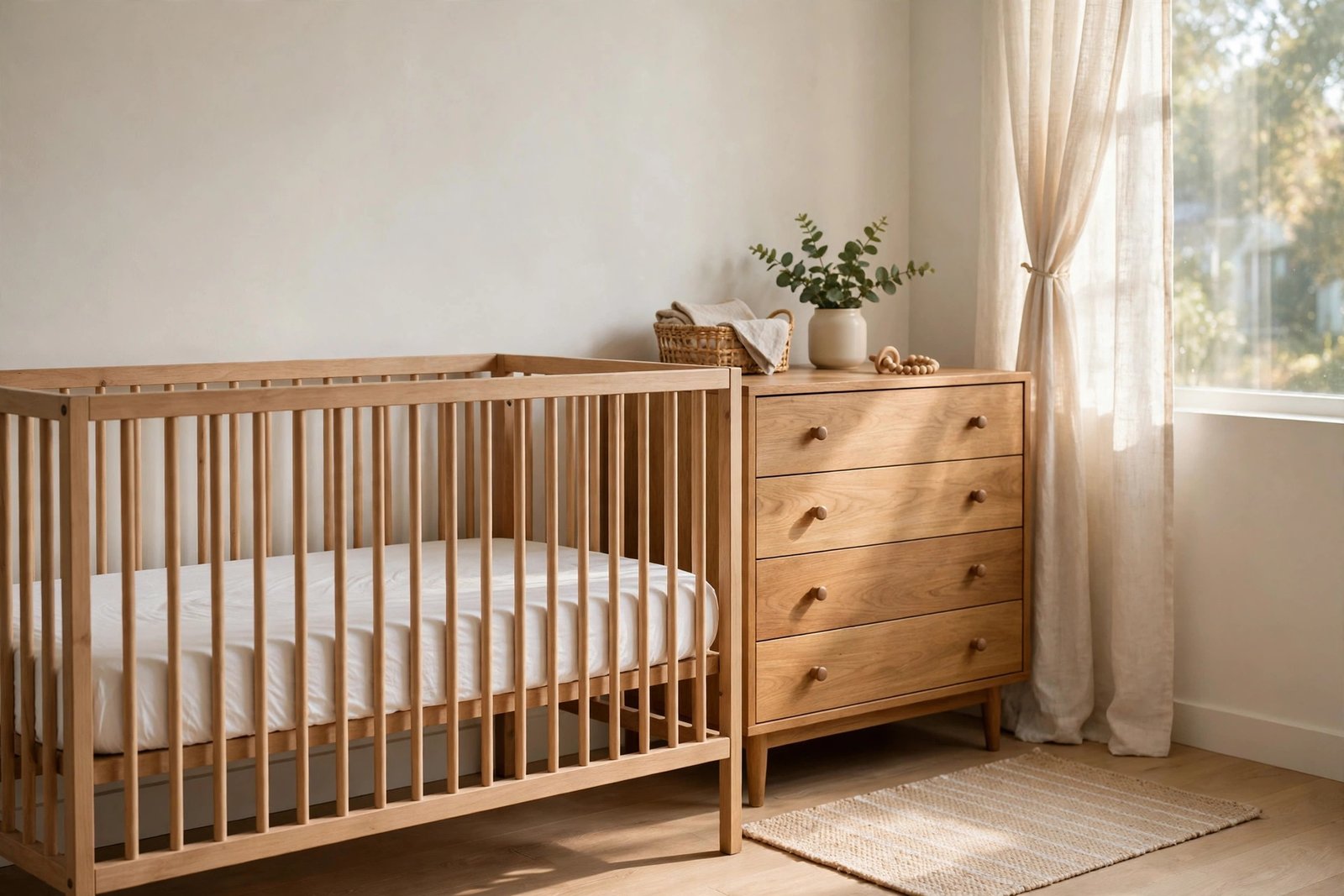
A standard crib measures 28 by 52 3/8 inches inside, takes a mattress at least 27 1/4 by 51 5/8 inches, and occupies about 56 by 30 inches of floor once the frame is counted. That three-number split is the whole buying decision: the interior decides safety, the mattress decides fit, and the exterior decides whether the nursery layout still works.
The three numbers, kept separate
Most crib guides quote one size and leave you to guess which measurement it is. There are three, and confusing them is how a crib that fits on paper fails in the room.
Definition: a full-size crib is the regulated standard crib. Its interior sleep surface is fixed by federal regulation, its mattress size follows from that interior, and its exterior footprint is set by the maker and varies by model. A mini crib is a different, unregulated size class, covered later in this guide.
| Measurement | Inches | Centimeters | Floor area | What it decides |
|---|---|---|---|---|
| Interior sleep surface | 28 x 52 3/8 | 71.1 x 133.0 | 10.2 sq ft | Whether the crib meets the standard at all |
| Standard mattress (minimum) | 27 1/4 x 51 5/8 | 69.2 x 131.1 | 9.8 sq ft | Whether a given mattress fits without a gap |
| Exterior footprint (typical) | 56 x 30 | 142.2 x 76.2 | 11.7 sq ft | Whether the crib fits the room and the layout |
The interior is 10.2 square feet (28 times 52.375, divided by 144). The typical exterior is 11.7 square feet (56 times 30, divided by 144). The frame therefore adds about 1.5 square feet that never appears in a mattress-size chart. Always plan the room from the exterior, never from the interior.
Standard crib dimensions, and the tolerance nobody quotes
A full-size crib must have interior dimensions of 28 inches wide by 52 3/8 inches long, within a tolerance of 5/8 inch either way, under federal regulation 16 CFR Part 1219, which incorporates ASTM F1169. That tolerance is the reason listings disagree by a fraction of an inch: they are all describing the same regulated box.
| Dimension | Nominal | Allowed range | How the range is worked out |
|---|---|---|---|
| Interior width | 28 in | 27 3/8 to 28 5/8 in | 28 minus 5/8, and 28 plus 5/8 |
| Interior length | 52 3/8 in | 51 3/4 to 53 in | 52 3/8 minus 5/8, and 52 3/8 plus 5/8 |
In centimeters, the nominal interior is 71.1 by 133.0 cm. If a listing gives an interior outside those ranges, it is not a full-size crib, whatever the listing calls it. Check the spec sheet, not the product title.
Crib mattress size and the gap subtraction
A standard crib mattress must measure at least 27 1/4 inches wide by 51 5/8 inches long and no more than 6 inches thick, under the federal crib mattress standard, which references ASTM F2933. Here is the subtraction no size chart runs:
| Direction | Interior (nominal) | Mattress (minimum) | Total gap | Gap per side, mattress centered |
|---|---|---|---|---|
| Width | 28 in | 27 1/4 in | 3/4 in | 3/8 in |
| Length | 52 3/8 in | 51 5/8 in | 3/4 in | 3/8 in |
The gap is 3/4 inch in both directions at nominal sizes: 28 minus 27 1/4, and 52 3/8 minus 51 5/8. Centered, that is 3/8 inch on each side. That small, even gap is the point of standardization. A mattress that leaves a wider gap is either the wrong size or sitting in a crib that is not full-size, and a gap a baby can slip into is an entrapment risk, not a comfort issue.
Two checks before you buy a mattress:
- Run the two-finger test. No more than two fingers should fit between the mattress and the crib side. A larger gap means the pairing is wrong, even if both boxes say standard.
- Keep thickness at or under 6 inches. A thicker mattress raises the sleep surface and eats into the rail height below, which is a safety margin measured in inches.
Sheets follow the same logic. Buy sheets labeled for a standard or full-size crib mattress, meaning the 28 by 52 inch class, and the fitted sheet will match the mattress this guide sizes. A sheet made for a mini crib will not fit a standard mattress, and a standard sheet will bag on a mini mattress.
Height, slats, and rails: the checks you can measure
Height is the one crib dimension the regulation does not fix as a single number, because makers build different styles. Typical overall heights run about 32 to 44 inches depending on style, so take the height from the exact model’s spec sheet, not from a category average. What the standards do fix, and what you can measure with a tape on the crib in front of you, is this:
| Check | Rule | Why it matters |
|---|---|---|
| Slat spacing | No more than 2 3/8 in (6.0 cm) between slats | Wider gaps can trap a baby’s head |
| Rail above lowest mattress support | At least 26 in | Keeps a standing toddler behind the rail |
| Rail above highest mattress support | At least 9 in | The newborn-height setting still holds a rail margin |
| Corner post height | No more than 1/16 in above the end panels | Stops clothing catching on a post |
| Drop-side cribs | Banned from sale in the US since June 2011 | The moving side could detach and trap a baby |
One more subtraction ties thickness to rail height. At the lowest mattress support, the rail stands at least 26 inches above the support. With a 6 inch mattress on that support, the rail stands 26 minus 6, which is 20 inches above the sleep surface. That is why the 6 inch thickness cap matters: every extra inch of mattress is an inch less rail.
Buy only a fixed-side crib made after June 2011. An older or secondhand crib needs its slat spacing, rail heights, and hardware checked against every row of the table above before it is used, and a crib with a drop side should not be used at all.
Mini crib dimensions: the smaller, unregulated class
A mini crib is not a smaller standard crib. Mini cribs have no single regulated size, so their dimensions vary by model, and their mattresses are model-specific. Typical figures, used as planning numbers only, are:
| Crib | Sleep surface (typical) | Exterior footprint (typical) | Floor area | Mattress rule |
|---|---|---|---|---|
| Standard (full-size) | 28 x 52 3/8 in | 56 x 30 in | 11.7 sq ft | Any standard mattress fits |
| Mini | About 37 x 24 in | About 40 x 26 in | 7.2 sq ft | Only the mattress made for that model |
The saving is real and easy to quantify. A mini exterior at 40 by 26 inches is 1,040 square inches, or 7.2 square feet. Against the standard 1,680 square inches, or 11.7 square feet, the difference is 640 square inches, or 4.4 square feet, which is 38 percent less floor. That is the whole case for a mini crib: it buys back nearly four and a half square feet in a small nursery or a shared bedroom.
The tradeoff is just as sharp. A mini crib mattress is not interchangeable with a standard mattress, and one mini maker’s mattress may not fit another maker’s mini crib. With a mini crib, buy the mattress and sheets made for that exact model, and re-measure if you ever replace either one. The size gap shows why: a standard mattress at 51 5/8 inches long is 14 5/8 inches longer than a mini sleep surface at 37 inches (51 5/8 minus 37). The safe rule is simpler than any subtraction: standard mattress, standard crib; model mattress, mini crib.
How much room a crib needs: the worked examples
Room math uses the exterior footprint plus the walkway standard from this site’s bedroom guides: 24 inches minimum and 30 inches comfortable on each open side, and 24 inches minimum at the foot. For the full walkway rules, including dresser drawer space that shares the foot zone, see our guide to space around a bed.
Worked example 1: a standard crib in a 10 by 10 foot room. The room is 120 by 120 inches. Put the crib’s 56 inch side along one wall, centered. Side walkways are (120 minus 56) divided by 2, which is 32 inches each: past the 30 inch comfortable tier. At the foot, 120 minus 30 leaves 90 inches: a walkway plus room for a dresser, which needs 36 inches of drawer pull-out in front of it, leaving 54 inches of open floor beyond the drawers.

Worked example 2: the same crib in an 8 by 10 foot room. On the 120 inch wall the sides are still 32 inches. On the 96 inch wall, the foot zone is 96 minus 30, which is 66 inches: a 24 inch walkway plus a 36 inch drawer zone leaves only 6 inches to spare, so the dresser either goes on an adjacent wall or the layout is tight.
Worked example 3: a mini crib in a 10 by 10 foot room. Sides are (120 minus 40) divided by 2, which is 40 inches. The foot zone is 120 minus 26, which is 94 inches. The mini crib turns a small room from workable into generous, which is exactly why it exists.
| Room | Crib | Side walkways | Foot zone | Verdict |
|---|---|---|---|---|
| 10 x 10 ft | Standard, 56 x 30 in | 32 in each | 90 in | Comfortable on every side |
| 8 x 10 ft | Standard, 56 x 30 in | 32 in each | 66 in | Works, dresser placement is tight |
| 10 x 10 ft | Mini, 40 x 26 in | 40 in each | 94 in | Generous, the mini crib’s best case |
For the room brackets these examples sit inside, including what counts as a small, standard, or large bedroom, see our guide to average bedroom size. A crib that passes the walkway math in a 10 by 10 room is not automatically right for a smaller room: run the same two subtractions, wall minus crib, on your own walls before ordering.
When a child outgrows a crib
Two limits end crib use, and whichever comes first wins. A child who is 35 inches tall should move out of a crib, and a child who can climb out should move out regardless of height. Both are safety limits, not milestones to stretch: a climbing child defeats the rail the day they learn to climb, and the 26 inch rail rule was written for a child who cannot yet do that.
The next bed depends on the child, not on this guide. Stacked beds change the question from floor space to ceiling height, and our guide to bunk bed dimensions runs that subtraction, ceiling minus mattress surface, with its own 30 inch minimum and 5 inch guardrail rule. What this guide does not do is size the converted bed: a convertible crib’s toddler-bed and full-bed stages take their own frames, kits, and mattresses, and those numbers belong to the bed they convert into, not to the crib.
Crib buying checklist
- Confirm the interior: 28 by 52 3/8 inches, within 5/8 inch either way, for a full-size crib.
- Confirm the exterior on the exact model’s spec sheet, and run the room subtractions on your own walls.
- Match the mattress: at least 27 1/4 by 51 5/8 inches, no more than 6 inches thick, and a two-finger gap at most.
- Measure the slats: no gap wider than 2 3/8 inches, anywhere on the crib.
- Check the rails and the date: fixed sides only, made after June 2011, with 26 inches of rail above the lowest mattress support.
Frequently asked questions
How big is a standard crib?
A standard, full-size crib has an interior of 28 by 52 3/8 inches, within 5/8 inch either way. Its exterior footprint is typically about 56 by 30 inches, but that varies by model, so check the spec sheet for the floor space it actually takes.
What size mattress fits a standard crib?
A standard crib mattress measures at least 27 1/4 by 51 5/8 inches and no more than 6 inches thick. At nominal sizes it leaves a 3/4 inch total gap, 3/8 inch per side when centered, which is the fit the two-finger test checks.
Will a standard crib mattress fit a mini crib?
No. Mini cribs are not regulated to one size, and their mattresses are made for specific models. A standard mattress is far longer than a mini sleep surface, so buy the mattress made for your exact mini crib model.
How much room do you need around a crib?
Allow 24 inches minimum and 30 inches comfortable on each open side, and 24 inches minimum at the foot, measured from the crib frame, not the mattress. In a 10 by 10 foot room a standard crib leaves 32 inch sides and 90 inches at the foot.
How tall is a standard crib?
Typical overall heights run about 32 to 44 inches depending on style, so there is no single standard height to quote. The regulated heights are the rail heights: at least 26 inches above the lowest mattress support and at least 9 inches above the highest.
When should a child move out of a crib?
When the child reaches 35 inches tall, or as soon as the child can climb out, whichever comes first. Both are safety limits, and climbing out ends crib use even if the child is under 35 inches.
Boundary notes
This page owns crib dimensions only. Nursery room sizing in general, including small, standard, and large bedroom brackets, lives on the average bedroom page linked above. Convertible-crib-to-bed conversions are noted here as a boundary only: the converted bed’s dimensions are not charted here. Toddler-bed and twin-bed sizes belong to their own dedicated guides when they publish, and no twin or toddler numbers are restated here beyond the outgrow rule above.
Sources
- Interior dimensions, tolerance, and mattress minimums under federal regulation: CPSC proposed standards for full-size and non-full-size cribs
- Standard crib interior, exterior footprint, and mini crib sleep surface: Project Nursery crib size guide
- Standard crib exterior ranges and typical heights by style: West Elm crib dimensions guide
- Standard and mini crib mattress sizes and interchangeability: Sleep Foundation crib mattress size guide
- Crib mattress minimums and thickness cap, cross-checked: EngineerFix crib sheet and mattress sizes
- Mini crib dimensions and model-specific mattress rule: Homenish mini crib dimensions guide
- Slat spacing, rail heights, and post-2011 fixed-side rule: Central Coast Pediatrics infant furniture crib checklist
- 35 inch height limit and climb-out rule: Rockaby crib safety standards summary
- Corner post protrusion limit: crib safety FAQ, slat and corner post measurements
