


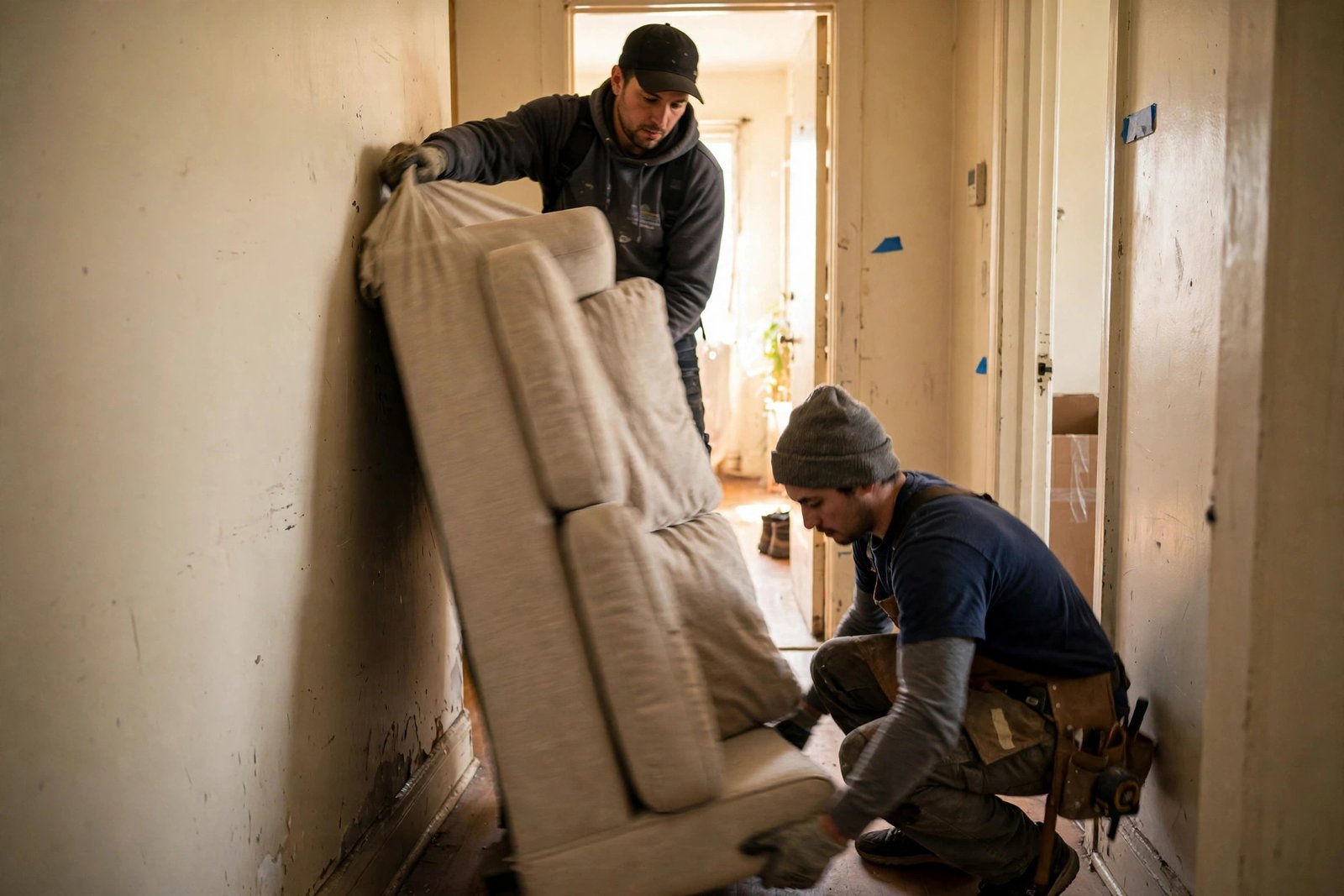
A couch can sail through the doorway and still get stuck at the hallway corner. That is the most common place a sofa move fails, because a corner is not a width problem. It is a pivot problem. The good news is that most sofas will turn a tight corner with the right technique, and three measurements will tell you whether the turn is possible before you lift anything.
Here is the short version. Stand the sofa on one end and use the hook method: feed the arm through the corner first, then swing the back around the inner corner while your partner steers the base. If tilting flat works better, try the diagonal twist at about 45 degrees, using the sofa’s own corner as the pivot. Before either move, check three numbers: the hallway width wall to wall, the diagonal from the inner corner to the outer edge of the turn (the pivot diagonal), and the sofa’s diagonal depth. When the sofa’s diagonal depth is smaller than the pivot diagonal and the sofa’s depth is smaller than the hallway width, the turn should work. The rest of this guide walks through the math, the four moves, and how to know when to stop. For the full route-measuring routine, see our guide on how to measure doorways and hallways for furniture delivery.
The Three Numbers That Decide the Turn
Corners defeat sofas for a simple reason: a sofa rotates as a diagonal, not as a straight line. Engineer Fix’s corner guide breaks the geometry into three measurements that you can take with a tape measure in five minutes (Engineer Fix).
| Number | How to get it | What it tests |
|---|---|---|
| Hallway width | Wall to wall, at the narrowest point of each leg | The swing room the sofa has while turning |
| Pivot diagonal | Diagonal from the inner wall corner to the outer edge of the opposite wall | The largest diagonal that can rotate through the turn |
| Sofa diagonal depth | Square root of (depth squared plus height squared) | The diagonal the sofa presents when stood on end |
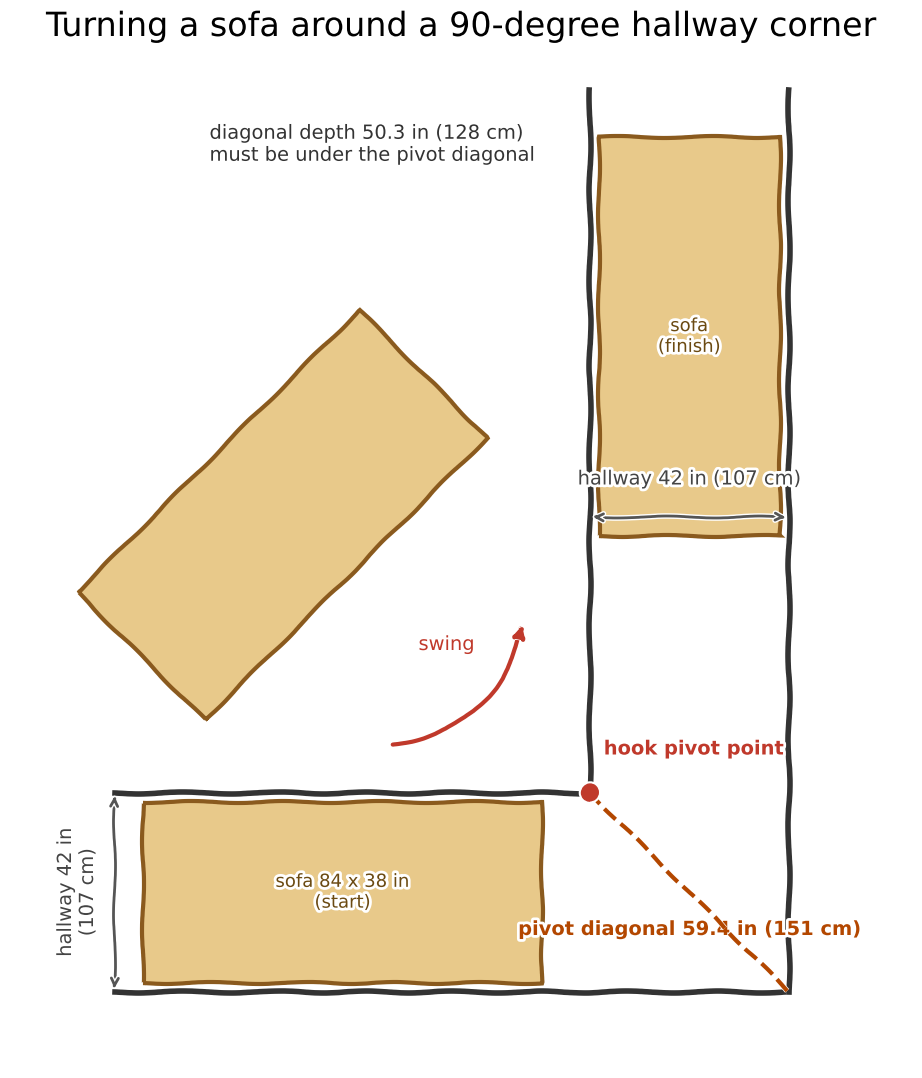
The rule is plain: the sofa’s diagonal depth must be smaller than the pivot diagonal, and the sofa’s depth must be smaller than the hallway width. If the depth is wider than the hallway, the sofa cannot swing far enough to complete the turn, and it will wedge against the inner corner wall.
Take a standard 84-inch three-seat sofa, 38 inches deep and 33 inches high, in a 42-inch hallway. Its diagonal depth is the square root of (38 x 38 + 33 x 33), which works out to about 50.3 inches (128 cm). The pivot diagonal of a 42-inch square corner is the square root of (42 x 42 + 42 x 42), about 59.4 inches (151 cm). Since 50.3 is under 59.4, and the 38-inch depth is under the 42-inch hallway width, this turn should work with the hook method.
Two details people miss. First, check the ceiling height along the whole route. Standing a sofa on end makes the sofa’s length the vertical dimension, so an 84-inch sofa needs 84 inches of overhead. A standard 8-foot ceiling gives 96 inches (244 cm), which clears it, but a low ceiling or a hanging light fixture can end the move before it starts. Second, if you want to confirm the math with your hands, cut a rigid cardboard rectangle to the sofa’s depth and height and physically walk it around the corner. Engineer Fix recommends exactly this test, since it shows in three dimensions what the numbers predict on paper.
For the sofa numbers themselves, the middle of the standard sofa dimensions ranges is a safe starting point: measure the actual piece at its widest points, including arms and any parts that do not come off.
Strip the Sofa Before You Carry It
Every removable part you take off makes the corner easier in two ways: the sofa gets smaller and it gets lighter. K-BOX’s furniture guide lists the order: cushions and pillows first, then removable legs, then modular sections, then frame disassembly if the fit is still too tight (K-BOX).
Work through this list:
- Cushions and pillows. Loose cushions add several inches of depth and they fall off mid-turn. Take them all off.
- Legs. Unscrew them and put the hardware in a labeled bag taped to the frame. MovingPlace notes that legs shave inches off the height and make the piece lighter, and keeping the screws with the frame means reassembly takes minutes (MovingPlace).
- Detachable backs and arms. Many reclining sofas have backs that lift off with a release lever. On some upholstered frames, removing the dust cover reveals bolts that hold the back or arms in place, and taking them off splits the sofa into manageable pieces.
- Modular sections. Sectional sofas split into individual pieces, and each piece turns a corner far more easily than the assembled whole. Check underneath for connector brackets before you assume the piece moves as one.
Re-measure the sofa after stripping it. The numbers that matter at the corner are the numbers of the stripped frame, not the showroom listing.
The Four Moves That Get a Couch Around a Corner
1. The hook method. This is the mover’s standard for sofas. Stand the sofa on one end. Feed one arm through the corner first, then rotate, or hook, the sofa’s back around the inner corner while your partner steers the base into the new hallway. K-BOX describes it as moving the arm through first and then hooking the back around the frame, and Kerb’s moving guide describes the same L-shaped curving motion used by long-distance movers (Kerb). Keep the rotation smooth and continuous rather than stopping halfway through the turn.
2. The diagonal twist. When the sofa cannot stand fully on end, usually because of a low ceiling, keep it low and tilt it to about 45 degrees with one person on each side. The person on the leading side guides the sofa’s own corner around the inner corner of the hallway, using that corner as the pivot point. This is the angled maneuver K-BOX recommends for pieces that are too tall to stand up, and it works because a tilted rectangle presents a smaller effective width than a flat one.
3. Slide on blankets. If the turn is tight but the math says it should pass, friction is your enemy. Lay moving blankets or old sheets on the floor and slide the sofa’s base through the turn instead of carrying it. Kerb recommends furniture sliders under each foot for the same reason: they kill friction and protect hardwood, tile, or carpet. Wrap the arms in a blanket too, so the fabric slides against the inner corner instead of catching on it.
4. High and low on stairs. Corners on staircases follow the same math, but the carrying changes. Kerb’s stair method: the person on the lower end carries the furniture from its bottom surface, the person on the higher end carries from the top surface, and the lower person sets the pace. Go slowly. The heaviest part of the sofa rides toward the higher end, which keeps the weight balanced instead of dragging the lower carrier forward.
Stairs and Landings Deserve Their Own Check
A stair landing is just a corner with a height limit, so run the same three numbers there. Measure the landing’s depth wall to wall, the pivot diagonal across it, and the ceiling height above the stairs. The sofa’s length is the vertical dimension when it stands on end, so compare it against the lowest ceiling point on the whole flight, including the bulkhead over the landing.
Two landing traps catch people. First, a landing that is deep enough for the sofa to stand on but too narrow for it to turn: the hook method needs swing room roughly equal to the sofa’s depth on at least one side of the turn. Second, the railing side. Banisters and newel posts stick out past the wall line, so measure to the post, not to the wall behind it. If the railing unbolts, removing it for ten minutes can buy the inches the math says you need.
When to Stop and Try Something Else
Forcing a wedged sofa is how frames crack, legs snap, and door frames dent. Stop when the math fails, not when the sofa does. If the sofa’s depth is wider than the hallway, or the diagonal depth is larger than the pivot diagonal, no technique fixes the geometry. Here is the order of escape routes:
- Disassemble further. Sleeper sofas get dramatically smaller with the mattress and metal frame out. Reclining sofas split at the backs. Sectionals separate piece by piece. As a last mechanical step, some upholstered frames let you unbolt the back or arms from inside the dust cover.
- Find another route. A wider door, a sliding patio door, or a ground-floor window can bypass the corner entirely. For anything involving the doorway itself, see our walkthrough on getting a couch through a 30-inch door.
- Call a mover for the one piece. K-BOX puts it plainly: if you are worried about damaging an expensive piece, a professional’s cost can be less than repairing the damage from a failed attempt. Many movers will take a single-piece job, and they bring straps, sliders, and blankets that make tight corners safer.
Frequently Asked Questions
How wide should a hallway be to move a couch around a corner?
There is no single number, because the hallway width works together with the corner shape and the sofa size. As a working rule, a 42-inch hallway turns a standard 84-inch sofa comfortably with the hook method: the math above gives a 59.4-inch pivot diagonal against a 50.3-inch sofa diagonal, with room to spare. Narrower than about 38 inches, a standard-depth sofa usually cannot swing far enough to complete the turn, and disassembly or another route becomes the plan.
Can you turn a couch in a 36-inch hallway?
Probably not with a standard sofa. A 36-inch square corner has a pivot diagonal of about 50.9 inches (129 cm), which barely clears the 50.3-inch diagonal of our example sofa. But the sofa’s 38-inch depth is wider than the 36-inch hallway, so there is no room to swing the base around the turn. The sofa wedges at the inner corner. A loveseat or a sectional piece might still make it, but a full-size sofa in a 36-inch hallway is a disassembly job.
What is the hook method for moving a sofa?
Stand the sofa on one end, feed one arm through the corner or doorway first, then rotate the back around the inner corner in a smooth L-shaped arc while your partner steers the base. It is the standard mover’s technique for sofas because it turns the sofa’s depth, not its length, into the dimension that crosses the turn. Both Kerb and K-BOX describe it as the go-to method for bulky pieces in tight spaces.
Should I remove the legs before moving my couch?
Yes. Legs typically add 2 to 4 inches of height, they are the most common snag point on door frames and corners, and removing them makes the sofa lighter. Unscrew them, bag the hardware, and tape the bag to the frame so reassembly is quick. This is one of the easiest gains in any tight move, and every moving guide recommends it before the first lift.
Is it worth hiring movers for just one stuck sofa?
Often yes. A single-piece move costs far less than a full relocation, and movers carry straps, sliders, and blankets that make tight corners safer. If the sofa is expensive or the turn is marginal, professional help costs less than a cracked frame or a gouged staircase. Get the math done first, though: if the numbers say the sofa cannot turn, tell the mover before they arrive so they can plan the disassembly or the alternate route.
A corner is a geometry test, and geometry gives honest answers. Measure the hallway, the pivot diagonal, and the sofa’s diagonal depth. Strip the sofa down to its frame. Then pick the move that fits the numbers: hook on end when the ceiling allows, diagonal twist when it does not, blankets when friction is the problem, and high-low on the stairs. When the numbers fail, disassemble or reroute instead of forcing it. The sofa that turns the corner cleanly is the one you measured first and lifted second.

4 Comments
Pingback: Will a Couch Fit Through a 30-Inch Door?
Pingback: Bedroom Size for a King Bed: Minimum & Ideal
Pingback: Sectional Sofa Dimensions & Room-Fit Guide
Pingback: Washing Machine Dimensions: Standard Sizes & Fit Guide