


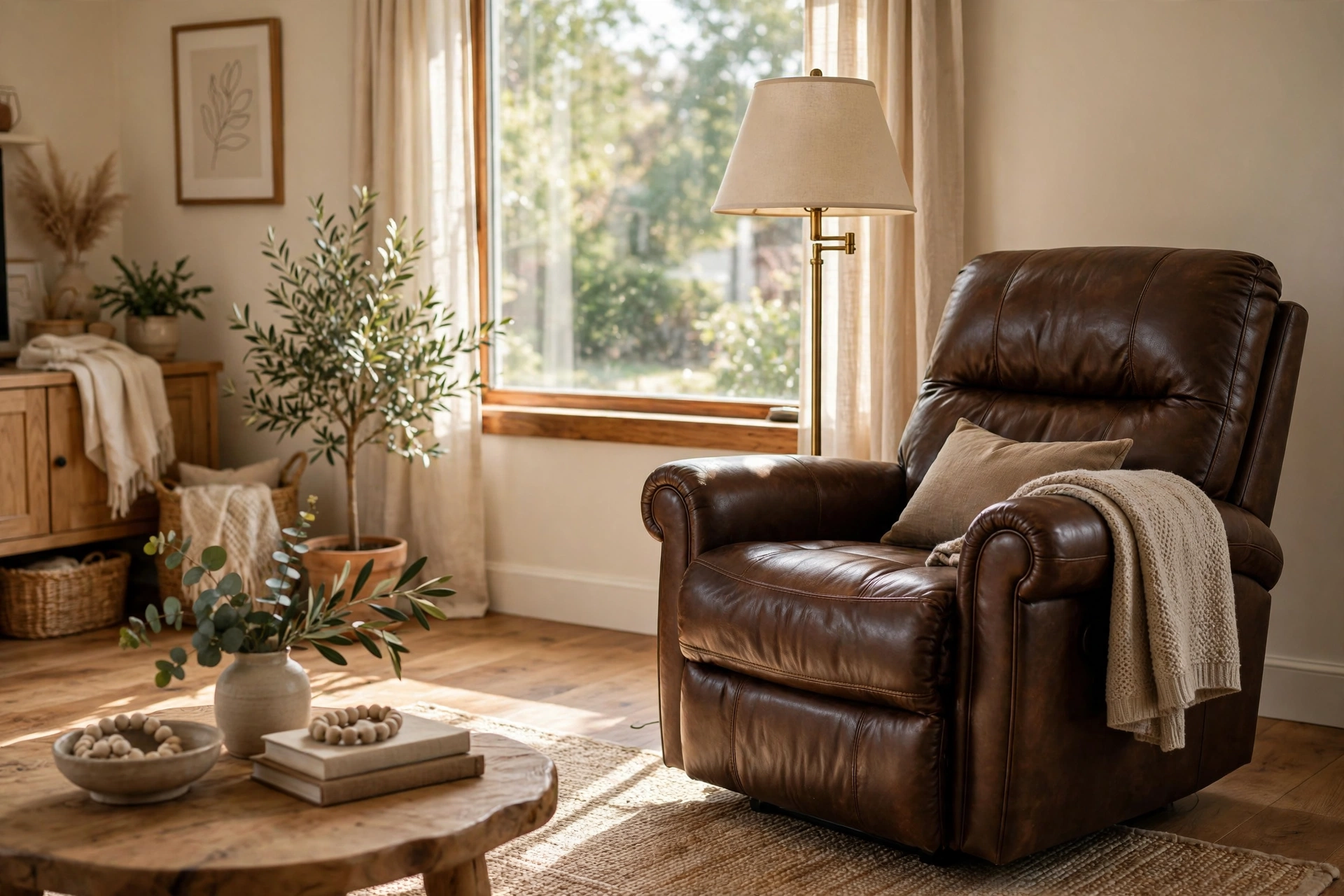
A standard recliner measures about 32 to 38 inches wide, 36 to 41 inches deep, and 40 to 44 inches high when upright. Fully reclined, the same chair stretches 65 to 72 inches long, and it needs 4 inches of wall clearance if it is a wall-hugger or 12 to 18 inches if it is a standard model. The number most shoppers get wrong is the reclined footprint, because product pages list the upright depth only.
Standard recliner dimensions
Recliners fall into four rough size classes. The table below uses overall width (arm to arm), upright depth (back of backrest to front of base), and overall height.
| Size class | Width | Depth (upright) | Height | Seat width |
|---|---|---|---|---|
| Petite / small | 29 to 32 in | 33 to 36 in | 39 to 42 in | 17 to 21 in |
| Standard / medium | 32 to 38 in | 36 to 41 in | 40 to 44 in | 20 to 22 in |
| Large | 38 to 44 in | 38 to 42 in | 42 to 45 in | 22 to 24 in |
| Oversized | 44 in and up | 40 to 44 in | 43 to 46 in | 24 in and up |
These ranges come from manufacturer spec sheets and independent size guides. Real models land inside them: a Steeple Maddox standard recliner is 36 inches wide, 36 deep, and 44 high with a 22-inch seat, and a Home Rooms Dimensions swivel glider runs 38 wide, 41 deep, and 43 high. Seat height runs 19 to 22 inches, seat depth 19 to 22 inches.
The reclined footprint: the math shoppers get wrong
A product page that says “38 inches deep” describes the chair upright, footrest tucked. Fully reclined, the leg rest swings forward and the backrest drops back, stretching a standard recliner to 65 to 72 inches: the ProLounger wall hugger measures 67 to 70 inches depending on model, and the OFS Voyage spec sheet lists 72 inches.
The formula is simple:
Reclined length = upright depth + leg-rest extension
Worked example with a typical 38-inch-deep standard recliner that reclines to 68 inches:
- Upright depth: 38 in
- Leg-rest extension forward: 30 in (68 minus 38)
- Floor the chair actually occupies when you are stretched out: 68 in, or 5 ft 8 in
That 30 inches of forward extension is the part people forget. The chair needs nearly 6 feet of clear floor in front of its upright position, so a coffee table 16 inches away will block the leg rest. Entirely avoidable with a tape measure.
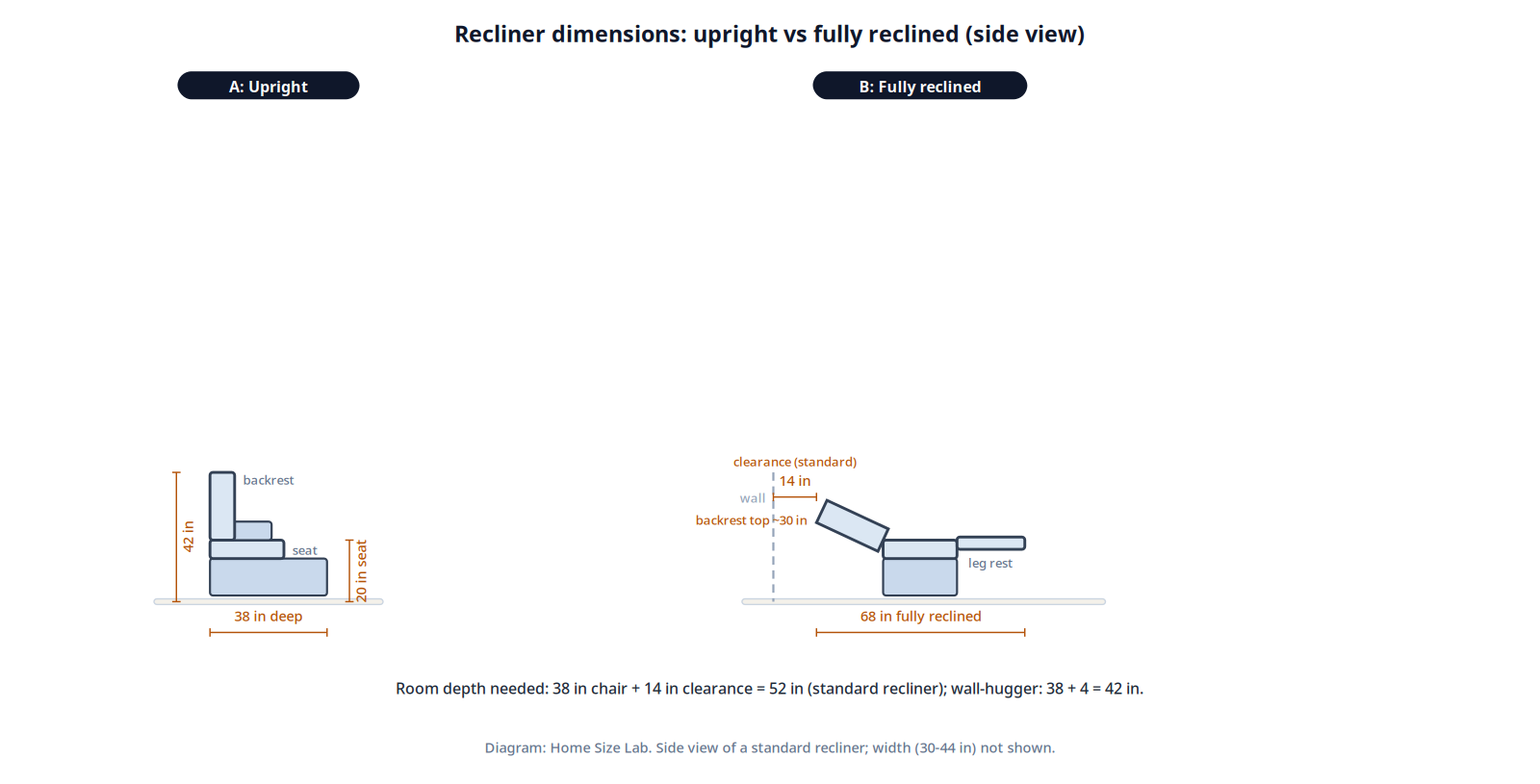
The diagram below shows a standard recliner upright (38 inches deep, 42 inches high) next to the same chair fully reclined (68 inches long), with the wall clearance drawn in.
Wall clearance by recliner type
Wall clearance is the gap you must leave behind the chair so the backrest can drop without hitting the wall. It depends entirely on the mechanism type, and this is where buying the wrong type for your room wastes space.
| Recliner type | Wall clearance needed | How it works |
|---|---|---|
| Wall-hugger (zero-wall) | 4 in | Seat slides forward as the back drops; needs almost no rear space |
| Standard (rocker / push-back) | 12 to 18 in | Backrest pivots backward into the space behind the chair |
| Large / oversized standard | 18 to 30 in | Same pivot motion, but a taller backrest sweeps a longer arc |
Manufacturer specs confirm the low end: ProLounger wall-hugger models list exactly 4 inches of wall clearance, plus a 25.5-inch front clearance for the leg rest swing. At the high end, independent guides note larger models can need up to 30 inches behind them.
Room-depth math for a standard 38-inch-deep recliner:
- Standard mechanism: 38 in (chair) + 14 in (clearance) = 52 in of room depth
- Wall-hugger: 38 in (chair) + 4 in (clearance) = 42 in of room depth
That 10-inch difference is the whole reason wall-huggers exist. In a small living room or a bedroom corner, it is the difference between the chair fitting and the chair blocking a walkway.
Seat width by body size
Seat width matters more than overall width for comfort. Overall width includes the arms; seat width is the space you actually sit in.
- Under 5 ft 6 in: 17 to 20-inch seat (petite). 5 ft 6 in to 6 ft: 20 to 22-inch seat (standard). Over 6 ft or broad build: 22 to 24-inch seat (large/oversized).
Fit checks from retailer buying guides: feet touch the floor sitting upright, head rests on the headrest without craning, and the seat-to-leg-rest gap stays under 5 inches (a pinch hazard for small children and pets).
Getting it through the door
A recliner is 30 to 44 inches wide and most interior doorways are 30 to 32 inches. Many recliners ship with a removable backrest, which cuts depth to about 30 inches for the carry-in, but the width does not shrink. Measure the narrowest doorway, hallway turn, and stairwell on the delivery path before ordering. Our guide to fitting a couch through a 30-inch door uses the same diagonal-carry math.
On rugs: a fully reclined chair needs its leg rest to land fully on the rug, not half off the edge; our living room rug size guide covers rug sizing for seating groups. Choosing between a recliner and a two-seat option for the same corner? Our loveseat dimensions guide breaks down loveseat sizing (48 to 72 inches wide) for when two people need to sit.
How to measure your space for a recliner
- Tape the upright footprint: a 38 by 36-inch rectangle, or your model’s depth and width, on the floor where the chair will sit.
- Mark the wall clearance behind it: 4 inches for a wall-hugger, 14 inches for a standard model.
- Mark the reclined extension forward: 28 to 32 inches for the leg rest.
- Walk the outline: open nearby doors, pull out adjacent chairs, and confirm the coffee table clears the leg-rest zone.
- Sit-test: sit fully back, recline completely, and confirm feet touch the floor and your head meets the headrest.
Mistakes that make a recliner not fit
- Buying on upright depth alone. The chair is 38 inches deep in the store and 68 inches long in your living room.
- Skipping the wall-clearance check. A standard recliner 6 inches from the wall gouges the paint on the first recline.
- Forgetting the leg rest needs the rug. A leg rest hanging half off the rug edge catches and looks unfinished.
- Sizing to the room instead of the sitter. A petite user in an oversized recliner cannot reach the floor.
How much space does a recliner need when fully reclined?
A standard recliner needs about 68 inches of floor length fully reclined, headrest to leg rest. Add wall clearance: 4 inches for a wall-hugger, 12 to 18 inches for a standard model. Total room depth: roughly 52 inches standard, 42 inches wall-hugger.
Can you put a recliner against the wall?
Only a wall-hugger (zero-wall) recliner can sit nearly against the wall; it needs just 4 inches of clearance because the seat slides forward as it reclines. A standard recliner needs 12 to 18 inches of space behind it, so placing it flush against the wall will damage the wall and block full recline.
How wide is a standard recliner seat?
A standard recliner seat is 20 to 22 inches wide, measured cushion to cushion between the arms. Petite models run 17 to 21 inches, and large or oversized models run 22 to 24 inches and up. Overall chair width, including arms, is 32 to 38 inches for a standard model.
How do you measure a recliner for a doorway?
Measure the chair’s widest point, arm to arm (30 to 44 inches), against the narrowest doorway on the delivery path (usually 30 to 32 inches for interior doors). If the backrest removes, measure without it, and allow 2 inches of wiggle room for the carry angle.
This guide covers recliners only; loveseat and sofa dimensions are covered in their own guides, linked above. Measure twice, recline once: tape the upright rectangle, add the wall clearance your mechanism needs, extend the tape for the leg rest, and only then commit to the spot.
Sources
- Designing Idea, Recliner Dimensions (Sizes Guide): standard recliner width, depth, and height ranges by size class
- Steeple Furniture, Maddox Leather Recliner specifications: 36 in wide, 36 in deep, 44 in high, 22 in seat width
- Steeple Furniture, Collegedale Recliner specifications: 32 in wide, 34 in deep, 42 in high (petite model)
- Home Rooms Furniture, Dimensions EZ5W00 Swivel Gliding Recliner: 38 in wide, 41 in deep, 43 in high
- OFS, Voyage Recliner Technical Specifications: 34 in wide, 37.5 in deep, 45.25 in high, 72 in extended length
- Bed Bath & Beyond, ProLounger Wall Hugger Recliner: 67 in fully reclined, 4 in wall clearance, 25.5 in front clearance
- Home Depot Canada, ProLounger Wall Hugger Recliner: 4 in wall clearance, 68 to 70 in fully reclined
- Stay Homebody, preventing recliner wall damage: 12 to 18 in standard clearance, up to 30 in for large models, 2 to 3 in for zero-clearance types
- Royal Furniture, Recliner Buying Guide: measure fully reclined, 1 to 3 ft from wall, feet on floor, headrest fit, 5 in maximum seat-to-leg-rest gap

1 Comment
Pingback: Loveseat Dimensions: Standard Sizes (Chart)