



A queen bed needs an 8×10 foot rug and a king bed needs a 9×12, laid with the wider side across the bed. The rule is subtraction: the rug should show 18 to 24 inches on each side of the mattress and past the foot. A queen is 60 inches wide, so an 8×10 leaves exactly 18 inches per side. Below is the same math for every bed size, plus the nightstand check most guides skip. The rug also has to clear the room itself – our guide to the average bedroom size lists standard room dimensions to measure against.
The rug-under-bed formula
Every bedroom rug guide repeats some version of the same rule: leave 18 to 24 inches of rug visible on each side of the bed and past the foot. Bedroom rug specialists frame it this way too, with a 12-inch minimum per side in small rooms and 24 to 30 inches as the generous end of the range. The problem is that almost no guide shows the subtraction that turns the rule into a rug size. Here it is:
Rug width minus bed width, divided by two, equals the inches of rug showing per side.
That single calculation is the whole article. Standard area rugs come in fixed widths (5, 6, 8, 9, 10 and 12 feet), and beds come in fixed widths, so there is no guesswork: for each bed you can check whether the result lands in the 18 to 24 inch band. The table below does it for the five standard bed sizes. Bed widths are the US mattress standard, confirmed by two independent mattress size references: twin 38 inches, full 54, queen 60, king 76 and California king 72.
Rug size chart by bed size, with the subtraction shown
| Bed size | Mattress width | Best rug | Inches of rug per side | Verdict |
|---|---|---|---|---|
| Twin (38 x 75 in) | 38 in | 6×9 ft | (72 – 38) / 2 = 17 in | Fits the 18-24 band near its floor |
| Full (54 x 75 in) | 54 in | 8×10 ft | (96 – 54) / 2 = 21 in | Clean fit |
| Queen (60 x 80 in) | 60 in | 8×10 ft | (96 – 60) / 2 = 18 in | Fits the band exactly at its floor |
| King (76 x 80 in) | 76 in | 9×12 ft | (108 – 76) / 2 = 16 in | Below 18 but above the 12-in minimum |
| California king (72 x 84 in) | 72 in | 9×12 ft | (108 – 72) / 2 = 18 in | Fits the band exactly at its floor |
Two entries in that chart deserve a second look, because they contradict what most guides tell you to buy.
First, the king. A 9×12 under a 76-inch king leaves only 16 inches per side, which is inside the bare minimum but outside the 18 to 24 inch target range. The guides still recommend 9×12 for kings, and they are not wrong for most rooms, but if your room can take it, a 10×14 gives (120 – 76) / 2 = 22 inches per side, which sits squarely in the target band. Buy the 9×12 for a small-to-medium bedroom and the 10×14 for a large one.
Second, the twin and full. Several guides call a 5×8 acceptable under a twin and a 6×9 acceptable under a full. Run the numbers: a 5×8 under a 38-inch twin leaves (60 – 38) / 2 = 11 inches per side, and a 6×9 under a 54-inch full leaves (72 – 54) / 2 = 9 inches per side. Both are below the 12-inch minimum, and both look skimpy in real rooms. For a twin, step up to a 6×9 (17 inches per side); for a full, step up to an 8×10 (21 inches per side). This is the place where “size up” actually matters, because the cheaper recommendation fails the rule it is supposed to follow.
Worked examples: queen and king
Queen bed: 8×10 or 9×12?
An 8×10 rug is 96 by 120 inches. Laid widthwise under a 60-inch queen, it leaves 18 inches of rug on each side, exactly the floor of the target range, and it is the recommendation you will find in nearly every rug-under-bed guide. Where should the extra length go? The rug is 120 inches long and the queen is 80 inches long, so 40 inches of rug extends beyond the bed. Slide the rug so about 16 inches of it sits tucked toward the headboard and 24 inches shows past the foot. That puts the foot landing where the 18 to 24 inch rule wants it.
A 9×12 (108 by 144 inches) under a queen leaves 24 inches per side, the top of the target range, and it is the right call when you want the nightstands on the rug. Standard nightstands run 20 to 24 inches wide; use 22 inches as a planning number. Queen 60 plus two 22-inch nightstands equals 104 inches, which fits on the 108-inch-wide 9×12 with 4 inches to spare. It does not fit on the 96-inch-wide 8×10. So the upgrade path is simple: 8×10 for the bed alone, 9×12 when the nightstands join.
King bed: 9×12 or 10×14?
A 9×12 under a 76-inch king leaves 16 inches per side, as the chart shows, which is acceptable but not generous. The length math works out comfortably: the rug is 144 inches long against the 80-inch bed, so with 24 inches past the foot there are 40 inches of rug running up toward the headboard, which is the classic lower-two-thirds look.
The nightstand story is where the 9×12 breaks down for kings, and no competitor shows this. King 76 plus two 22-inch nightstands equals 120 inches. A 9×12 is only 108 inches wide, so the nightstands cannot sit on it, despite what several guides imply when they describe a 9×12 as fitting “bed plus nightstands” for a king. If you want the full sleep setup on the rug, a 10×14 (120 inches wide) holds it exactly, with no spare margin, and a 12×15 (144 inches wide) leaves (144 – 76) / 2 = 34 inches per side. Pick your level of generosity accordingly.
If you are still choosing between king variants, our guide to king size bed dimensions in feet lays out the standard, California and oversized kings side by side.
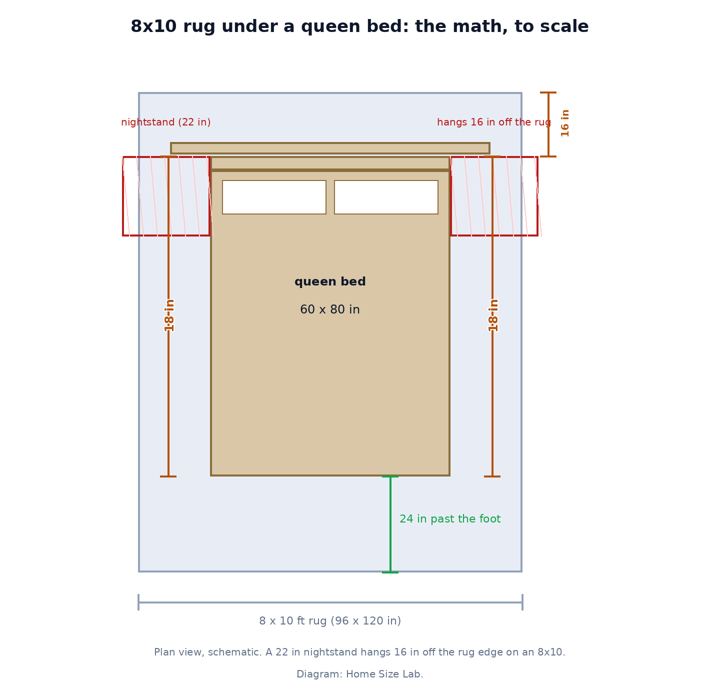
The three placement layouts
How far under the bed the rug goes changes the look more than the size does. There are three standard placements, and each pairs with a position of the rug along the bed’s length.
Layout 1: the whole bed on the rug. The rug runs from just behind the nightstands to well past the foot. This is the generous, hotel-like look, and it needs the largest rug for your bed size: 9×12 for a queen, 10×14 or 12×15 for a king. Everything sits on the rug, including nightstands and any bench at the foot.
Layout 2: the lower two-thirds. The most common placement in real bedrooms. The rug starts roughly a third of the way down from the headboard and extends 18 to 24 inches past the foot. For a queen with an 8×10, the worked example above (16 inches tucked at the head, 24 inches past the foot) is exactly this layout. Nightstands stay on the bare floor. This is the layout the diagram shows.
Layout 3: side runners instead of one rug. Two runners, one on each side of the bed, each about 2.5 to 3 feet wide and 7 to 8 feet long, with the inner edge tucked a few inches under the bed and the outer end reaching 12 to 18 inches past the foot. Runners are the fix for small bedrooms where an 8×10 would swallow the floor, and for beds pushed against a wall, where a runner on the open side is the only placement that makes sense.
One mechanical note for all three: use a rug pad. Bedroom rug guides are unanimous on this, because a pad stops the rug from creeping across hard floors and keeps the rug flat where feet land first thing in the morning.
Two numbers to check before you buy
Your bed frame, not your mattress. The chart above uses mattress widths, but frames run bigger. A typical upholstered frame adds 2 to 4 inches per side, and a chunky wooden frame can add 5. Add twice the per-side addition to the mattress width before running the subtraction. A queen with a frame that adds 4 inches per side is effectively a 68-inch-wide bed, and an 8×10 then leaves only (96 – 68) / 2 = 14 inches per side. That is still above the 12-inch minimum, but it is no longer 18, and it may push you to the 9×12.
Your room’s wall clearance. The rug should not touch the walls; leave 10 to 20 inches of bare floor between the rug edge and the wall on every side. Check the 9×12 in a 12 by 14 foot bedroom: the room is 144 by 168 inches, the rug is 108 by 144, so there are 18 inches of bare floor on the sides and 12 inches at the ends. A 10×14 in the same room leaves 12 inches on the sides but runs wall to wall at the ends — zero clearance, which breaks the 10-to-20-inch rule above, so it is too big for this room. The 9×12 is the honest maximum for a 12-by-14 bedroom. If your room cannot clear a 9×12, a 10 by 12 foot bedroom fits an 8×10 under a queen comfortably (120 – 96 = 24 inches, or 12 per side) and leaves a 9×12 exactly wall to wall at one end, so for a king in that room, side runners are the honest recommendation.
For the full walkway math around the bed, our guide to the space around a bed works out the clearances for nightstands, dressers and doors from the same starting numbers.
Living rooms use a different rule
This page covers rugs under beds only. Living room rugs are sized from the seating area, not the furniture footprint, with their own margins and layouts. For that, see our guide to what size rug for a living room.
Frequently asked questions
What size rug goes under a queen bed?
An 8×10 foot rug, laid widthwise. It leaves 18 inches of rug on each side of a 60-inch queen mattress and 24 inches past the foot when positioned with 16 inches tucked toward the headboard. Step up to a 9×12 if you want the nightstands on the rug too, since 60 plus two 22-inch nightstands needs 104 inches of rug width.
What size rug goes under a king bed?
A 9×12 foot rug for most bedrooms, giving 16 inches per side of a 76-inch king. A 10×14 gives 22 inches per side and is the better choice for a large bedroom. Neither holds the nightstands: king plus two 22-inch nightstands needs 120 inches of rug width, which is a 10×14 exactly, and 12×15 leaves real breathing room.
Should the rug go under the headboard?
No. The rug should not run wall to wall under the headboard. The standard placement starts the rug a third of the way down from the head of the bed, with the nightstands on the bare floor behind it, so the rug covers the lower two-thirds and extends 18 to 24 inches past the foot.
Can I put an 8×10 rug under a king bed?
Only in a tight room, and only as the lower-two-thirds layout. An 8×10 under a 76-inch king leaves (96 – 76) / 2 = 10 inches per side, which is below the 12-inch minimum. It will read as slightly small. If the room truly cannot fit a 9×12, it is the fallback, not the plan.
What size rug for a twin bed?
A 6×9 foot rug leaves 17 inches per side of a 38-inch twin. A 5×8 leaves only 11 inches per side, below the minimum, so skip it despite how often it is recommended. For very small rooms, two runners beside the bed work better than one undersized rug.
Sources
- Sleep Foundation, standard mattress size chart: twin 38 x 75, full 54 x 75, queen 60 x 80, king 76 x 80, California king 72 x 84
- A House in the Hills, rug-under-bed placement rules: 18 to 24 inches visible per side and at the foot, 12-inch minimum in small rooms, size chart by bed type
- Edward Martin, bedroom rug sizing guide: queen 8×10, king 9×12, 18 to 24 inch extension past sides and foot
- ALRUG, standard rug sizes for every room: 9×12 under a king, 24 to 30 inch extension
- Opple House, rug-under-bed sizing guidelines: 18 to 24 inch visible rule, bed-by-bed cheat sheet

3 Comments
Pingback: How Much Space Around a Bed? Clearance Guide
Pingback: King Size Bed Dimensions in Feet: All King Sizes
Pingback: What Size Rug for Living Room? Sizes, Layouts & Diagrams