



A standard nightstand measures 24 to 28 inches tall, 18 to 24 inches wide, and 14 to 20 inches deep. The height rule matters more than the rest: the nightstand top should sit level with the top of your mattress, within plus or minus 2 inches, and slightly above is better than slightly below. Width scales with the bed, from under 21 inches for a twin to 24 to 30 inches for a king.
Most guides stop at those three ranges. This guide adds the part they skip: the exact inch math that connects your mattress height to the right table height, width by bed size with the totals worked out, and lamp clearance measured from the floor, not guessed.
What are standard nightstand dimensions?
Standard nightstand dimensions are 24 to 28 inches high, 18 to 24 inches wide, and 14 to 20 inches deep. The average nightstand dimensions in US bedrooms land near 25 inches tall, 22 inches wide, and 18 inches deep, which is why a 25-inch table sits level with most standard mattress tops. Typical nightstand dimensions outside that band are not wrong, they are built for non-standard beds: low platform beds need 20 to 24 inches, and tall pillow-top setups need 28 to 32 inches. Measure your mattress height first, then pick width and depth around it.
| Dimension | Standard range | Metric | Built for |
|---|---|---|---|
| Height | 24–28 in | 61–71 cm | Standard bed with box spring and mattress |
| Low height | 20–24 in | 51–61 cm | Platform beds |
| Tall height | 28–32 in | 71–81 cm | Pillow-top mattresses and tall frames |
| Width | 18–24 in | 46–61 cm | Twin, full, and queen beds |
| Wide width | 24–30 in | 61–76 cm | King beds |
| Depth | 14–20 in | 36–51 cm | Standard use without crowding the walkway |
The nightstand height rule, with the math
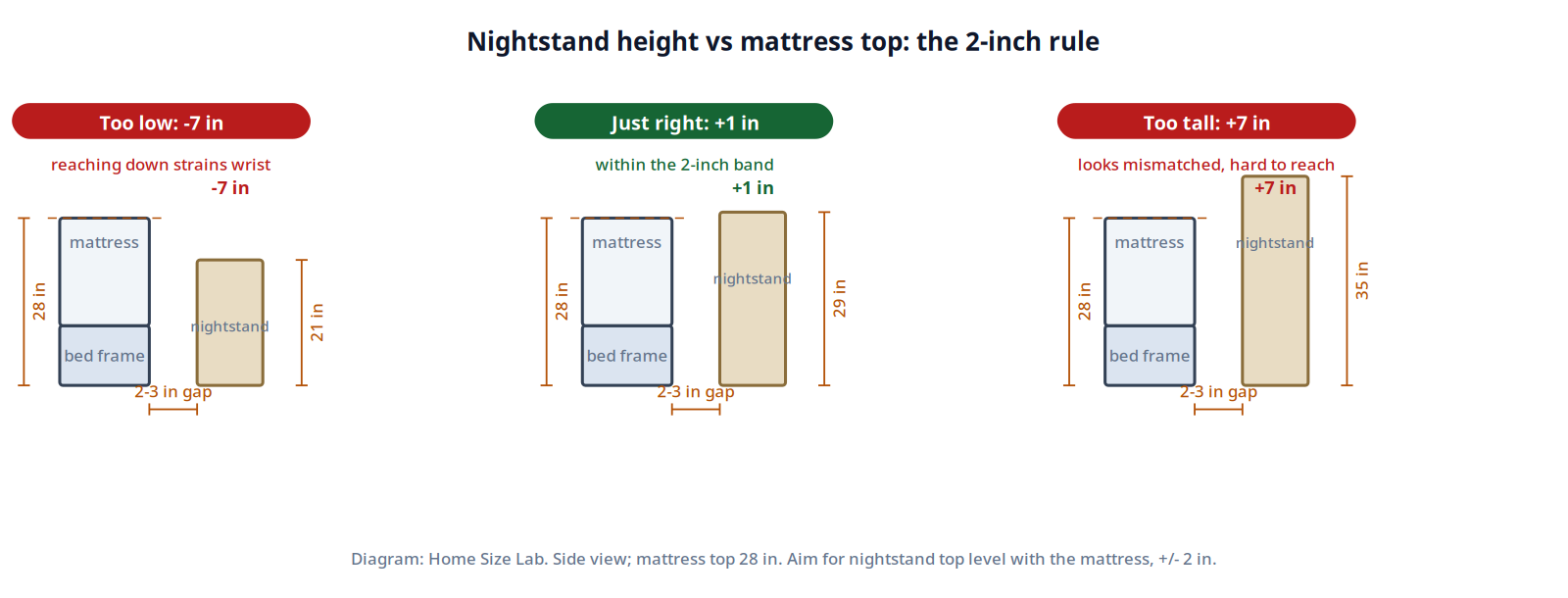
Nightstand height is the one dimension people get wrong, and it is the one that matters most. Reach across a 6-inch gap at 2 a.m. and you will feel it in your wrist and shoulder. The rule: the top of the nightstand should be level with the top of your mattress, plus or minus 2 inches. One to 2 inches above the mattress is the sweet spot for most people, because reaching slightly down is easier than reaching across, and small items are less likely to roll off toward the bed.
The generous outer bound is plus or minus 4 inches, but treat that as the edge of acceptable, not the target. Past 4 inches in either direction, the table looks mismatched and works badly.
Start from your actual bed. Measure from the floor to the top of the mattress, including the frame, box spring, mattress, and any topper. That single number is your target nightstand height. Typical totals by bed type:
| Bed type | Mattress top from floor | Target nightstand height |
|---|---|---|
| Platform bed (no box spring) | 12–18 in | 20–24 in |
| Standard bed with box spring | 24–28 in | 24–28 in |
| Tall bed / thick pillow-top | 30–36 in | 28–32 in |
| Adjustable bed | 25–30 in (flat position) | Match your most common sleep position |
Example: a platform bed with a 10-inch frame and a 10-inch mattress puts the sleep surface at 20 inches. A 24-inch nightstand next to it sits 4 inches above the mattress, at the edge of acceptable. A 22-inch table lands it exactly in the ±2-inch band. That is the whole method: measure, then pick the standard size that falls within 2 inches of your number. Our guide to bedroom size for a queen bed uses the same measure-first approach for laying out the full room around that bed height.
Typical nightstand width by bed size
Width should scale with the bed so the table does not look dwarfed beside a wide headboard, and so there is real surface area for a lamp plus the nightly essentials.
| Bed size | Bed width | Nightstand width | Total wall span (bed + 2 tables) |
|---|---|---|---|
| Twin / Twin XL | 38–39 in | 16–20 in | 70–79 in |
| Full | 54 in | 18–24 in | 90–102 in |
| Queen | 60 in | 20–28 in | 100–116 in |
| King | 76 in | 24–30 in | 124–136 in |
Check the king row before you buy: a 76-inch-wide bed with two 28-inch nightstands spans 132 inches, exactly 11 feet of wall. If your wall is only 10 feet, you need the narrow end of the range, or a single table on one side. For a queen, 20 to 28 inches gives room for a lamp, a phone, and a book; under 20 inches and the lamp crowds everything else off the table.
Depth and placement gaps
Standard depth is 14 to 20 inches. Shallow tables at 12 to 16 inches suit small bedrooms where every inch of walkway counts. Deep tables at 20 to 30 inches exist for people who want the nightstand to do dresser duty, with drawers deep enough for folded clothes.
Leave 2 to 3 inches between the side of the nightstand and the side of the bed. That gap is close enough for easy reach and wide enough for bedding to tuck without snagging. On the far side, keep the walkway open: our queen bedroom layout keeps 24 inches of clear walking space beside the bed, and the nightstand depth plus its position should never eat into that.
Drawer vs open shelf
Both store things; they just fail differently when you overload them.
| Drawer nightstand | Open-shelf nightstand | |
|---|---|---|
| Storage style | Concealed, hides clutter | Visible, needs tidying |
| Night access | Open the drawer first | Grab instantly in the dark |
| Small items | Stay contained | Migrate to the back |
| Visual weight | Heavier, more traditional | Airier, more modern |
| Best for | Chargers, medication, reading glasses | Minimalists, small rooms |
If you keep more than a lamp and a book at the bedside, get at least one drawer. The drawer holds the clutter so the top stays clear for the water glass and the lamp.
Lamp clearance, measured from the floor
A lamp that is too tall glares in your eyes when you sit up to read; too short and it lights the tabletop instead of the book. Two numbers control this.
First, the lamp itself should rise about 18 to 24 inches above the tabletop, which is the range that delivers comfortable bedside reading light without spilling glare onto the pillow. Second, the bottom of the lampshade should sit near your seated eye level, roughly 55 to 65 inches from the floor, so the bulb is never in your direct line of sight. On a 26-inch nightstand, a 27-inch-tall lamp lands the shade bottom right in that zone.
If you prefer wall lighting, mount the sconce 55 to 65 inches from the floor and 6 to 12 inches from the edge of the bed, so the switch is an easy reach without sitting up.
How to measure for your nightstand in four steps
When the chart gives you two plausible answers, settle it on your own floor in ten minutes.
- Measure the mattress top. Run the tape from the floor to the top of the mattress, frame and topper included. Write the number down; it is your target height.
- Measure the space beside the bed. Allow 2 to 3 inches of gap between the bed and the table, and check what width fits between that gap and the wall or the walkway.
- Check the swing. Open any drawer fully on paper: drawers need their depth plus a few inches in front. In a tight room, an open shelf beats a deep drawer.
- Tape the outline. Mark the table’s footprint on the floor with painter’s tape and live with it for a day. Open the bedroom door, walk the path, reach from the pillow. Tape is cheaper than a return.
The same height-matching principle applies beyond the bedroom: a side table next to a sofa follows the same rule, which is why our guide to end table height vs sofa height uses the identical level-with-the-seat logic.
Frequently asked questions
Should a nightstand be taller or shorter than the bed?
Level with the top of the mattress, or 1 to 2 inches taller. Shorter is the worse direction: a low table forces you to reach down and looks undersized next to the bed.
What is the average nightstand height?
24 to 28 inches, which matches most standard beds. Platform beds need the 20 to 24 inch range; tall pillow-top setups need 28 to 32 inches.
How wide should a nightstand be for a king bed?
24 to 30 inches. A king is 76 inches wide, and narrower tables look lost beside it while also leaving no room for a lamp plus essentials.
Can a small dresser work as a nightstand?
Yes, and it is a good move when you need more storage than a nightstand offers. But dresser proportions follow different rules around drawer depth and height, so check our guide to dresser dimensions before buying one for bedside duty.
The short version
Measure your mattress top from the floor. Buy a nightstand within 2 inches of that number, slightly above if you have to choose. Scale the width to the bed, keep the depth at 20 inches or less, and put the lampshade bottom near seated eye level. Do those four things and the nightstand disappears into the bedroom the way good furniture should: useful, balanced, and never something you think about at 2 a.m.
Sources
- Sleeperholic, Bedside Table Dimensions: standard 24–28 × 18–24 × 15–20 inch ranges and the level-with-mattress rule
- Wayfair, Nightstand Dimensions guide: 23–28 inch height range, width and depth categories, height within 3 inches of mattress top
- SICOTAS, How Tall Should a Nightstand Be: ±2 inch rule, height chart by bed type, sconce mounting heights
- Apartment Therapy, What Height Should Your Nightstand Be: mattress height ±4 inch formula and width by bed size
- Homenish, Guide to Standard Nightstand Sizes: 23–28 inch height, 22–28 inch width, 14–20 inch depth
- Coohom, Nightstand Too Tall or Too Small: 18–24 inch lamp height above tabletop and IES reading-light guidance
- dshop Australia, How Tall Should a Nightstand Be: mattress-level ±5 cm principle and reach-strain explanation
