


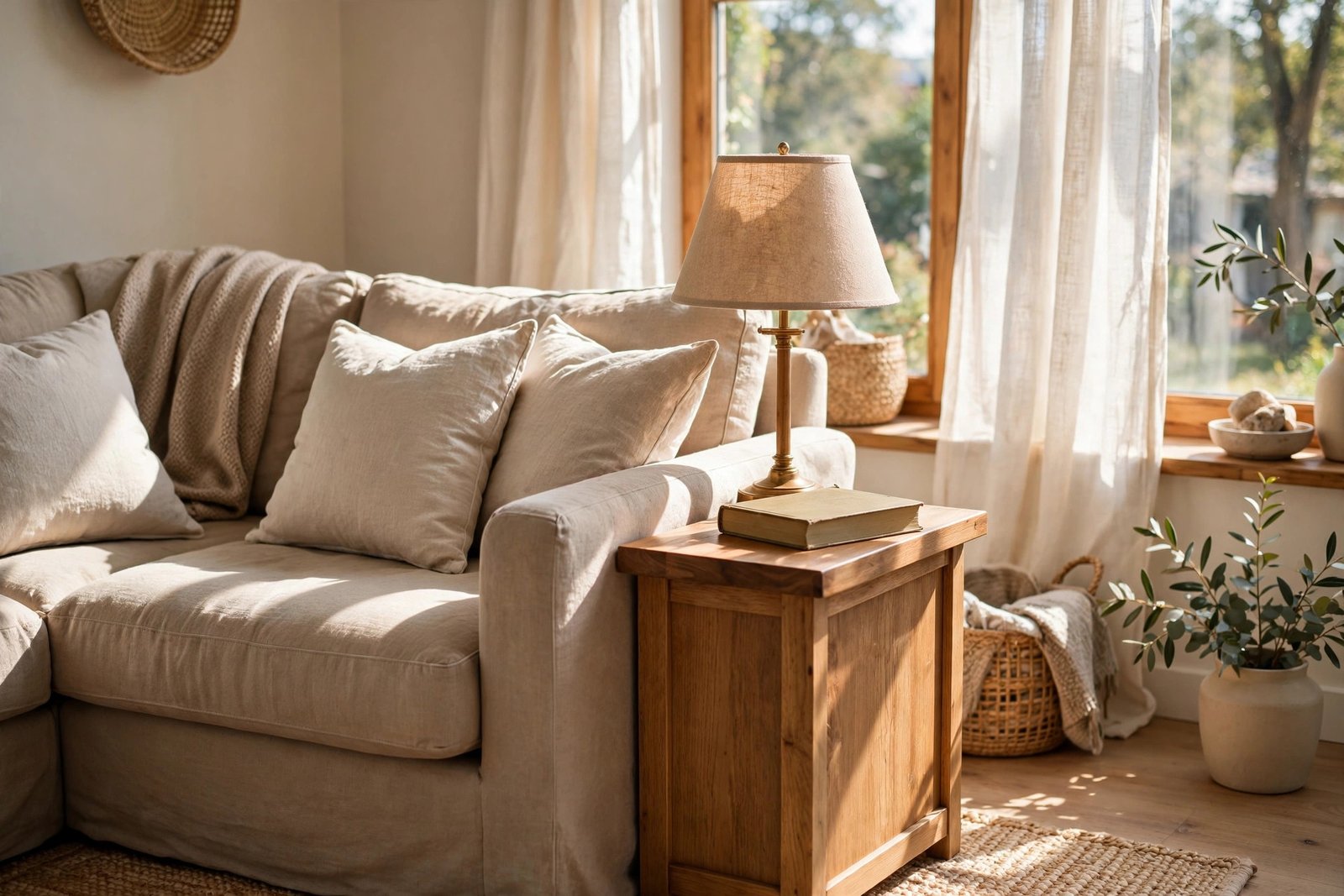
An end table should sit within about 2 inches of your sofa-arm height: equal to the arm, or up to 2 inches below it, is the sweet spot. That one rule settles the purchase for almost every sofa. No arms? Size from the seat cushion instead, and stay within 2 inches of seat height.
Get it right and the table disappears into your routine. Get it wrong and every reach for your tea becomes a little negotiation.
End Table Height at a Glance
| Measurement | Typical range | Aim for |
|---|---|---|
| End-table height | 18–28″ (46–71 cm) | Within ±2″ (5 cm) of the arm; ideally equal or up to 2″ below |
| Sofa-arm height | 22–28″ (56–71 cm) | Measure your own, which vary more than you’d think |
| Table width | 16–28″ (41–71 cm) | Wide enough for a lamp plus a drink |
| Table depth | 22–24″ (56–61 cm) | Roughly the depth of the seat beside it |
| Gap between table and sofa | 2–4″ (5–10 cm) | Close enough to reach, not wedged together |
These are planning guidelines from furniture retailers and designers, not fixed standards. The right number always starts with measuring the sofa you actually own.
The Two-Inch Rule: Why Arm Height Runs the Show
The most quoted guideline in the business is the armrest rule: your end table should sit at or slightly below the height of your sofa’s arm, ideally within two inches. Wayfair’s sizing guide states it exactly that way, because that’s the range where setting down a drink feels effortless instead of awkward.
Why the preference for slightly below? It’s simple ergonomics. When the table is lower than the arm, you extend your arm sideways and slightly down, a natural motion. When the table is taller, you’re reaching up past the armrest, which feels strained and looks off. Rapport Furniture’s dimensions guide agrees the table can sit up to two inches above the arm without breaking the look, but notes that many designers won’t spec a table taller than the arm at all.
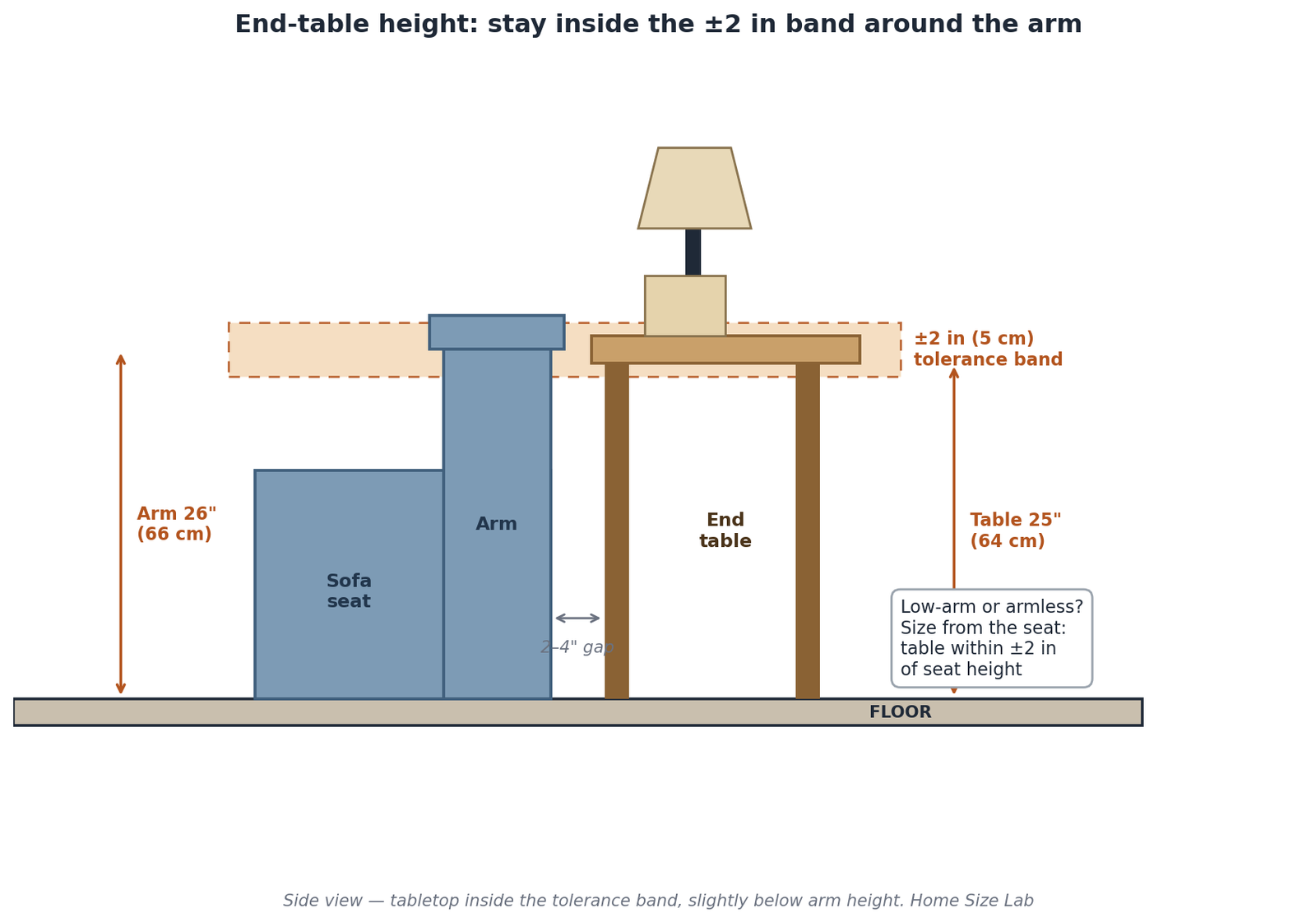
Think of it as a tolerance band: arm height ±2 inches is acceptable, arm height down to 2 inches below is ideal. A 26-inch arm pairs beautifully with a 24- or 25-inch table.
The same reach logic applies to the floor around the table: keep the sofa to coffee table distance generous enough to walk through, so the end table isn’t doing all the work in a cramped corner.
Worked Example: A 26-Inch Arm
Say you measure your sofa’s arm at 26 inches (66 cm), a very common height.
- Acceptable band: 24–28″ (61–71 cm)
- Ideal pick: 24–26″, equal to the arm or up to two inches below
- Skip: 22″ or shorter (you’ll stoop for every mug) and anything over 28″ (you’ll reach up past the arm)
If the table also needs to hold a reading lamp, don’t solve it with a taller table. Solve it with a taller lamp. And if you’re sizing the table in front of the sofa too, our guide to coffee table height vs sofa runs the same kind of arm-and-seat math for that piece.
Minimum vs. Comfortable: What Each Height Feels Like
Below the band (more than 2″ under the arm): The table visually disappears, and using it means a deliberate stoop. Fine for a decorative plant stand; bad for the table you’ll use fifty times a day.
Inside the band (±2″ of the arm): The comfortable zone. Your hand finds the surface without looking, and the pieces read as a matched set even if they came from different stores.
Above the band (more than 2″ over the arm): The table dominates. It blocks sightlines, makes the arm look stubby, and turns every reach into a small lift. This is the most common end-table mistake, and it’s almost always a table bought for its looks with no measuring tape involved.
Low-Profile Sofas and Armless Seating
Low, lounge-style sofas change the math but not the method. With arms at 20–22 inches you need a genuinely low table. Wayfair suggests 18–22 inches for low sofas, and this is where most people go wrong, because low tables are harder to find than standard ones. If you’re choosing between a 20-inch table inside the band and a prettier 24-inch one outside it, take the 20. Proportion beats style at this scale.
Armless sofas and chairs need a different reference point: size from the seat. Measure floor to the top of the seat cushion and choose a table within about two inches of that height, often just above it. A typical seat is 17–19 inches high, so the working table lands around 18–22 inches. Some guides suggest 24–26 inches for armless sofas, the height where an arm would be, which works if the table mostly holds a lamp. But for a table you’ll use daily, seat-height sizing keeps everything within a natural reach.
The Lamp Exception (That Isn’t One)
“I need a taller table so my lamp sits high enough.” It comes up constantly, and it’s backwards. A reading lamp works when the bottom of its shade sits near your seated eye level, and you get there with a taller lamp, not a taller table. Stretching the table past the arm to lift a short lamp breaks the reach rule for everything else you’ll set down. Size the table to the arm; size the lamp to your eyes.
How to Measure for an End Table
1. Measure the arm where the table will sit. Arms slope and roll, so measure floor to the top of the arm at the exact spot the table will stand, not at the back corner where it’s tallest.
2. Write down the band. Arm height ±2 inches is your shopping range; arm height down to arm-minus-2 is the bullseye.
3. For armless seating, measure the seat. Floor to the top of the cushion (sit in it first: cushions compress). Your band is seat height ±2 inches.
4. Check width and depth. The table should be shallower than the sofa’s seat depth, with 2–4 inches of breathing room between the table’s edge and the arm. Jammed flush, even a perfectly tall table looks like an afterthought. If you are unsure which numbers count as seat depth versus overall depth, see how to plan standard sofa dimensions before you measure.
5. Sit and mime it. Reach sideways to the target height before you buy. If your shoulder lifts or your wrist bends sharply, the number is wrong no matter what the tape says.
Common Mistakes to Avoid
Buying for looks, measuring never. The number-one error. A beautiful 28-inch table next to a 24-inch arm will annoy you daily; a plain 23-inch table will disappear into your routine in the best way.
Going too tall for the lamp. Fix lamp height with the lamp, not the table.
Pushing the table flush against the arm. That 2–4-inch gap matters. Without it the pieces merge into one blob, and you’ll scrape the sofa sliding the table out to vacuum.
Deeper than the sofa seat. A table sticking out past the seat cushion blocks the path around the sofa. Match the seat depth or come up a little short.
One table height for two different seats. If the table sits between a sofa (26-inch arms) and an accent chair (23-inch arms), favor the seat you’ll use more.
Forgetting the second table. In a symmetrical room, both end tables need the same height. Measure once, buy twice.
Frequently Asked Questions
Should an end table be higher or lower than a sofa arm?
Equal or lower: ideally the same height or up to 2 inches below the arm. Up to 2 inches above is technically within tolerance, but most designers advise staying at or below arm height for the easiest reach and best proportions.
What if the sofa has no arm?
Size from the seat instead. Measure floor to the top of the seat cushion and choose a table within about 2 inches of that height, often just above it. For a typical 17–19-inch seat, that’s a table around 18–22 inches tall.
How tall should a side table be?
Standard side tables run 18–28 inches (46–71 cm), most around 24 inches. But it depends on the seat next to it: measure the arm (or the seat, for armless pieces) and keep the table within about 2 inches of it.
Can my end table be taller than the sofa arm if I need the surface higher?
Don’t go more than 2 inches above the arm. Beyond that, reaching feels awkward and the table overpowers the sofa. If you need height for a lamp, get a taller lamp instead.
How far should an end table sit from the sofa?
Leave 2–4 inches (5–10 cm) between the table and the arm or seat edge. Close enough to reach without leaning, with enough air that the pieces don’t look wedged together.
Do both end tables have to be the same height?
If they flank the same sofa, yes: mismatched heights look like a mistake. If they serve different seats with different arm heights, match each table to its own seat.
An end table is a small piece, but it changes how a living room feels to actually live in. Measure the arm, stay inside the two-inch band, lean a touch below rather than above, and size from the seat when there’s no arm to measure. Do that, and the table just melts into your routine, which is exactly what good furniture should do.

4 Comments
Pingback: Coffee Table Height vs. Sofa: The Right Match
Pingback: Sofa-to-Coffee-Table Distance: Minimum & Ideal
Pingback: Dining Table Dimensions: Sizes by Seats (Chart)
Pingback: Nightstand Dimensions: Standard Sizes & Height Rules