


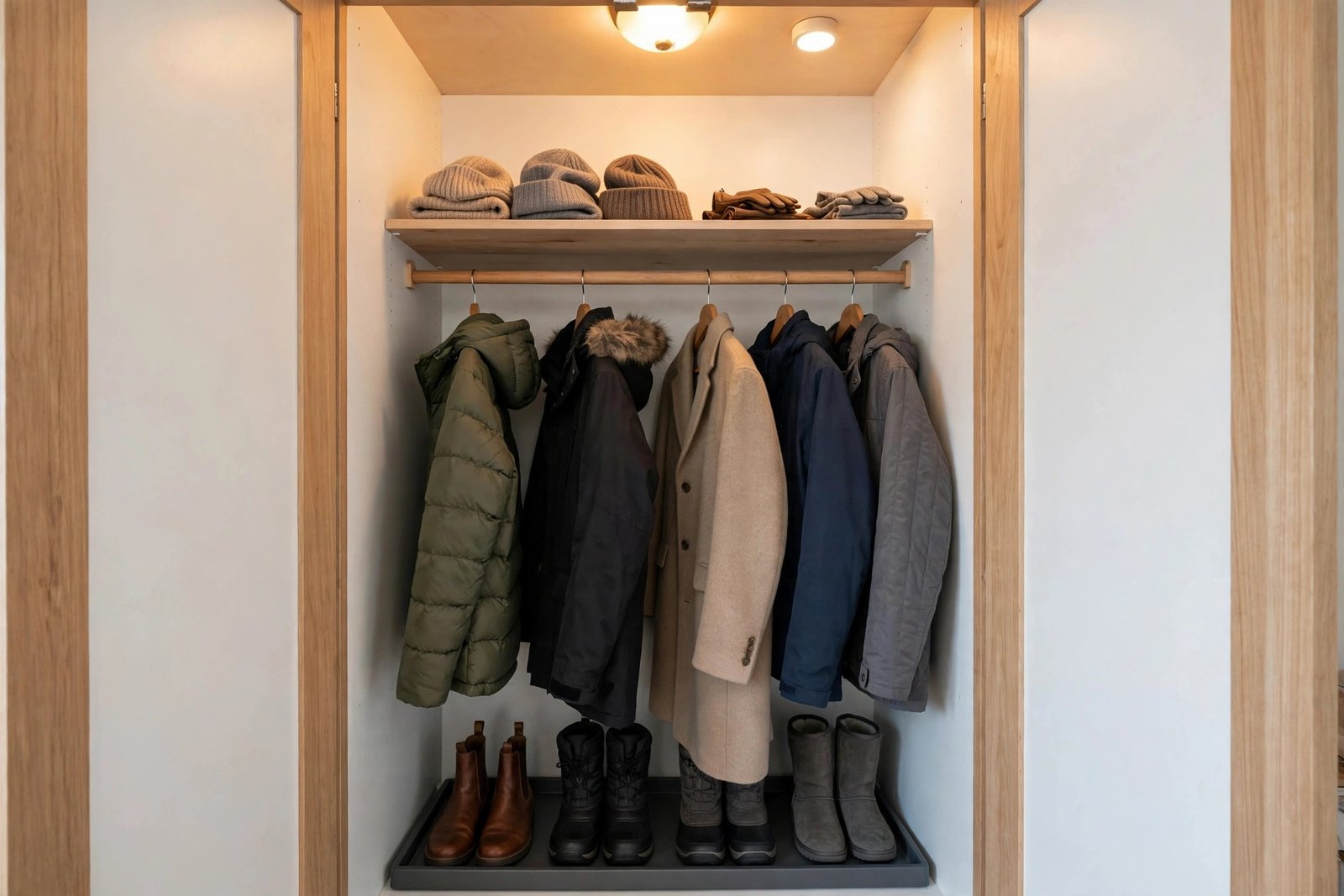
A standard coat closet is 24 inches (61 cm) deep, 36 inches (91 cm) wide, with the rod at 66 to 70 inches (168–178 cm) off the floor, measured to the center of the rod. Those three numbers fit long overcoats with clearance to spare, boots underneath, and hats on a shelf above. If your winters are serious, go 26–28 inches (66–71 cm) deep and 48 inches (122 cm) wide if the wall allows.
Don’t be fooled by the size: a coat closet is usually the smallest closet in the house, and it stores the bulkiest things you own. Winter parkas, long wool overcoats, rain jackets, plus boots, hats, gloves, and whatever your guests arrive wearing. A thick coat takes up roughly 4 inches of rod space, about double a dress shirt, so every inch of this little footprint matters.
Coat Closet Dimensions at a Glance
| Dimension | Minimum | Comfortable | Why it matters |
|---|---|---|---|
| Interior depth | 24″ (61 cm) | 28–30″ (71–76 cm) | Thick winter coats need clearance so fabric doesn’t press against the door or back wall |
| Width | 36″ (91 cm) | 48″ (122 cm) | Determines how many coats actually fit; see the capacity chart below |
| Rod height | 66″ (168 cm) | 68–70″ (173–178 cm) | Long overcoats hang 44–52″; the rod must clear them plus boots below |
| Shelf above rod | 12″ clearance | 15–16″ (38–41 cm) | Room for hats, gloves, and bins without crushing them |
| Top shelf height | ~80″ (203 cm) | 80–84″ (203–213 cm) | Seasonal storage up high, out of the daily grab zone |
These are planning guidelines from closet designers and contractors, not building-code requirements: residential codes don’t dictate closet dimensions. The 24-inch depth matches the standard closet depth used across reach-in closets, and contractor Mike Costello (via Family Handyman) puts the standard coat closet at a minimum of 36 inches wide and 24 inches deep.
How Wide Should a Coat Closet Be?
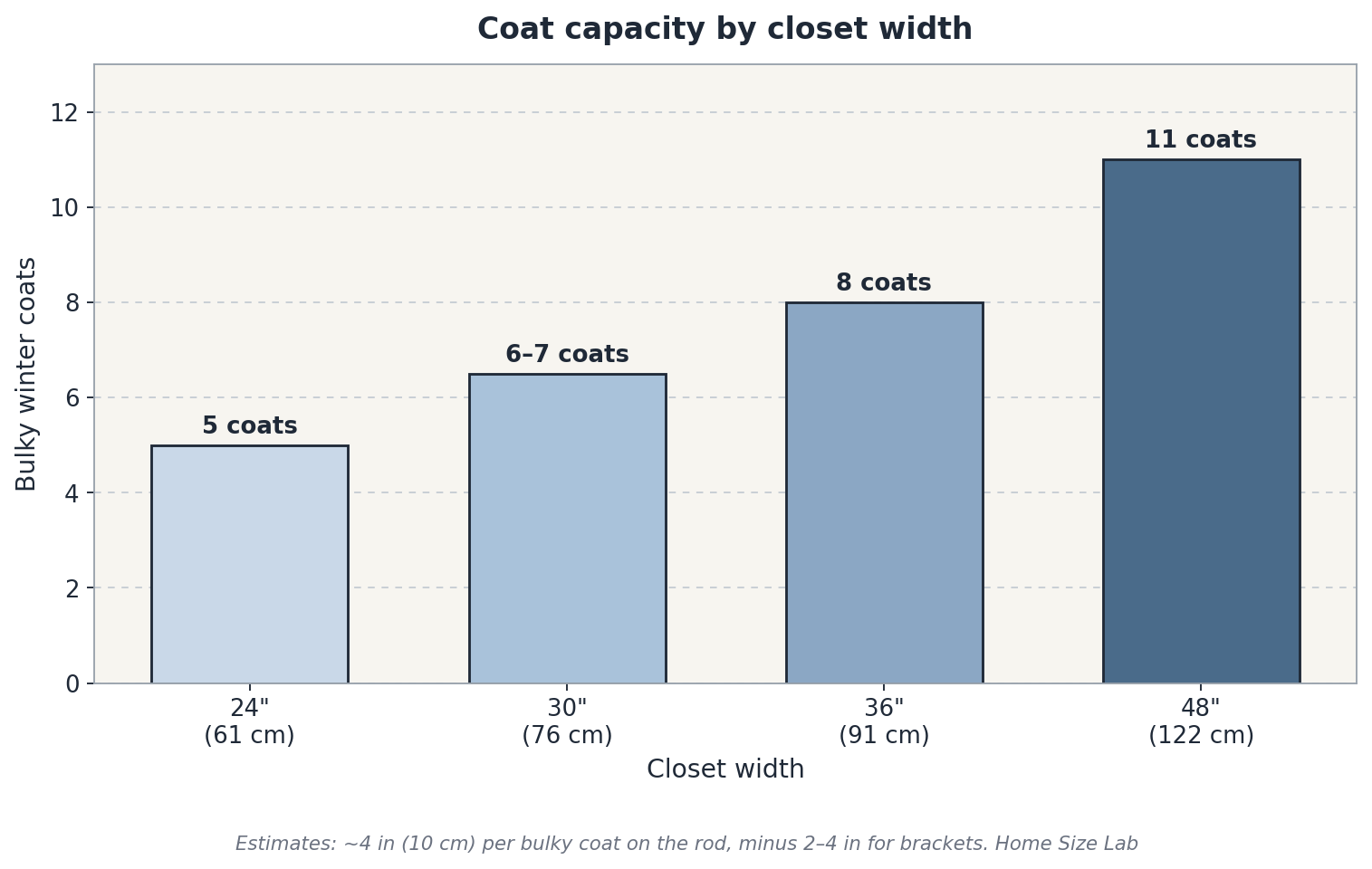
Width is really a capacity question: how many bulky coats need to live here? A thick winter coat takes up roughly 4 inches of rod space, about double a dress shirt, and brackets plus end caps eat another 2–4 inches of the rod. Do the math before you frame:
| Closet width | Usable rod length | Bulky-coat capacity | Best for |
|---|---|---|---|
| 24″ (61 cm) | ~20″ | 5 coats | Tight single-person entry; better than nothing |
| 30″ (76 cm) | ~26″ | 6–7 coats | One person with a real winter wardrobe |
| 36″ (91 cm) | ~32″ | 8 coats | The standard: a couple’s daily coats plus a guest or two |
| 48″ (122 cm) | ~44″ | 11 coats | Family entry with kids’ gear and guest overflow |
Thirty-six inches is the sweet spot for most homes. It’s the minimum width contractors quote, and it holds a genuine working wardrobe. Below 30 inches, you’ll be playing coat Tetris by January. One more practical point from Taskrabbit’s closet guide: a rod spans about 4–5 feet without a center support, but anything longer needs a middle bracket so it won’t sag under wet winter coats.
Rod Height for Coats: The Number That Matters Most
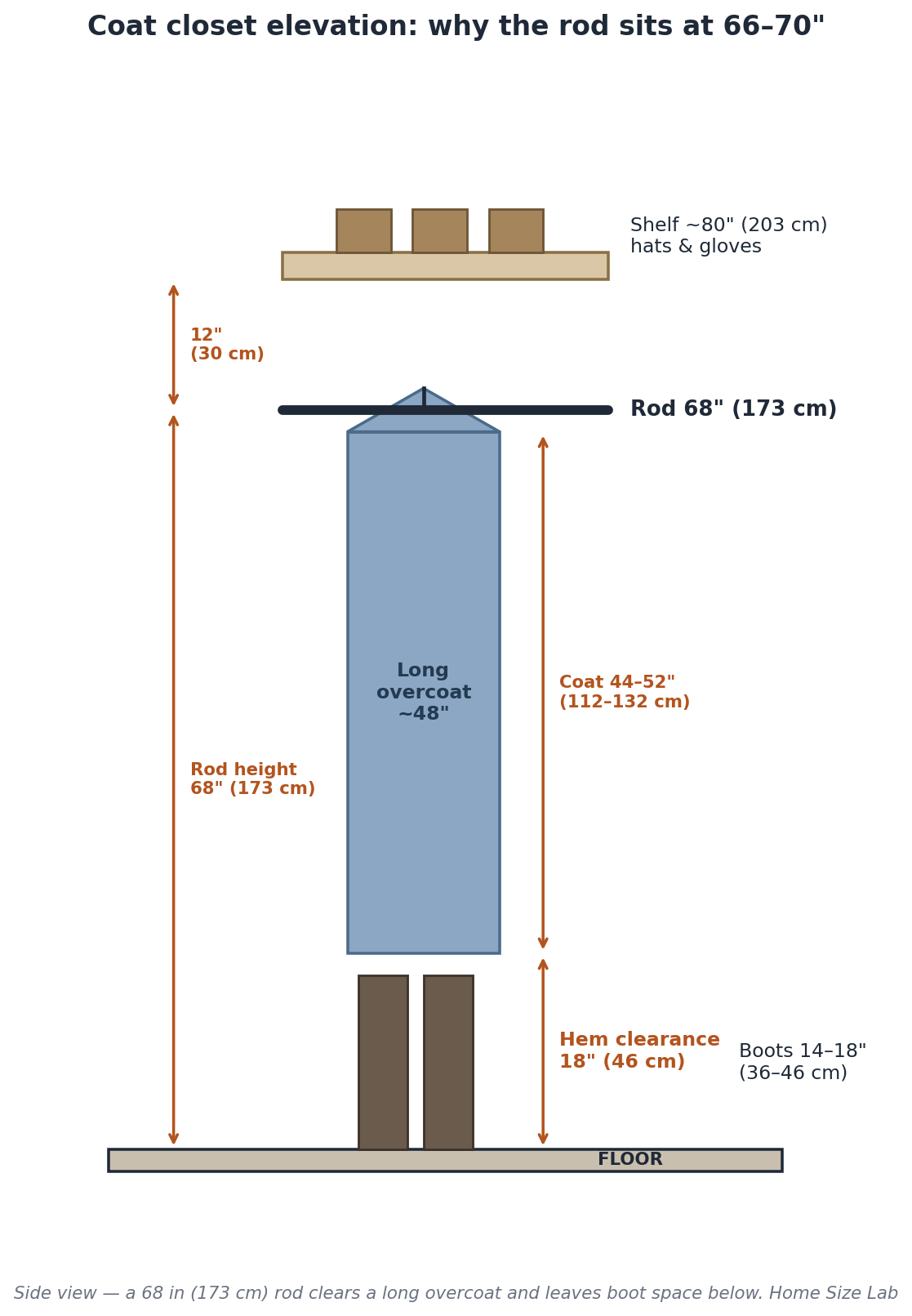
Here’s where coat closets split from bedroom closets. A bedroom rod at 60 inches handles shirts and suits fine; coats are longer and thicker, so the rod goes higher: 66 to 70 inches (168–178 cm) off the floor, measured to the center of the rod. Our closet rod height guide covers the full height chart for every closet type.
The math is straightforward. A long men’s overcoat runs about 44–52 inches from hanger to hem. Hang it on a rod at 68 inches and the hem lands roughly 16–24 inches off the floor, clear of the ground with room underneath for boots. Drop the rod to 60 inches and the same coat puddles on the floor or drapes across your boot tray. Taskrabbit’s closet specialists land in the same range, recommending 66–70 inches specifically for bulky winter coats in entry closets, with 66 inches as the baseline for most coats.
Above the rod, leave room for a shelf. Hats, gloves, scarves, and the summer gear that lives here in winter (sunscreen, bug spray) need about 12 inches of vertical clearance at minimum, though 15–16 inches is more honest. That puts the shelf itself around 80–84 inches off the floor: reachable for most adults, out of the daily grab zone.
Under the rod is boot territory. Tall winter boots run 14–18 inches high, and the 16–24 inches of clearance under a properly hung overcoat covers exactly that, with no wasted vertical space. Set a boot tray or low shoe rack underneath and the closet works as one system: coats above, boots below, hats on the shelf.
Minimum vs. Comfortable: Where to Spend Your Inches
If you’re working with an existing closet and can’t move walls, prioritize in this order:
- Depth first. If the closet is only 22 inches deep, bulky coats will brush the door every time it closes. No organizer fixes shallow, but slim velvet hangers cheat back about an inch per coat versus chunky wood ones.
- Rod height second. This one costs nothing during a refresh: moving a rod up to 68 inches instantly fixes coats dragging on the floor.
- Width third. More width is always nicer, but a well-organized 36-inch closet beats a chaotic 48-inch one. If width is fixed, guard every inch of rod: don’t let the vacuum or a stack of board games colonize one end.
The comfortable spec (28 inches deep, 48 inches wide, rod at 70 inches) is worth building toward in new construction or a full entryway renovation. In a retrofit, hitting the minimums with the rod at the right height gets you most of the way there.
How to Measure Your Coat Closet
1. Measure interior depth at three heights. Walls are never perfectly straight. Measure the inside depth at the floor, at rod height, and near the top, then plan from the smallest number. Baseboards can steal a full inch at the bottom, so measure above them.
2. Check what’s behind the back wall. Coat closets often back onto plumbing chases or stairwells. A 4-inch bump-out around a pipe turns 24 inches of depth into 20 inches of usable hanging, and that’s the difference between coats fitting and coats bunching.
3. Measure the door opening, not just the door. Bifold doors on a 36-inch closet typically give about 32–34 inches of clear access when open. You need to reach every hanger, so confirm your arm (and a bulky parka) actually fit through the opening.
4. Map the entry-door swing. Coat closets live by the front door, and front doors swing inward. Tape both arcs on the floor: if the entry door’s swing blocks the closet door, you’ll be shuffling past each other every time guests arrive. Flipping the closet door’s hinges, or switching to a bifold, often solves it.
5. Note the light. Most coat closets have no window and one dim bulb (or none). While you measure, check for a junction box for a light. Battery puck lights work, but a wired fixture is better in a closet you use with your hands full.
The Entry-Door Conflict (and How to Solve It)
The most common coat-closet complaint isn’t size, it’s choreography: the closet sits by the front door, the front door swings inward, and the two doors fight. Three fixes, in order of effort:
- Flip the closet door swing so it opens against the nearest wall instead of into the entry path. Free if the hinges allow it.
- Switch to a bifold or sliding door. A bifold needs almost no floor clearance and still gives decent access to a 36-inch closet.
- Move the closet rod to the side wall in very tight entries, so the door opens onto open floor rather than a wall of coats.
Common Mistakes to Avoid
Hanging the rod at bedroom height. A 60-inch rod works for suits but lets long coats touch the floor. In a coat closet, 66 inches is the floor, not the ceiling: go 68–70 inches if your household wears long overcoats.
Forgetting guest coats. Your daily coats might fit fine, but the closet’s real test is a dinner party in February: four extra parkas with nowhere to go. If width allows, keep 8–12 inches of rod in reserve, or park a freestanding coat rack nearby for overflow.
No boot plan. Coats get the rod; boots get the floor by default, which means a puddle-stained pile. A boot tray under the rod costs little and keeps the closet and entryway floor civilized.
Deep shelves above the rod. A 16-inch-deep shelf above a coat rod is fine; a 24-inch-deep one creates a dark cave where gloves disappear. Keep upper shelves at 12–16 inches deep so you can see and reach everything.
Blocking the rod ends. The last 6 inches at each end of the rod are prime real estate. Don’t surrender them to the broom, the step stool, or the vacuum: those belong in a utility closet.
Frequently Asked Questions
How deep should a coat closet be?
At least 24 inches (61 cm) of interior depth, the same as a standard reach-in closet. If your household wears bulky winter parkas, 28–30 inches is noticeably better: it keeps thick sleeves off the door.
What is the minimum width for a coat closet?
Thirty-six inches (91 cm). That fits about 8 bulky coats on the rod with room to slide them apart. A 30-inch closet works for one person; below that, you’ll need overflow by midwinter.
How high should the rod be for coats?
Sixty-six to 70 inches (168–178 cm) off the floor, measured to the center of the rod. That clears long overcoats (44–52 inches long) while leaving room for boots underneath. For comparison, our guide to closet rod height covers the lower heights used for shirts and suits in bedroom closets.
Can I store boots in a coat closet?
Yes, it’s the natural home for them. With the rod at 68 inches, hanging coats leave 16–24 inches of floor clearance, which fits tall winter boots. Add a boot tray to contain meltwater.
Do I need a double rod in a coat closet?
Usually not. Double rods suit shirts and pants in bedroom closets; coats are too long for a lower rod to be useful. One high rod plus a shelf above and boot space below is the right formula. Save double rods for the bedroom.
Should a coat closet have a light?
It should. You use this closet with your hands full, often in a windowless entry. A simple wired ceiling fixture, or a motion-sensor battery light at minimum, makes it far more usable.
Get the depth, width, and rod height right, and a coat closet punches far above its square footage. Start with 24 inches deep, 36 inches wide, and a rod at 68 inches, then adjust for your winters. And
if you’re planning the rest of the bedroom storage too, our standard closet depth guide covers the everyday reach-in numbers these entry measurements build on.
Last reviewed: October 7, 2026

2 Comments
Pingback: Closet Rod Height: Single, Double & Accessible
Pingback: Standard Closet Depth: Minimum & Ideal Sizes