



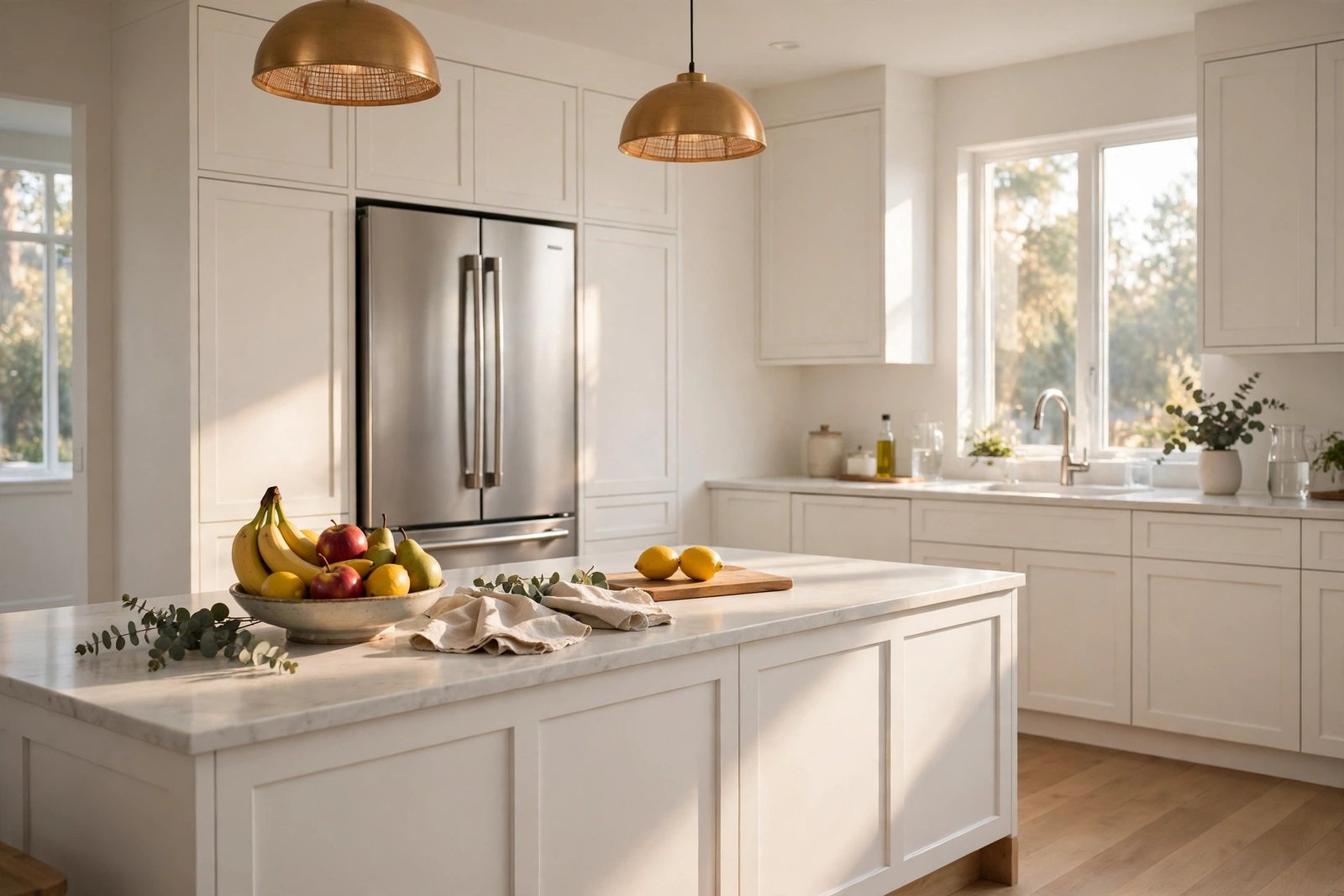
A refrigerator is not a 36 inch box. A 36 inch class French door fridge measures 35.75 inches wide, needs 1 inch of air on each side, and so needs a 38 inch opening: 35.75 + 1 + 1 = 37.75, rounded up to 38. Its doors and handles push it about 6 inches past the counter edge, and its open doors reach 43.38 inches from the wall. This guide sizes the fridge from those numbers, not the catalog headline.
Refrigerator dimensions at a glance
Every size below is a finished, installed size: width, height and depth including doors and handles unless the row says otherwise. Catalog pages often quote the cabinet box alone, which is 5 to 7 inches shallower than the fridge you actually walk past. Check which depth a listing means before comparing two models.
| Refrigerator type | Width | Height | Depth with doors and handles | Typical capacity |
|---|---|---|---|---|
| Top freezer | 28 to 33 in | 61 to 69 in | 28 to 34 in | 14 to 22 cu. ft. |
| Bottom freezer | 29 to 36 in | 67 to 70 in | 29 to 34 in | 19 to 25 cu. ft. |
| Side by side | 30 to 36 in | 65 to 71 in | 29 to 31 in | 20 to 28 cu. ft. |
| French door, standard depth | 30 to 36 in, up to 42 in | 67 to 71 in | 29 to 35 in | 20 to 30 cu. ft. |
| French door, counter depth | 30 to 36 in | 68 to 72 in | 28 to 31 in | 20 to 25 cu. ft. |
| Compact or apartment | 24 in, some 18 to 28 in | 60 to 75 in | 29 to 33 in | 11 to 14 cu. ft. |
Three patterns run through the whole table. Width is the most standardized dimension: full size fridges cluster at 30, 33 and 36 inches, because those are the three common opening widths builders frame. Height is the least standardized: a top freezer can stand 61 inches while a counter depth French door reaches 72. Depth is where the marketing lives: two fridges with the same width and height can differ by 6 inches of depth, and that difference decides whether the kitchen aisle still works.
The 38 inch opening rule
A fridge opening is not the fridge width. It is the fridge width plus the air the fridge needs on both sides, and that addition is what most shoppers skip.
Opening width = fridge width + left clearance + right clearance
Plan with 1 inch of clearance on each side. That is the generous end of the manufacturer range, and it is the figure that leaves room to slide the fridge out for cleaning and to open the doors without scraping a cabinet face. One manufacturer manual specifies 0.5 inch on each side and at the top, so 1 inch per side is a planning margin, not a bare minimum. The two worked examples below show why the rule matters.
- 36 inch class French door, 35.75 in wide: 35.75 + 1 + 1 = 37.75 inches. Round up to a 38 inch opening. A framed 36 inch opening leaves 36 – 35.75 = 0.25 inch total, or 0.125 inch per side, which is the spec sheet minimum for one built in model and no room at all for an out of square wall or a thick cabinet panel.
- 33 inch class fridge, 32.75 in wide: 32.75 + 1 + 1 = 34.75 inches. Round up to a 35 inch opening. A 33 inch opening gives 33 – 32.75 = 0.25 inch total, the same trap one size down.
- 30 inch class fridge, nominal 30 in wide: 30 + 1 + 1 = 32 inches. A nominal width gives a 32 inch opening; use the model spec width when it is published, since class widths run slightly under nominal.
The same addition governs height:
Opening height = fridge height to the top of the hinge + top clearance
Take a verified counter depth model: height to the top of the door is 70.5 inches and height to the top of the hinge is 69.88 inches. Add 1 inch of top clearance to the door height and the opening needs 70.5 + 1 = 71.5 inches. In a 72 inch tall opening that leaves 72 – 70.5 = 1.5 inches spare, which is comfortable. In a 70 inch opening the same fridge does not fit at all, even though a 69 inch case height might have suggested it would. Always measure to the hinge and door top, never to the case alone: the case of that same model is only 69 inches tall, a full 1.5 inches below the door top.
Counter depth vs standard depth: the flush myth
Counter depth is the volume driver in this keyword set, and it is also the most misunderstood label in the aisle. The honest version has three depths, not one, and they come from one verified spec sheet.
| Depth measure, GE Cafe counter depth French door | Inches | What it means |
|---|---|---|
| Case depth without door | 24.38 in | The box alone, and the only figure that sits flush with a 24 in cabinet |
| Depth with door, less handle | 30.25 in | Add the door: 30.25 – 24.375 = 5.88 in of door (case depth shown rounded as 24.38) |
| Depth with door and handle | 31.25 in | Add the handle: 31.25 – 30.25 = 1 in of handle |
A standard base cabinet is 24 inches deep and its countertop nose adds about 1.5 inches, so the counter edge sits 24 + 1.5 = 25.5 inches from the wall. Run the protrusion math against that edge:
- Counter depth with handles: 31.25 – 25.5 = 5.75 inches past the counter edge. Against the cabinet face it is 31.25 – 24 = 7.25 inches.
- Standard depth, same brand family, 37.5 in deep: 37.5 – 25.5 = 12 inches past the counter edge.
- Depth saved by going counter depth: 37.5 – 31.25 = 6.25 inches.
So a counter depth fridge is not flush. Its box is flush and its doors and handles still stand about 6 inches proud of the counter. Guides that promise a 1 to 2 inch protrusion are measuring to the cabinet face with the doors off or quoting the box depth as if it were the whole fridge. The 6.25 inches you save is still worth real money in aisle space, as the next section shows, but budget for 6 inches of protrusion, not zero.

What the protrusion does to your aisle
This is where the fridge stops being an appliance choice and becomes a kitchen layout choice. Measure the aisle from the counter edge, because that is how kitchen clearances are drawn, then subtract the fridge protrusion to find the aisle you actually walk through.
| Aisle at the counter edge | Counter depth fridge face | Standard depth fridge face |
|---|---|---|
| 42 in work aisle | 42 – 5.75 = 36.25 in | 42 – 12 = 30 in |
| 48 in two cook aisle | 48 – 5.75 = 42.25 in | 48 – 12 = 36 in |
A 36 inch walkway is the minimum for passing with no work activity, and 42 inches is the one cook work aisle. In a 42 inch aisle, the counter depth fridge leaves 36.25 inches, just above the walkway minimum. The standard depth fridge leaves 30 inches, below it: two people cannot pass, and a person carrying a hot pan has to turn sideways. In a 48 inch aisle both work, and the standard depth fridge still leaves exactly the 36 inch minimum. The rule that falls out: a standard depth fridge needs a 48 inch aisle at the fridge, while a counter depth fridge gets by in a 42 inch aisle. Our guide to kitchen island clearances sets those 36, 42 and 48 inch aisle figures and shows how they stack up around an island; the fridge face, not the counter edge, is the number to carry into that math.
Counter depth also costs capacity. At the same width, a counter depth model holds roughly 3 to 5 fewer cubic feet than its standard depth twin, because the missing depth has to be made up in height and width and it never fully is. The manufacturer ranges tell the same story: counter depth runs 15 to 25 cubic feet with an average near 22, while standard depth runs 20 to 28 cubic feet. Counter depth models run taller for exactly this reason, 68 to 72 inches against 61 to 72 for standard depth, trading height for the depth they gave up. If your household needs 25 cubic feet or more, check the capacity before falling for the flush look.
Dimensions by door style
Door style decides the swing, the shelf width and the drawer reach, so pick it by the room, not by the showroom.
Top freezer
The narrowest and shortest full size style: 28 to 33 inches wide, 61 to 69 inches tall, 28 to 34 inches deep, 14 to 22 cubic feet. One wide door swings the full width, so a 33 inch top freezer needs a 33 inch swing radius in front of it. It suits small kitchens, rentals and second fridges, and its low height fits under wall cabinets that a 70 inch French door would hit.
Bottom freezer
Fresh food at eye level, freezer drawer below: 29 to 36 inches wide, 67 to 70 inches tall, 29 to 34 inches deep, 19 to 25 cubic feet. The single fresh food door swings the full width like a top freezer, so the same swing radius applies, but the pull out freezer drawer needs clear floor in front: the drawer plus your standing room, about 24 inches minimum in front of the fridge, and more if the drawer must come fully out for cleaning.
Side by side
Two tall narrow doors, fridge on one side and freezer on the other: 30 to 36 inches wide, 65 to 71 inches tall, 29 to 31 inches deep, 20 to 28 cubic feet. Each door is about half the width, so a 36 inch side by side swings two 18 inch doors: 36 / 2 = 18 inches per door. That narrow swing is the style's real advantage in a tight kitchen or a galley where a full width door would hit an island or a wall. The cost is shelf width: neither side fits a wide pizza box or a party platter flat.
French door
Two narrow fresh food doors on top and a freezer drawer below: 30 to 36 inches wide in the common sizes, up to 42 inches in the widest models, 67 to 71 inches tall, 29 to 35 inches deep, 20 to 30 cubic feet. Each door is half the width, so a 35.75 inch French door swings two doors of 35.75 / 2 = 17.88 inches each. The wide fresh food compartment fits platters and sheet pans flat, which is why this style dominates the 36 inch class. A verified example: a Samsung counter depth French door measures 35.75 inches wide, 70 inches tall and 30.25 inches deep with 25 cubic feet, and an LG counter depth French door measures 35.75 inches wide, 70.25 inches tall and 29.88 inches deep with 23.7 cubic feet. Same class, same width, 1.3 cubic feet apart: always compare the spec sheet, not the class name.
Compact and apartment
Apartment fridges run about 24 inches wide, 60 to 75 inches tall and 29 to 33 inches deep, with 11 to 14 cubic feet. They suit one or two people, kitchenettes and offices. The trap is the same as full size: a 24 inch wide compact in a 24 inch opening leaves no ventilation gap, so plan a 26 inch opening (24 + 1 + 1 = 26) and check the height, since some tall compacts reach 75 inches.
What size refrigerator do you need: capacity by household
Capacity is measured in cubic feet, and the planning rule used across buying guides is 4 to 6 cubic feet per adult. Run it for your household, then adjust for how you shop.
| Household | Planning math | Recommended capacity |
|---|---|---|
| 1 to 2 people | 2 x 4 = 8 to 2 x 6 = 12, plus staples base | 10 to 16 cu. ft. |
| 3 to 4 people | 4 x 4 = 16 to 4 x 6 = 24 | 18 to 24 cu. ft. |
| 5 or more people | 5 x 4 = 20 to 5 x 6 = 30, plus bulk | 25 cu. ft. or more |
A family of four lands at 16 to 24 cubic feet by the per person rule, and the published household bands agree: 18 to 24 cubic feet for three to four people. Bulk shoppers should add one person's share, 4 to 6 cubic feet, to the household figure: a four person bulk shopping household plans for 16 + 4 = 20 cubic feet at the low end and 24 + 6 = 30 cubic feet at the high end, which pushes the choice into the 25 cubic foot class. Entertainers and meal preppers add the same way. Note what the rule does not cover: freezer share. A household that freezes in bulk needs the freezer fraction checked separately, because two 22 cubic foot models can split fresh and frozen very differently.
Tie capacity back to width. A 25 cubic foot or larger fridge is almost always a 36 inch class model, and a 36 inch class model needs the 38 inch opening from the first section. Buying the capacity first and discovering the opening second is the most common sizing failure in this category. Size the opening, then pick the capacity that fits it.
Clearance: ventilation, walls and the front
A fridge makes heat every hour it runs, and the clearances are how that heat escapes. They are also what lets the doors open and the fridge slide out. Use the planning figures below, which sit at the generous end of the manufacturer range so an out of square wall does not eat the whole margin.
| Zone | Planning clearance | Manufacturer basis |
|---|---|---|
| Each side | 1 in | Manuals specify 0.5 in minimum; 1 in is the planning figure |
| Top | 1 in | Manuals specify 0.5 to 1 in |
| Behind, for air and cords | 1 to 2 in | Manuals specify 1 in; guides allow up to 2 in for water lines |
| Hinge side, next to a fixed wall | 3.75 in | One manufacturer manual specifies 3.75 in minimum so the door swings |
| In front, to open doors and drawers | 24 in | One manufacturer spec sheet requires at least 24 in in front |
Three details hide inside that table. First, the back clearance is not just air: an ice maker water line and the power cord live there, so a fridge pushed tight to the wall kinks the line and traps heat at the same time. Second, the hinge side clearance only matters next to a fixed wall or a deep cabinet: in open space the door swings free, but against a wall the door edge and handle need that 3.75 inches or the door cannot reach 90 degrees and the crisper drawers cannot come out. Third, the top clearance matters twice: it vents heat and it is the only way to slide the fridge out without scraping the cabinet above. A fridge under a 70 inch cabinet soffit with a 70.5 inch door height is already a failed fit before ventilation is even discussed.
Door swing and open depth, worked
Closed depth flatters every fridge. Open depth is what you live with, and one verified spec sheet gives all three numbers for the same model.
- Depth with doors closed, handles included: 31.25 inches.
- Depth with fresh food doors open 90 degrees: 43.38 inches. The doors add 43.38 – 31.25 = 12.13 inches beyond the closed front.
- Width with doors open 90 degrees, handles included: 44.75 inches. The open doors add 44.75 – 35.75 = 9 inches beyond the closed width, all on the hinge side.
Carry those numbers into the aisle math. With the counter edge 25.5 inches from the wall, open doors reach 43.38 – 25.5 = 17.88 inches past the counter edge into the room. In a 42 inch aisle that leaves 42 – 17.88 = 24.12 inches of passage with the doors open, which is exactly the 24 inch front clearance one manufacturer requires, and no more. If an island sits opposite the fridge, the island edge, not the far counter, is the number the open doors meet: a 36 inch gap from the fridge counter edge to the island leaves 36 – 17.88 = 18.12 inches with the doors open, too tight to stand in while loading groceries. Size the fridge aisle for open doors, not closed doors.
Drawer models add a second swing check. A bottom freezer drawer pulls straight out toward you, and a French door freezer drawer is the widest drawer in the kitchen: it needs its full depth of travel plus your body in front of it. If the fridge faces an island, the drawer travel plus standing room is the binding number, not the door swing. Measure the drawer travel from the spec sheet where it is published; where it is not, allow the full closed depth again in front of the fridge as a planning figure.
Storage beside the fridge
A fridge rarely stands alone in the run. The gap beside it usually holds a pull out cabinet, a tall pantry cabinet or a broom closet, and each has its own depth that must be planned against the fridge depth, not copied from it. A pull out pantry cabinet runs 12 to 18 inches wide and 24 inches deep, which sits neatly beside a counter depth box but stands 6 to 7 inches shallower than the fridge doors. That step is normal and useful: the shallower cabinet gives your hand room at the fridge handle. Our guide to pantry dimensions sizes those pull out and tall cabinet pantries, including the 12 to 16 inch shelf depths that decide whether a cabinet beside the fridge actually holds anything. Do not size the filler strip from the fridge width: size it from the opening math in the first section, so the fridge plus its clearances plus the filler equal the run width exactly, with no leftover sliver and no squeezed door.
How to measure for a refrigerator
Measure the space, not the old fridge. Old fridges shrink in memory and grow in spec sheets, and the new fridge is the only number that matters.
- Measure the opening width in three places: at the floor, at counter height and at the top of the opening. Use the smallest reading. Walls lean and cabinets bow, and the smallest reading is the one the fridge must pass.
- Measure the opening height to the lowest obstruction: the cabinet above, the soffit, a light valance or a trim piece. Compare against the door top height, not the case height.
- Measure the opening depth from the wall to the counter edge, then add the protrusion math: closed depth with handles minus 25.5 inches of counter gives the inches the fridge will stand into the room.
- Measure the hinge side gap: if a wall or tall cabinet sits beside the fridge, confirm 3.75 inches on the hinge side, or plan to pull the fridge forward so the door clears.
- Measure the front clearance: 24 inches minimum in front of the fridge for doors and drawers, and recheck it with the doors open using the open depth figure.
- Walk the delivery route: every doorway, hallway, stair turn and elevator on the path from the truck to the kitchen, measured as clear openings, not frame sizes.
- Write down the four numbers for the model you buy: width, height to the door top, depth with handles, and depth with doors open 90 degrees. If the listing gives only one depth, find the spec sheet before ordering.
Delivery: the check that fails after the sale
A fridge that fits the kitchen can still fail the hallway. One manufacturer manual sets the delivery rules plainly: a minimum door opening of 33 inches is required, and if the opening is 36 inches or less, the doors, drawers and hinges must come off. Run that against a 36 inch class fridge.
- Carried face forward, width first: 35.75 inches of fridge against a 33 inch opening fails by 35.75 – 33 = 2.75 inches.
- Carried on its side, depth first: 31.25 inches of depth against a 33 inch opening passes with 33 – 31.25 = 1.75 inches to spare, which is why delivery crews turn the box and why the manual's door removal rule exists.
- Doors removed: the depth falls to the case depth of 24.38 inches, saving 31.25 – 24.38 = 6.87 inches and turning a failed doorway into a comfortable pass.
The full route check, corners and stair turns included, is a separate job, and our guide to the delivery route check runs it step by step for any large piece. For a fridge, add two checks that guide does not emphasize: confirm the water line shutoff location before delivery day, since the crew needs the line connected before the fridge slides into its final 1 to 2 inches of back clearance, and confirm the floor can take a loaded appliance dolly without denting, especially on softwood or vinyl plank.
Common refrigerator mistakes
- Buying the class, not the model. A 36 inch class fridge can be 35.75 inches wide or 35.87 inches wide, and its depth with handles can run from 28.75 to 31.25 inches. The class name is a label, not a dimension.
- Quoting the box depth as the fridge depth. The box is 24.38 inches. The fridge you walk past is 31.25 inches. The 6.87 inch gap between those figures is the door and the handle, and it is the gap that breaks aisles.
- Fitting the width and forgetting the height. A 70.5 inch door top under a 70 inch soffit is a return, not a tight fit. Hinge height and door height are different numbers and both are on the spec sheet.
- Ventilating to the minimum. Half an inch per side is a spec sheet minimum for one model, not a planning figure for a wall that is out of square. Plan 1 inch per side and keep it.
- Ignoring the open doors. A 42 inch aisle is generous until the doors open 17.88 inches into it and leave 24.12 inches to stand in. Size aisles for open doors.
- Forgetting the water line. A fridge with an ice maker needs the line, the shutoff and the back clearance all planned before it slides in, because none of them is reachable afterwards.
Frequently asked questions
What are standard refrigerator dimensions?
A standard full size refrigerator runs 30 to 36 inches wide, 65 to 72 inches tall and 30 to 36 inches deep with doors and handles, holding 20 to 28 cubic feet. The most common single size is the 36 inch class: about 35.75 inches wide, about 70 inches tall and about 31 inches deep in counter depth form or about 35 inches deep in standard depth form. There is no single official standard size; the class widths of 30, 33 and 36 inches are the de facto standards because builders frame those openings.
How wide is a refrigerator?
Most full size refrigerators are 30, 33 or 36 inches wide, measured as the cabinet width, with actual models at 35.75 inches in the 36 inch class. Counter depth and standard depth models share the same width classes; depth is where they differ, not width. Apartment models run about 24 inches wide, and the widest French door models reach 42 inches. Add 1 inch of clearance on each side to get the opening width: a 35.75 inch fridge needs a 38 inch opening.
What is a counter depth refrigerator?
A counter depth refrigerator has a cabinet box about 24 to 25 inches deep, so the box sits flush with standard 24 inch base cabinets. With doors and handles the total depth runs 28 to 31 inches, so it still stands about 6 inches past the counter edge. Counter depth models run 30 to 36 inches wide, 68 to 72 inches tall and hold 15 to 25 cubic feet, averaging near 22. They trade 3 to 5 cubic feet of capacity against standard depth for the slimmer profile.
How much clearance does a refrigerator need?
Plan 1 inch on each side, 1 inch on top and 1 to 2 inches behind for ventilation, cords and the water line. Next to a fixed wall, allow 3.75 inches on the hinge side so the door can swing to 90 degrees. In front, allow at least 24 inches for doors and drawers to open. Manufacturer minimums run lower, 0.5 inch on the sides and top for some models, but the planning figures above leave room for out of square walls and for sliding the fridge out to clean behind it.
How deep is a counter depth refrigerator with handles?
About 30 to 31 inches in the common 36 inch French door class: one verified model measures 30.25 inches with the door and 31.25 inches with the handle, against a case depth of 24.38 inches without the door. The handle alone adds about 1 inch and the door adds about 5.88 inches to the box. Measure depth with handles for aisle math, because the handle is the part your hip meets.
Will a 36 inch refrigerator fit in a 36 inch opening?
Usually not with proper clearance. A 36 inch class fridge measures about 35.75 inches wide, leaving 0.25 inch total in a 36 inch opening, or 0.125 inch per side. That matches one spec sheet minimum and leaves nothing for an out of square wall. With the 1 inch per side planning clearance, the same fridge needs 35.75 + 1 + 1 = 37.75 inches, rounded up to a 38 inch opening. If the opening is already framed at 36 inches, pick a narrower model or accept the bare minimum clearance and check the wall is square first.
Sources
- Whirlpool counter depth refrigerator measurements guide: counter depth 24 to 30 inches deep excluding handles, 15 to 25 cubic feet averaging about 22, standard depth 31 to 36 inches deep and 20 to 28 cubic feet
- Angi refrigerator sizes and dimensions guide: standard sizes 24 to 36 inches wide and 60 to 75 inches high, 4 to 6 cubic feet per person, household bands 1 to 2 people 4 to 13 cubic feet, 3 to 4 people 14 to 24 cubic feet, 5 or more 25 cubic feet or more, counter depth 23 to 29 inches deep
- Town Appliance standard fridge sizes guide: standard 65 to 69 inches tall, 30 to 36 inches wide, 28 to 34 inches deep, counter depth 69 to 71 inches tall and 24 to 30 inches deep, style table by door type, clearance about 1 inch sides and top and about 2 inches at the back
- Fridge.com standard vs counter depth refrigerator comparison: standard 30 to 36 inches wide, 65 to 70 inches tall, 28 to 34 inches deep, counter depth cabinet 24 to 25 inches without doors and 24 to 30 inches overall
- GE Cafe counter depth French door specification sheet: model CWE23SSH, width 35.75 inches, height to door top 70.5 inches, hinge 69.88 inches, case 69 inches, case depth without door 24.38 inches, depth less handle 30.25 inches, with handle 31.25 inches, depth with door open 90 degrees 43.38 inches, width with door open 90 degrees 44.75 inches, side clearance 0.125 inch
- KitchenAid French door refrigerator installation manual: 0.5 inch each side and top, 1 inch behind, 3.75 inches to a fixed wall for door swing, minimum delivery door opening 33 inches, doors and drawers removed when the opening is 36 inches or less
- Engineer Fix refrigerator door clearance guide: 1 to 2 inches behind for ventilation, 0.5 to 1 inch top, hinge side attention for 90 degree and wider swings, drawer removal needs wider than 90 degrees
- Engineer Fix standard fridge opening dimensions guide: common opening widths 30, 33 and 36 inches, openings built for units up to 70 to 72 inches tall, standard depth 30 to 35 inches including door and handles
- Engineer Fix refrigerator capacity and space guide: 4 to 6 cubic feet per adult, four person household 16 to 24 cubic feet by that rule, bulk shoppers add 4 to 6 cubic feet
- LG counter depth French door refrigerator listing with spec sheet figures: model LF24Z6330S, 35.75 inches wide, 70.25 inches tall, 29.88 inches deep, 23.7 cubic feet, spec sheet requires at least 24 inches in front and at least 2 inches behind
- Samsung counter depth French door refrigerator listing: model RF27CG5900SR, 35.75 inches wide, 70 inches tall, 30.25 inches deep, 25 cubic feet

1 Comment
Pingback: Kitchen Sink Dimensions: 33×22 Is Standard (Cabinet-Minus-3 Rule)