



A standard office chair has a seat height of 16 to 21 inches, a seat width of 17 to 20 inches, a seat depth of 15 to 20 inches, and an overall height of 35 to 52 inches. The number that matters most is not in that chart: seat height plus armrest height must stay at or under 28 inches, or the arms will not slide under a 29-inch desk. This guide runs the fit math the standard charts skip.
What are office chair dimensions?
Office chair dimensions describe the seat height, seat width, seat depth, backrest height, armrest height, overall height, and base diameter of a chair built for desk work. Every figure below is in inches, measured the industry-standard way: seat height from the floor to the top of the uncompressed seat, width across the usable sitting surface, depth from the front edge to where the seat meets the backrest, backrest and armrest heights measured up from the seat, and base diameter across the casters.
Two things separate office chairs from every other chair in the house. First, the seat height adjusts: a gas cylinder typically covers 5 or more inches, so one chair can serve several body sizes. Second, the chair must fit a second object, the desk, and that pairing is where most buying mistakes happen. The sections below cover the standard numbers first, then the desk math that decides whether the chair works in your room.
Office chair dimensions chart
| Measurement | Standard range | How to measure |
|---|---|---|
| Seat height | 16 to 21 in | Floor to top of uncompressed seat |
| Seat width | 17 to 20 in | Across the usable sitting surface |
| Seat depth | 15 to 20 in | Front edge to backrest |
| Backrest height | 16 to 24 in above seat | Seat top to top of backrest |
| Armrest height | 7 to 10 in above seat | Seat top to top of arm pad |
| Overall height | 35 to 52 in | Floor to top of backrest |
| Overall width | 26 to 28 in | Widest point, usually the base or arms |
| Base diameter | 24 to 30 in | Across the casters |
The ranges are wide because office chairs are adjustable by design. A chair at the bottom of the seat-height band with the cylinder down is a different chair from the same model with the cylinder up, and the buying decision is about the range, not a single number.
Chair types shift the band. The comparison below follows the per-type figures published by ergonomic chair makers and reviewers:
| Chair type | Seat height | Seat width | Seat depth | Backrest height |
|---|---|---|---|---|
| Task chair | 16 to 21 in | 17 to 20 in | 15 to 18 in | 12 to 18 in above seat |
| Ergonomic chair | 16 to 22 in | 18 to 22 in | 16 to 20 in | 20 to 28 in above seat |
| Executive chair | 18 to 22 in | 20 to 24 in | 18 to 22 in | 24 to 30 in above seat |
| Conference chair | 17 to 21 in | 18 to 22 in | 16 to 19 in | 16 to 22 in above seat |
Executive chairs run wider and deeper because they are built for larger frames and longer sits, not because the standard moved. If your desk setup is a normal home office, the task and ergonomic rows are the ones that apply.
Office chair seat height
Seat height is the only office chair dimension governed by your body rather than your room. The rule is the popliteal rule: the seat should sit at about your lower-leg length, so your feet rest flat on the floor and your knees bend near 90 degrees. Too high and your feet dangle, cutting circulation behind the knees. Too low and your knees rise above your hips, rounding your lower back.
Most adjustable chairs cover the full standard band with one cylinder, so the question is rarely whether the chair adjusts far enough. It is whether the middle of its range lands on your leg length. Use these starting points, derived from the manufacturer size bands in the Aeron and Leap section below:
| Your height | Seat height starting point |
|---|---|
| Under 5 ft 3 in | 15 to 17 in |
| 5 ft 3 in to 5 ft 11 in | 17 to 19 in |
| 6 ft and over | 19 to 21 in |
Treat the table as a starting point, not a prescription. Two people at the same height with different leg-to-torso ratios need different seat heights, and the sit test decides: feet flat, knees near 90 degrees, no pressure behind the knees. Measure seat height at the front edge of the seat, on the uncompressed cushion, because foam settles once you sit.
How wide and deep should an office chair seat be?
Seat width follows your hips, not your shoulders. Measure your hip width sitting down, then add 1 to 2 inches per side for movement. That lands most adults in the 17 to 20 inch standard band. Executive chairs at 20 to 24 inches exist for broader frames, but a seat much wider than your hips is not more comfortable: it lets you slide sideways off the lumbar support.
Seat depth follows your thigh, and the rule is a subtraction:
Knee gap = thigh length minus seat depth, and it must land between 2 and 4 inches.
The gap is the clearance between the back of your knees and the front edge of the seat. Less than 2 inches and the seat edge presses into the back of your knees. More than 4 and your lower back loses contact with the backrest unless you perch forward.
Worked examples:
- A 20-inch thigh on a 17-inch seat: 20 minus 17 equals 3 inches of gap. Passes.
- A 19-inch thigh on an 18.5-inch fixed seat: 19 minus 18.5 equals 0.5 inches of gap. Fails. Size down or pick an adjustable-depth chair.
- A 21-inch thigh on a 16-inch seat: 21 minus 16 equals 5 inches of gap. Too much. Size up or slide the seat pan forward if the chair allows it.
Depth adjustability is the feature that decides this section. Some chairs, like the Steelcase Leap, slide the seat pan from 15.75 to 18.75 inches, so one chair covers all three examples above. Others, like the Herman Miller Aeron, fix the depth per size at 16, 17, or 18.5 inches, so choosing the size chooses the depth permanently. On a fixed-depth chair, measure your thigh before you order. On an adjustable-depth chair, verify the range covers your thigh minus 2 to 4 inches.
Backrest and armrest heights
Backrest height above the seat runs 16 to 24 inches on standard chairs, with 18 to 22 inches the typical band. Total backrest height matters less than where the lumbar support lands: it should meet the natural curve of your lower back, roughly a hand above the seat on most adults. Height-adjustable lumbar support beats a taller fixed backrest, because a tall backrest with lumbar support in the wrong place supports nothing.
Armrest height runs 7 to 10 inches above the seat. The comfort test is simple: with your forearms on the pads, your shoulders should hang relaxed, not shrugged and not drooping. Armrests that sit too high push your shoulders up all day. Armrests that sit too low leave your arms hanging, which pulls on your neck. Width between the arms matters too: pads should sit just outside your hips so your elbows rest near your sides, not splayed outward.
The desk fit math: the 28-inch rule
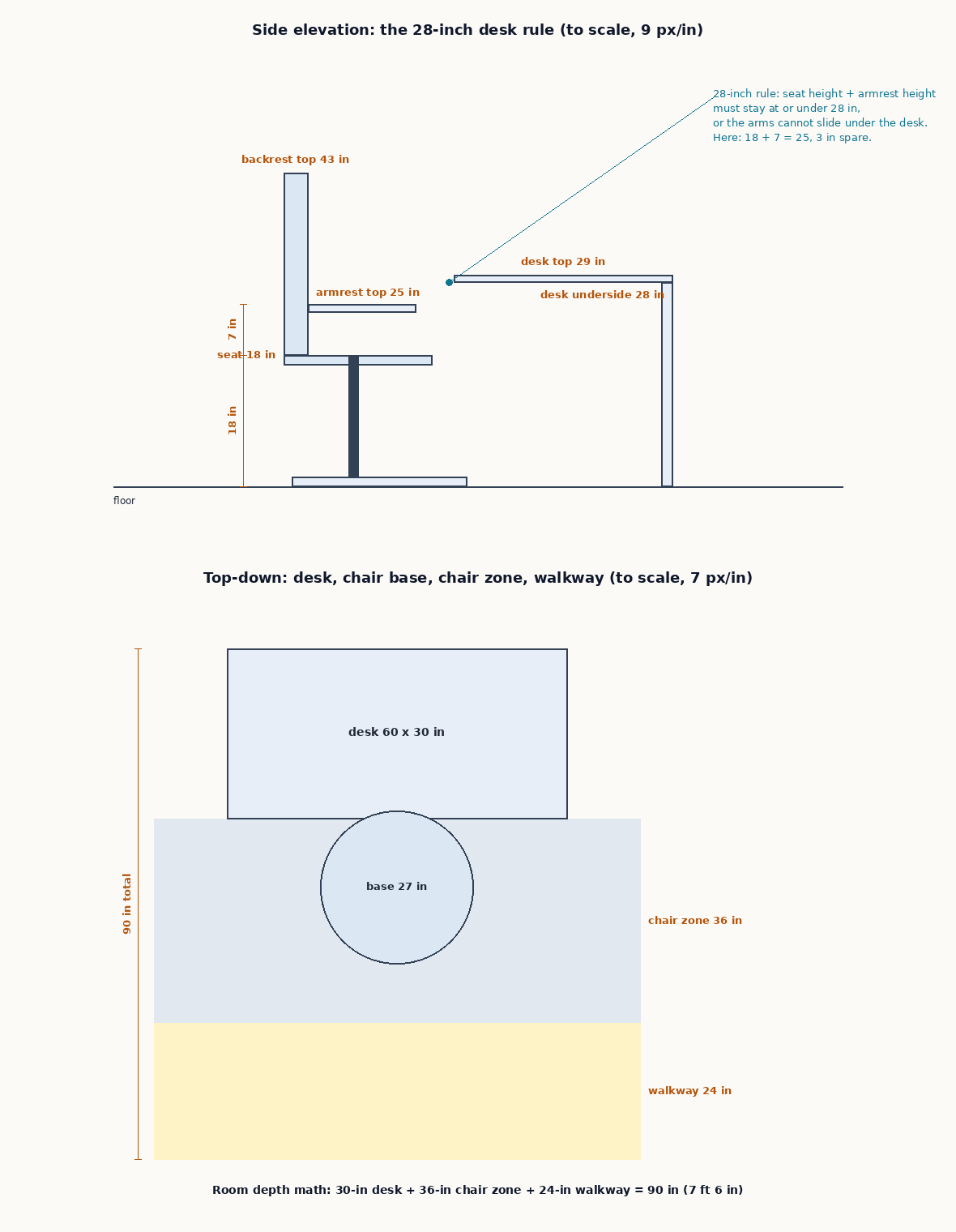
This is the section the standard charts skip, and it is the one that decides whether your chair works with your desk. A standard desk is 29 inches tall, and a 1-inch top leaves a desk underside at 28 inches. Desk heights and the full desk sizing chart live on our desk dimensions guide. The rule for the chair is:
Seat height plus armrest height must stay at or under 28 inches.
If the sum passes, the armrests slide under the desk and the chair tucks fully in. If it fails, the chair lives an inch or two out from the desk permanently, and your reach to the keyboard stretches with it.
Worked examples against a 29-inch desk:
| Seat height | Armrest height | Armrest top | Result |
|---|---|---|---|
| 18 in | 7 in | 25 in | Passes with 3 in to spare |
| 18 in | 10 in | 28 in | Exactly at the underside, grazes |
| 20 in | 10 in | 30 in | Fails by 2 in, arms cannot tuck |
| 16 in | 10 in | 26 in | Passes with 2 in to spare |
Two fixes, in order of preference: lower the seat until the sum passes, or drop the armrests if they adjust independently. Raising the desk is the last resort, and only height-adjustable desks allow it.
Thigh clearance under the desk is the second subtraction. Desk underside minus seat height is your thigh room: 28 minus 18 equals 10 inches at a common seat height, and 28 minus 21 equals 7 inches at the top of the band. Thighs run about 5 to 6 inches thick, so 10 inches passes with room and 7 inches passes but feels tight for thicker thighs. If your seat sits at the top of its range and your thighs graze the desk frame, the desk is too low for that seat height, not the other way around.
The elbow check closes the loop. Add roughly 10 inches to your seat height: the result should land at or just under your desktop height. An 18-inch seat gives elbows near 28 inches, 1 inch under a 29-inch desktop, which is the comfortable zone with forearms parallel to the floor. A 21-inch seat pushes elbows to about 31 inches, above the desktop, so shoulders lift to type. If your elbows land above the desktop, lower the seat first and re-run the 28-inch rule before blaming the desk.
Footprint and room math
A chair’s seat is not its footprint. Plan with the footprint: overall width 26 to 28 inches, overall depth 22 to 26 inches, base diameter 24 to 30 inches. The base is wider than the seat because five casters need a stable spread, and that spread decides how the chair moves, not how it sits.
Room depth is a separate budget from the desk. Our desk dimensions guide allows 33 to 36 inches of chair zone behind the desk, plus 24 inches of walkway if anyone passes behind you. The subtraction for a 30-inch desk:
- Desk plus chair zone: 30 plus 36 equals 66 inches, or 5 ft 6 in, with no walkway.
- Desk plus chair zone plus walkway: 30 plus 36 plus 24 equals 90 inches, or 7 ft 6 in.
- Minimum without a walkway: 30 plus 33 equals 63 inches, or 5 ft 3 in.
One apparent conflict resolves itself: a 27-inch base is wider than the 24-inch minimum knee opening under a desk, but the base sits on the floor, so it never competes with your knees. Pedestal drawers are the real knee-width limit, because they rise from the floor into the knee space. Check that at least 24 inches of clear knee width remains between them, and let the base roll where it wants.
Manufacturer sizes: Aeron and Leap
Published manufacturer specifications show how the standard bands play out on real chairs, and they expose the fixed-versus-adjustable depth split from the seat depth section.
| Model | Seat height | Seat depth | Seat width | Overall width | Fits |
|---|---|---|---|---|---|
| Herman Miller Aeron A | 14.75 to 19 in | 16 in, fixed | 25.75 in overall | 25.75 in | 4 ft 10 in to 5 ft 4 in |
| Herman Miller Aeron B | 16 to 20.5 in | 17 in, fixed | 27 in overall | 27 in | 5 ft 2 in to 6 ft |
| Herman Miller Aeron C | 16 to 20.5 in | 18.5 in, fixed | 28.25 in overall | 28.25 in | 5 ft 10 in to 6 ft 6 in |
| Steelcase Leap V2 | 15.5 to 20.5 in | 15.75 to 18.75 in, adjustable | 19.25 in | 27 in | Most adults, one frame |
The Aeron teaches the key lesson twice over. First, sizes B and C share the same 16 to 20.5 inch seat-height range: the difference between them is depth and width, not height. Second, Aeron depth is fixed per size, so a buyer between sizes must choose based on thigh length, not height alone. The Leap teaches the opposite lesson: one frame with an adjustable seat pan covers the depth range the Aeron splits across three sizes.
Weight capacities follow the same pattern. Most standard chairs rate up to 250 lbs. The Aeron rates 300 lbs in size A and 350 lbs in sizes B and C. The Leap is listed up to 400 lbs in its review spec listings. Check the spec sheet for the exact configuration you buy, because capacity varies by cylinder and base option.
How to measure an office chair
- Measure seat height at the front edge, floor to the top of the uncompressed seat. Compare against your lower-leg length with the popliteal rule.
- Measure seat width across the usable sitting surface, then overall width at the widest point, including the arms and base.
- Measure seat depth from the front edge to where the seat meets the backrest, then check whether the depth adjusts and across what range.
- Measure backrest height from the seat to the top of the backrest, and armrest height from the seat to the top of the arm pad.
- Measure the base diameter across the casters and the overall depth from the front of the seat to the back of the base.
- Run the desk math: seat plus armrest against 28 inches, desk underside minus seat for thigh room, and tape the footprint plus chair zone on the floor before ordering.
Office chairs versus dining chairs
Dining chairs are fixed-height furniture for a different job: 18 to 20 inch seats, 16 to 20 inch widths, and 16 to 18 inch depths, built to pair with a 28 to 30 inch table and never adjust. Our dining chair dimensions guide owns those numbers. Office chairs trade that fixed simplicity for adjustment: a 16 to 21 inch seat range, adjustable depth on better models, and armrests that must pass the 28-inch desk rule. If a chair in your home office never adjusts, judge it by the dining numbers. If it adjusts, judge it by this guide.
Commercial and reception seating
Reception desks add a second height that office chairs do not serve: a 42-inch transaction counter for standing visitors over a 28 to 30 inch work surface for the seated receptionist. The receptionist’s chair follows exactly the seat math in this guide, because the work surface is an ordinary desk height. The counter height is a standing height and no chair dimension applies to it. Our reception desk dimensions guide covers the counter, the ADA section, and the lobby clearances.
Frequently asked questions
What is the standard height of an office chair?
The seat adjusts from 16 to 21 inches on most chairs, and the overall height runs 35 to 52 inches from floor to top of backrest. The right seat height is the one that puts your feet flat on the floor with knees near 90 degrees, not a single number in the band.
What seat depth should I choose?
Subtract 2 to 4 inches from your thigh length. A 20-inch thigh wants a 16 to 18 inch seat depth. On a fixed-depth chair, pick the size whose depth lands in that window. On an adjustable-depth chair, check that its range covers your window.
Can office chair armrests fit under a desk?
Yes, if seat height plus armrest height stays at or under 28 inches for a standard 29-inch desk. An 18-inch seat with 7-inch armrests gives a 25-inch armrest top, 3 inches of spare room. A 20-inch seat with 10-inch armrests gives 30 inches, which fails by 2 inches.
How much space do you need behind a desk chair?
Allow 33 to 36 inches behind the desk for the chair, getting in, and pushing back, plus 24 inches of walkway if anyone passes behind you. A 30-inch desk with a full chair zone and walkway needs 90 inches, or 7 ft 6 in, of room depth.
What size office chair do I need if I am tall?
Start at a 19 to 21 inch seat height and check depth, not just height. Tall buyers most often fail on depth: a long thigh on a shallow seat leaves the lower back unsupported, and a short thigh on a deep fixed seat cuts circulation behind the knees. On fixed-depth chairs, the large size exists for exactly this buyer.
Sources
- Herman Miller store, Aeron Chair product page (manufacturer specifications: size A, B, and C seat heights, overall widths and heights, user height ranges, and weight capacities)
- Chair Dinkum, Herman Miller Aeron Review Australia (Herman Miller published specifications: fixed seat depths of 406, 432, and 470 mm per size and the size B and C width note)
- OfficeLogixShop, Steelcase Leap V2 Chair (Steelcase published Leap V2 specifications: seat height, functional seat depth, overall dimensions, and arm height range)
- Tom’s Guide, Steelcase Leap review (review spec listing: Leap height, seat height, seat depth, seat width, and weight limit)
- Homenish, What Are the Office Chair Dimensions? (independent guide: standard seat, width, depth, backrest, and armrest ranges, overall height band, and base diameter)
- Merryfair, Ergonomic Chair Size Chart by Height and Weight (BIFMA-based guide: standard ranges, body-fit notes, and the 250 lb standard capacity)
- Boulies, Ergonomic Office Chair Dimensions (independent guide: per-type dimension table and typical ranges)
- Deskone, Understanding Office Chair Dimensions: A Complete Size Chart Guide (independent guide: seat height, width, depth, and backrest ranges by chair type)

2 Comments
Pingback: Desk Dimensions: Standard Sizes by Use (Chart)
Pingback: Reception Desk Dimensions: The 42-Inch Counter Rule