

Rug Size Calculator
Enter your room and furniture measurements to get the right rug size, based on standard placement rules.
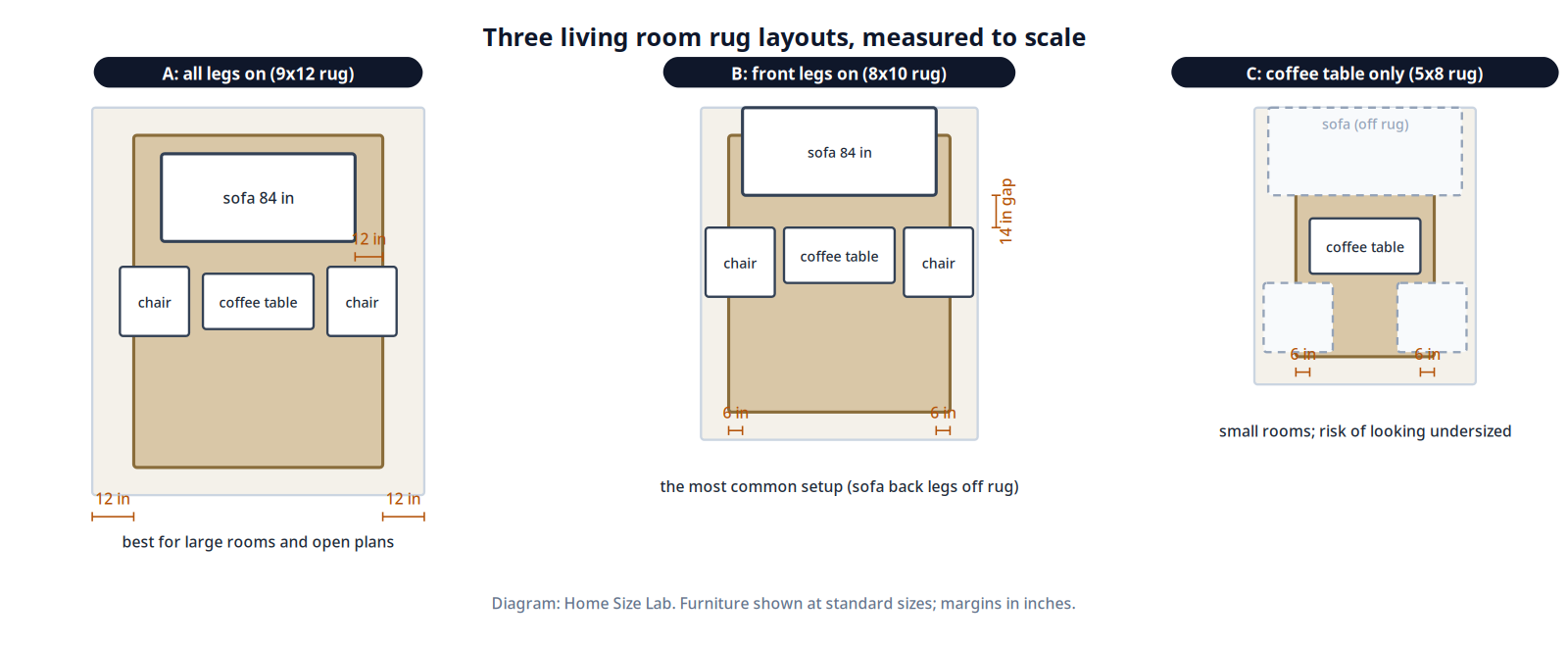
Quick answer: In a living room, your rug should be 6 to 8 inches wider than your sofa on each side, with the front legs of the sofa on the rug. In a dining room, add 24 inches beyond the table on all sides so chairs stay on the rug when pulled out. In a bedroom, extend the rug 18 to 24 inches beyond the sides and foot of the bed. Use the calculator above for your exact measurements.
The three rug sizing rules
Interior designers and rug retailers converge on the same three rules. They work because they tie the rug to the furniture, not just the room.
- Living room: at least the front legs of the sofa and chairs sit on the rug, and the rug extends 6 to 18 inches beyond the ends of the sofa. Leave 12 to 18 inches of bare floor between the rug edge and the walls in small rooms, 18 to 24 in large rooms.
- Dining room: a minimum of 24 inches of rug beyond the table edge on all sides. Pull the chairs out as far as they go: if the back legs leave the rug, it is too small.
- Bedroom: 18 to 24 inches of rug visible on each side and at the foot of the bed, so your feet land on rug when you get up. A queen bed usually needs an 8 x 10 ft rug; a king needs 9 x 12.
How to measure for a rug in 3 steps
- Measure the room wall to wall, length and width. Subtract 24 to 36 inches total to find your maximum rug size.
- Measure the anchor furniture: sofa length, dining table length and width, or bed width. Apply the rule for your room type.
- Match to a standard size: 5×8, 6×9, 8×10, 9×12, 10×14, 12×15 ft. When between sizes, size up. A slightly large rug looks intentional; a small one looks like a postage stamp.
Common rug size questions
In large rooms, yes: all legs on the rug unifies the seating group. In average rooms, front legs on the rug is the standard compromise and looks intentional.
Size up, not down. You can also layer: a large natural-fiber rug with a smaller patterned rug on top.
Yes on hard floors. It prevents slipping, protects the floor, and adds cushioning. Size the pad 1 to 2 inches smaller than the rug on each side.
For the full room-by-room breakdown with diagrams, see our rug size guide. More calculators: all HomeSizeLab tools.