


A standard dresser measures 30 to 50 inches high, 35 to 58 inches wide, and 18 to 24 inches deep, with six to nine drawers. The drawers you actually use are 14 to 18 inches deep inside. Leave 36 inches of clear floor in front so drawers open fully and you can walk past.
Those are the dresser dimensions that matter when you shop. The rest of this guide covers what most size charts skip: how deep drawers really are, whether a wide or tall dresser gives you more storage per square foot of floor, and how high to hang a mirror above one.
Standard dresser dimensions, defined
Standard dresser dimensions describe the most common manufactured size: 30 to 50 inches tall, 35 to 58 inches wide, and 18 to 24 inches deep, usually with six to nine drawers. The dimensions of a dresser change with its type, so use the chart below to match the type to your room before you compare individual pieces.
| Dresser type | Height | Width | Depth | Drawers | Best for |
|---|---|---|---|---|---|
| Standard / horizontal 6-drawer | 32-36 in | 54-60 in | 18 in | 6-9 | Most bedrooms |
| Double dresser | 30-34 in | 60-66 in | 18-22 in | 6-10 | Couples, shared rooms |
| Triple dresser | 32-34 in | 72-78 in | 18 in | 9-12 | Maximum storage |
| Tall dresser / chest of drawers | 48-54 in | 30-38 in | 18 in | 5-6 | Narrow rooms |
| Lowboy dresser | 28-30 in | 50-56 in | 19 in | 4-6 | Under windows |
| Small / bachelor chest | 32-34 in | 30-34 in | 17 in | 3-4 | Small bedrooms |
| Media dresser | 30-34 in | 54-66 in | 20 in | 4-8 | TV on top |
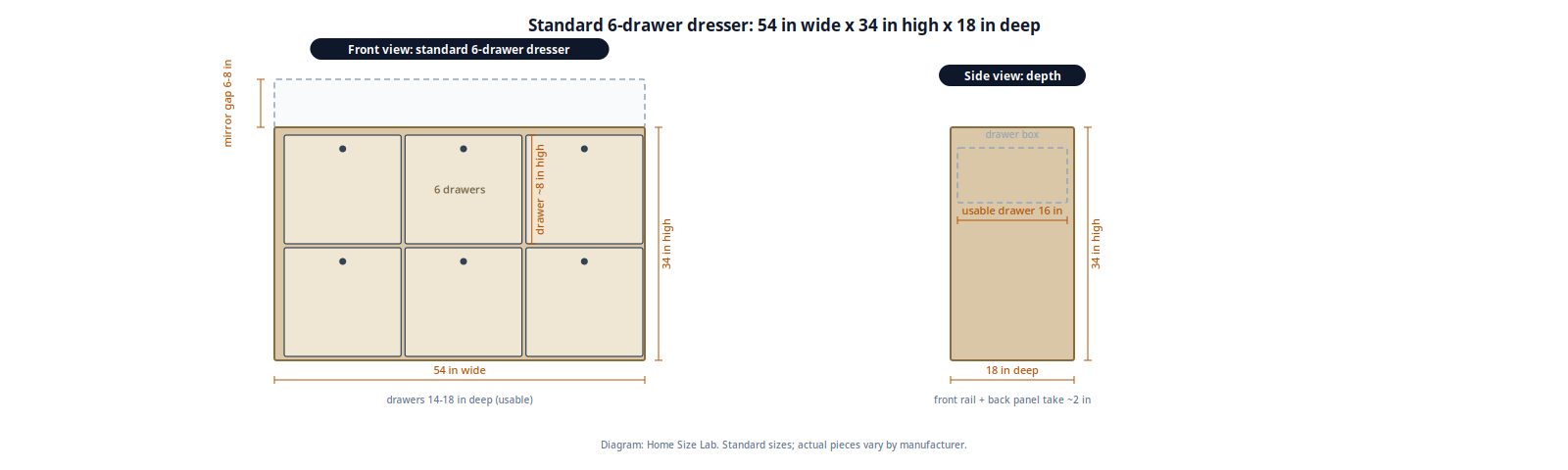
Average dresser dimensions land near the middle of these ranges: about 34 inches high, 54 inches wide, and 18 inches deep for the classic six-drawer piece. Typical dresser dimensions for a double dresser run wider, 60 to 66 inches, at the same height. When a listing gives only one number, it is usually the width, so check the full height by width by depth before you buy.
Dresser dimensions in feet are easier to picture in a room: a standard six-drawer dresser is about 2.8 feet high, 4.5 feet wide, and 1.5 feet deep. A tall dresser is about 4.5 feet high and under 3 feet wide. A triple dresser stretches 6 to 6.5 feet wide.
How deep are dresser drawers, really
This is the number almost no size chart gives you, and it is the one that decides whether your folded clothes actually fit. The usable inside depth of a standard dresser drawer is 14 to 18 inches, with 16 to 18 inches the most common. The outside depth of the dresser is 18 to 24 inches; the front rail, drawer front thickness, and back panel eat roughly 2 inches, leaving the 16-inch usable box you see in the diagram.
Why the narrow range? Drawers are sized to the materials they are built from, and 16 to 18 inches is the sweet spot where folded shirts and pants fit without the back of the drawer becoming a dead zone you cannot reach. Shallow 14-inch drawers suit accessories and small items; anything past 20 inches is custom or antique territory.
Drawer height runs 4 to 8 inches inside, which decides what stacks: 4-inch drawers hold underwear and socks, 6 to 8-inch drawers hold folded shirts and jeans. Drawer width follows the dresser: about 12 inches on small chests, up to 28 to 30 inches on wide pieces. Measure the inside of the drawer, not the outside of the dresser, when you are buying organizers.
Wide vs tall: the floor-space math
A wide dresser and a tall dresser can hold similar amounts of clothing while using very different amounts of floor. Run the numbers before you choose.
Take a standard six-drawer dresser at 54 inches wide and 18 inches deep. Its footprint is 54 x 18 = 972 square inches, or 6.75 square feet. Each of its six drawer boxes is roughly 15 inches wide by 16 inches deep by 7 inches high inside, about 1,680 cubic inches. Six of them give roughly 10,000 cubic inches of storage, about 5.8 cubic feet.
Now take a tall five-drawer dresser at 34 inches wide and 18 inches deep. Its footprint is 34 x 18 = 612 square inches, or 4.25 square feet, which is 2.5 square feet less floor. Its drawers run full width, roughly 28 by 16 by 8 inches inside, about 3,584 cubic inches each. Five of them give roughly 17,900 cubic inches, about 10.4 cubic feet.
Read that again: the tall dresser uses 2.5 fewer square feet of floor and holds nearly twice the volume in this worked example, because its drawers are full-width and its height is all storage. The tradeoff is reach: the top drawer of a 54-inch-tall dresser sits above many people’s comfortable reach, and a tall piece can loom in a small room. Choose wide when you want a surface for a TV or decor and easy access to every drawer; choose tall when floor space is the constraint. If your closet already handles hanging clothes, a smaller dresser may be enough either way, so compare against standard walk-in closet dimensions before you size up.
How to measure for a dresser in your room
Do this before you shop, in order:
- Measure the wall. Measure the width of the wall where the dresser will go, in inches. Subtract the dresser width. If less than 6 inches remain on each side, the piece will look wedged in; drop a size or pick a narrower type from the chart.
- Check the depth plus clearance. Add the dresser depth to 36 inches of clear floor in front. That total must fit the room dimension it faces. A standard 18-inch-deep dresser needs 54 inches from the wall. In a 10-foot-wide (120-inch) room that leaves 66 inches, plenty. In a narrow 8-foot room it leaves 42 inches, which still works but rules out anything deeper.
- Check the doors and path. Dressers are rigid boxes; measure your doorways and hallway turns against the dresser depth and height. Our guide to bedroom size for a queen bed maps where a dresser lands in typical 10×12 and 12×12 layouts, which helps you see the clearance in context.
- Check under-window fit. If the dresser goes under a window, its top must sit below the sill. Lowboy dressers at 28 to 30 inches high are made for this. Measure your sill height first; a standard 34-inch dresser blocks the lower sash of many windows.
- Check the ceiling line. Tall dressers need vertical clearance but also visual clearance. In a room with 8-foot ceilings, a 54-inch dresser leaves 42 inches above it, fine for a mirror. Our king bedroom size guide shows dresser placement in larger king bedrooms where a tall piece has room to breathe.
Dresser height and mirror clearance
A dresser top is a display surface, and mirrors are the most common thing hung above it. The gap between the dresser top and the bottom of the mirror depends on the dresser height:
| Dresser height | Mirror gap | Why |
|---|---|---|
| Under 35 in | 8-12 in | Keeps the mirror near standing eye level |
| 35-40 in (standard) | 6-8 in | The classic placement |
| Over 40 in (tall) | 3-5 in | Closes the gap so the mirror does not float |
Check it with eye level. A standard 34-inch dresser with an 8-inch gap puts the mirror bottom at 42 inches. A 30-inch-tall mirror then centers at 57 inches, right in the 57 to 65-inch standing eye-level band. The diagram shows the 6 to 8-inch gap zone for a standard dresser.
Size the mirror to the dresser: two-thirds to three-quarters of the dresser width. On a 60-inch dresser that is 40 to 45 inches of mirror; on a 36-inch chest it is 24 to 27 inches. Never let the mirror run wider than the dresser it hangs over.
What is the standard size of a dresser?
A standard dresser is 30 to 50 inches high, 35 to 58 inches wide, and 18 to 24 inches deep, with six to nine drawers. The most common single configuration is the six-drawer horizontal dresser at about 34 inches high, 54 to 60 inches wide, and 18 inches deep.
How deep are dresser drawers?
Usable drawer depth is 14 to 18 inches inside, most commonly 16 to 18 inches. The dresser itself is 18 to 24 inches deep outside; the frame takes about 2 inches. Measure the inside of the drawer when buying organizers.
How much space do you need in front of a dresser?
Leave 36 inches of clear floor in front. That covers a fully extended drawer (about 18 inches of drawer travel) plus room to stand and walk past. In tight rooms this is the number that decides between a standard-depth and a slim dresser, not the width.
Can you put a dresser under a window?
Yes, if the dresser top sits below the window sill. Lowboy dressers at 28 to 30 inches high are designed for this. Measure the sill height first, and confirm the window still opens and locks with the dresser in place.
What size mirror goes over a 60-inch dresser?
A mirror 40 to 45 inches wide, hung with a 6 to 8-inch gap above the dresser top. That is two-thirds to three-quarters of the dresser width, centered, with the mirror center near 57 to 65 inches from the floor.
A note on nightstands
This guide covers dressers only. The smaller bedside piece follows different rules, nightstand height is matched to the mattress top rather than the room, and our upcoming nightstand dimensions guide will cover it in full.
Most dresser guides stop at a list of ranges. This one gave you the working numbers: 16 inches of usable drawer depth, the wide-versus-tall volume math, 36 inches of floor clearance, and the mirror gap by dresser height. Measure the wall, subtract the clearance, and buy the type that fits the subtraction. That is the whole method.
Sources
- Wayfair, Dresser Dimensions: How to Choose the Right One: standard 30-50 in high, 35-58 in wide, 18-24 in deep; drawers typically 16-18 in deep
- Coleman Furniture, Dresser Dimensions Guide: 30-55 in high, 35-70 in wide, 18-24 in deep; horizontal 30-36 in high and 50-70 in wide; 36 in front clearance
- TaskRabbit, Dresser Dimensions That Will Fit Your Room: standard 30-50 in high, 30-70 in wide, 18-24 in deep; vertical dresser ranges
- EngineerFix, How Deep Are Dresser Drawers: usable drawer depths 14-18 in, most commonly 16-18 in
- DC Drawers, How Deep Are Dresser Drawers: standard 18 in drawer depth; drawer heights 4-8 in
- Decorated Life, How Big Should a Mirror Be Over the Dresser: 6-8 in gap above a standard dresser; mirror two-thirds to three-quarters of dresser width
- House Trick, How High to Hang a Mirror Over a Dresser: gap by dresser height, 8-12 in under 35 in, 3-5 in over 40 in
- The Painted Hinge, Different Dresser Dimensions and Types: type-by-type comparison chart including tall, double, triple, and lowboy dressers
