


A queen mattress measures 60 by 80 inches, but the frame stretches that footprint to about 64 by 84, and you need 24 inches of walkway on each side plus 24 inches at the foot. That math makes 10 by 10 feet the minimum bedroom size for a queen bed, with 10 by 12 feet the comfortable standard that also fits nightstands. Here is the exact arithmetic behind those numbers.
The short answer: minimum room size for a queen bed
Most guides hand you a room size without showing their work. Here is the verdict first, with the proof in the sections below.
- Absolute minimum: 10 by 10 feet (100 square feet). The bed fits with real walkways on both sides and at the foot, but furniture is limited to one nightstand and there is no room for a dresser at the foot. In short, the minimum room size for a queen bed is 10 by 10 feet.
- Comfortable standard: 10 by 12 feet (120 square feet). This is the bedroom size for a queen bed that most people should aim for. One or two nightstands fit depending on placement, a dresser works on the long wall, and the door swing stops being a problem.
- Ideal: 12 by 12 feet (144 square feet). The ideal room size for a queen bed if you want the full set: two nightstands, a dresser with drawers that actually open, and walkways you never have to sidestep through.
If your room is smaller than 10 by 10, a queen will physically go in, but the walkways will not meet the minimum standard. The 9 by 10 case gets its own honest verdict below.
Queen bed room dimensions: the exact math
The mistake almost everyone makes is planning around the mattress instead of the whole bed. Every bedroom size for a queen bed recommendation comes down to the same three layers: the mattress, the frame overhang, and the clearances around it.
Start with the mattress
A standard US queen mattress is 60 inches wide by 80 inches long (152 by 203 cm), or 5 feet by 6 feet 8 inches. That number is universal across manufacturers, and it is confirmed in manufacturer dimension charts such as Casper’s queen bed frame dimensions guide. Two sleepers get about 30 inches of personal width each, roughly a twin bed apiece.
Add the frame overhang
The mattress is not the footprint. Frames add roughly 1 to 6 inches per side depending on the design, as Casper’s frame guide notes, and a headboard adds length. Real queen frames on the market span a clear range:
| Frame style | Example | Footprint (in) |
|---|---|---|
| Minimal platform, no headboard | Zinus Mia queen platform frame | 59.3 x 79.5 |
| Upholstered with headboard | Standard upholstered queen frame | 63.9 x 82.8 |
| Wood frame with headboard | Solid wood queen frame | 64 x 84.5 |
For the math in this guide, we use a realistic middle case: a 64 by 84 inch frame footprint (163 by 213 cm). If your frame is a bulky sleigh or a storage bed, measure it and substitute your own numbers into the formulas below. The method stays the same. One edge case worth knowing: an Olympic queen mattress runs 66 by 80 inches, which pushes the frame to roughly 70 inches wide and adds about 6 inches to every width calculation in this guide.
Add the queen bed clearance
This is the layer most room-size recommendations skip, and it is the one that decides whether the room actually works. Interior layout guidance, including Wayfair’s bed size and layout guide, converges on three clearance tiers: 24 inches minimum (you can walk through and make the bed), 30 inches comfortable (no sidestepping), and 36 inches ideal (the bed never feels cramped).
The derivation
Now the part no competitor shows. Add the tiers to the 64 by 84 frame:
| Tier | Width math | Length math | Room it needs |
|---|---|---|---|
| Minimum (24 in walkways) | 64 + 24 + 24 = 112 in (9 ft 4 in) | 84 + 24 = 108 in (9 ft) | 10 x 10 ft |
| Comfortable (30 in walkways) | 64 + 30 + 30 = 124 in (10 ft 4 in) | 84 + 30 = 114 in (9 ft 6 in) | 10 x 12 ft |
| Ideal (36 in walkways) | 64 + 36 + 36 = 136 in (11 ft 4 in) | 84 + 36 = 120 in (10 ft) | 12 x 12 ft |
That is where 10 by 10 comes from. It is not a guess; it is 112 inches of width need inside a 120 inch wall, leaving 8 inches of spare, and 108 inches of length need inside a 120 inch wall, leaving 12 inches of spare.
A quick reality check with a second method: the bed footprint is 64 times 84 inches, about 37.3 square feet. In a 10 by 10 room that is 37 percent of the floor, which lands inside the 35 to 45 percent band that bedroom layout guides treat as a workable bed-to-room ratio. And a warning square footage alone cannot give you: a 9 by 12 room (108 square feet) fits a queen better than a 10 by 10 (100 square feet), because the 12 foot wall absorbs the nightstands. Shape beats area.
Three measured queen bedroom layouts
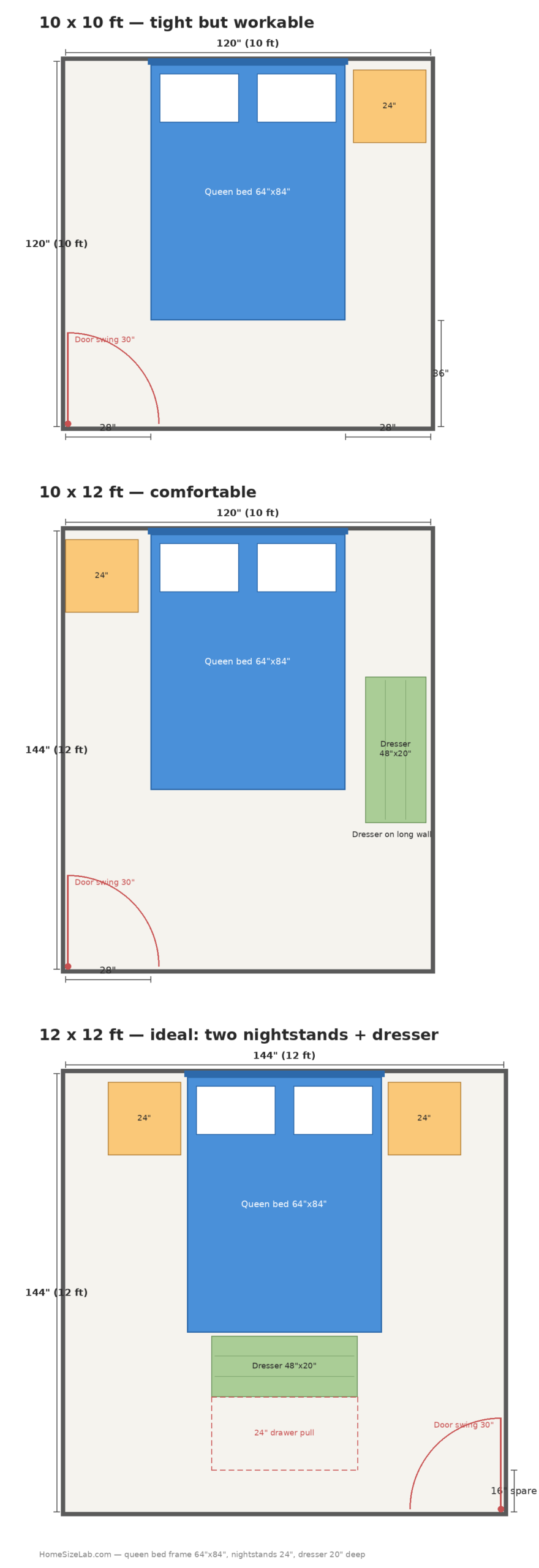
Numbers are abstract until you see furniture in them. These three layouts use the 64 by 84 frame, 24 inch nightstands, and a 20 inch deep dresser, drawn to scale in the diagram below.
Layout 1: 10 by 10, tight but workable. Bed centered on one wall. Walkways work out to 28 inches per side (120 minus 64, split two ways) and 36 inches at the foot (120 minus 84). One 24 inch nightstand fits beside the bed, leaving a 28 inch walkway on the other side. No dresser at the foot. This is the minimum room size for a queen bed in practice, not just on paper.
Layout 2: 10 by 12, comfortable. Bed on the 10 foot wall, same walkways as above, but the extra 2 feet of length change everything: a dresser fits on the long wall, the door swing clears the bed, and there is space to walk around the foot without turning sideways.
Layout 3: 12 by 12, ideal. Two 24 inch nightstands flank the bed (64 plus 48 plus small gaps uses 136 of 144 inches), and a 20 inch dresser sits at the foot with 16 inches to spare after allowing 24 inches of drawer pull space. Every walkway meets the comfortable tier.
If your room is exactly 10×10, see our guide to can a queen bed fit in a 10×10 room for the exact side clearances and measured layouts.
The furniture wall budget
The question behind most “will it fit” searches is really about the wall, not the room. Here is what each furniture combination demands from a single wall, using 24 inch wide nightstands:
| Setup | Wall inches needed | Verdict |
|---|---|---|
| Queen alone, 24 in walkways | 64 + 48 = 112 in (9 ft 4 in) | Fits any 10 ft wall, 8 in spare |
| Queen + 1 nightstand | 64 + 24 + 24 = 112 in (9 ft 4 in) | Fits any 10 ft wall, 8 in spare |
| Queen + 2 nightstands, tight 12 in gaps | 64 + 48 + 24 = 136 in (11 ft 4 in) | Needs a 12 ft wall |
| Queen + 2 nightstands, full 24 in walkways | 64 + 48 + 48 = 160 in (13 ft 4 in) | Needs a 13+ ft wall |
This table is why 10 foot walls force a choice: two nightstands or real walkways, not both. No competing guide lays this out as a wall budget, which is exactly why shoppers keep guessing.
Queen bed and dresser: do the subtraction
“Room size for a queen and dresser” is one of the most asked follow-ups, and it is weakly answered everywhere. Here is the subtraction, assuming a standard 20 inch deep dresser and 24 inches of drawer pull space in front of it:
- 10 foot room: 120 minus 84 (frame) minus 20 (dresser) minus 24 (drawer pull) = minus 8 inches. It does not fit at the foot, full stop.
- 12 foot room: 144 minus 84 minus 20 minus 24 = 16 inches spare. It fits with room to walk past.
In a 10 by 12 room the workaround is placement, not math: put the dresser on the long 12 foot wall instead of at the foot of the bed. The arithmetic only fails when the dresser competes with the bed for the same wall.
Door swing: subtract it from the room
Wayfair’s layout guide states the rule every planner should use: subtract the door’s width from the room’s usable length when the door swings inward. Here is that rule made queen-specific. A standard interior door is 30 inches wide, and its swing carves a 30 by 30 inch arc out of the floor.
In a 10 by 10 room with 36 inches of foot clearance, a door swinging into the foot zone eats nearly the whole walkway inside its arc. The fix costs nothing: hinge the door to swing flat against the nearest wall, or place the bed so the arc lands in a dead corner rather than in the walkway. In a 10 by 12 room the extra 2 feet give you enough slack that the arc simply stops mattering. Measure the swing before you measure the furniture; it is the most forgotten 30 inches in bedroom planning.
Is 9 by 10 big enough for a queen bed?
This is the second most asked question about queen bedrooms, and most answers wave their hands at it. The math does not: a 9 foot wall is 108 inches. Subtract the 64 inch frame and 44 inches remain, which is 22 inches per side, below the 24 inch minimum. The bed goes in, but neither walkway meets the standard. That is the honest verdict.
Three tradeoffs make it livable, each with a real cost:
- Push the bed into a corner. One side gets 0 inches, the other gets the full 44. Works for a single sleeper; the walled side becomes dead space for making the bed.
- One nightstand, wall mounted or floating, and no dresser. You recover the missing inches by deleting furniture, not by finding space.
- Drop to a full-size bed. A 54 inch wide mattress leaves 27 inches per side in the same room, which clears the minimum with room to spare.
Our full measured 9 by 10 queen layout, with exact furniture placement, is coming as a dedicated guide. The verdict here is the math; the layout deserves its own page.
Why sources disagree about the minimum
You will see 10 by 10, 11 by 10, and even 12 by 12 quoted as the minimum. They are not all wrong; they are answering with different assumptions. This table reconciles them:
| Source position | Minimum claimed | Frame assumed | Clearance used |
|---|---|---|---|
| Most guides | 10 x 10 ft | ~64 in wide | 24 in (minimum tier) |
| Wayfair | 11 x 10 ft | ~65 in wide | 30 in (comfortable tier) |
| Strict planners | 12 x 12 ft | ~66 in wide | 36 in (ideal tier) |
A wider frame assumption times a stricter clearance standard equals a bigger room. Our derivation above shows all three tiers honestly, so you can pick the standard that matches how you actually live instead of arguing about whose number is right.
Better alternatives
If the math above feels tight, the alternatives are honest ones. A full-size bed (54 by 75 inches) buys back 10 inches of width and 5 inches of length, which is often the difference between a room that works and one that fights you. And if your room is 12 by 12 or larger and you are debating the step up, see what size bedroom is needed for a king bed before you decide, because the king’s 76 inch width changes every calculation on this page.
FAQs
What is the minimum room size for a queen bed?
10 by 10 feet. The derivation: a 64 by 84 inch frame plus 24 inch walkways on both sides and 24 inches at the foot needs 112 by 108 inches, which a 120 by 120 inch room absorbs with inches to spare.
Is a 9 by 10 bedroom big enough for a queen bed?
Only with compromises. The math leaves 22 inches per side, under the 24 inch minimum. Corner placement, a single nightstand, or dropping to a full-size bed are the three workable tradeoffs.
What room size fits a queen bed and a dresser?
12 by 12 feet for a dresser at the foot of the bed, allowing full drawer pull space. In a 10 by 12 room, put the dresser on the long wall instead.
How much clearance do you need around a queen bed?
24 inches minimum on each side and at the foot, 30 inches for comfortable daily use, 36 inches for an ideal feel. These tiers come from standard interior layout guidance.
Sources
Queen mattress and frame dimensions are manufacturer-published: Casper’s queen bed frame dimensions guide confirms the 60 by 80 inch mattress standard and notes frames add 1 to 6 inches by design, while the Zinus Mia queen platform frame lists a 79.5 by 59.3 inch footprint for the minimal style. Room comfort figures use dimensioncan’s queen bed dimensions guide, which tabulates frame footprints from 64 to 66 inches wide with room-size comfort ratings, and Wayfair’s bed size and layout guide for the 24/36 inch clearance tiers and the door swing subtraction rule. Clearance application, wall budgets, and the dresser subtraction are original calculations from those inputs.

5 Comments
Pingback: Can a King Bed Fit in a 10x10 Room?
Pingback: Bedroom Size for a King Bed: Minimum & Ideal
Pingback: Can a Queen Bed Fit in a 10x10 Room?
Pingback: Dresser Dimensions: Standard Sizes & Drawer Depth
Pingback: Nightstand Dimensions: Standard Sizes & Height Rules