



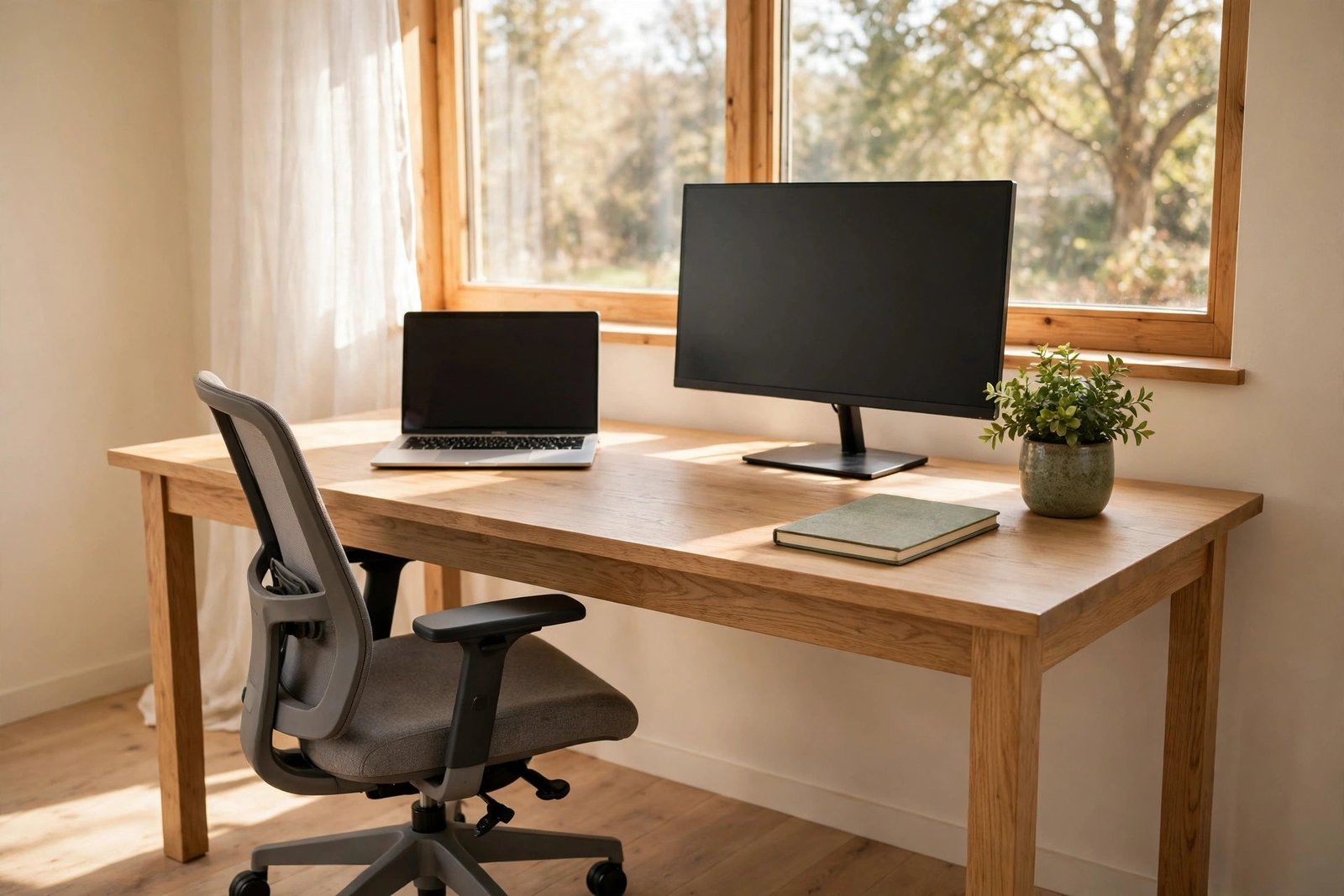
The standard desk height is 29 inches from the floor to the top of the worksurface. That number fits people around 6 feet tall and runs high for most everyone else. Your correct desk height is your seated elbow height, which runs from 24 inches at 5 feet tall to 31 inches at 6 feet 4 inches. Measure your elbow, match the desk to it, and the chair and monitor fall into place around that one number.
Definition: desk height is the distance from the finished floor to the top of the desk worksurface, measured at the front edge where your forearms rest. For typing, the number that matters is the keyboard height, not the desktop height: if your keyboard sits on the desktop, the two are the same, but if you use a keyboard tray, the tray is the surface to measure. Every height in this guide is in inches, with centimeters in the tables.
How this guide measures desk height
Every height in this guide is your elbow height, seated or standing, with your feet flat, your thighs roughly level, your shoulders relaxed, and your elbows bent to about 90 degrees with your forearms parallel to the floor. Measure from the floor to the underside of your forearm. That measurement is your correct desk height.
Three formulas estimate it when you cannot measure directly. Seated desk height is about your height times 0.404. Standing desk height is about your height times 0.63. Chair seat height is about your height times 0.25. The formulas come from ErgoLivingSpace, which publishes the same three and a matching chart, and the chart in this guide follows them exactly. Allow about plus or minus 1 inch either way, because two people at the same height can have different torso-to-leg ratios. Measure your own elbow when the number has to be exact, for example before ordering a fixed-height desk.
Two things the formulas do not cover. Shoes add height to your standing number, so measure standing elbow height in the shoes you wear at work. And a thick mechanical keyboard or a wrist rest raises your hands by half an inch to 1 inch, so subtract that much from the desk height if you type on one.
This guide is about ergonomic height only: seated and standing height by your height, the elbow rule, and the chair and monitor pairing. Product sizes, width and depth by desk type, live in the site's desk dimensions guide. This guide owns the height question; the guide owns the size question.
Desk height at a glance
| Your height | Seated desk height | Standing desk height | Chair seat height |
|---|---|---|---|
| 5 ft 0 in (152 cm) | 24 in (61 cm) | 38 in (97 cm) | 15 in (38 cm) |
| 5 ft 3 in (160 cm) | 25 in (64 cm) | 40 in (102 cm) | 16 in (41 cm) |
| 5 ft 6 in (168 cm) | 27 in (69 cm) | 42 in (107 cm) | 17 in (43 cm) |
| 5 ft 8 in (173 cm) | 27 to 28 in (69 to 71 cm) | 43 in (109 cm) | 17 in (43 cm) |
| 5 ft 10 in (178 cm) | 28 in (71 cm) | 44 in (112 cm) | 17 to 18 in (43 to 46 cm) |
| 6 ft 0 in (183 cm) | 29 in (74 cm) | 45 in (114 cm) | 18 in (46 cm) |
| 6 ft 2 in (188 cm) | 30 in (76 cm) | 47 in (119 cm) | 18 to 19 in (46 to 48 cm) |
| 6 ft 4 in (193 cm) | 31 in (79 cm) | 48 in (122 cm) | 19 in (48 cm) |
The table follows the formulas above, rounded to the nearest inch. The 5 ft 8 in seated figure is 27.5 inches by the formula, so the table prints the 27 to 28 inch band it rounds to. If your height falls between two rows, start at the lower number: it is easier to add height with a keyboard tray or a monitor riser than to subtract it.
What is the standard desk height?
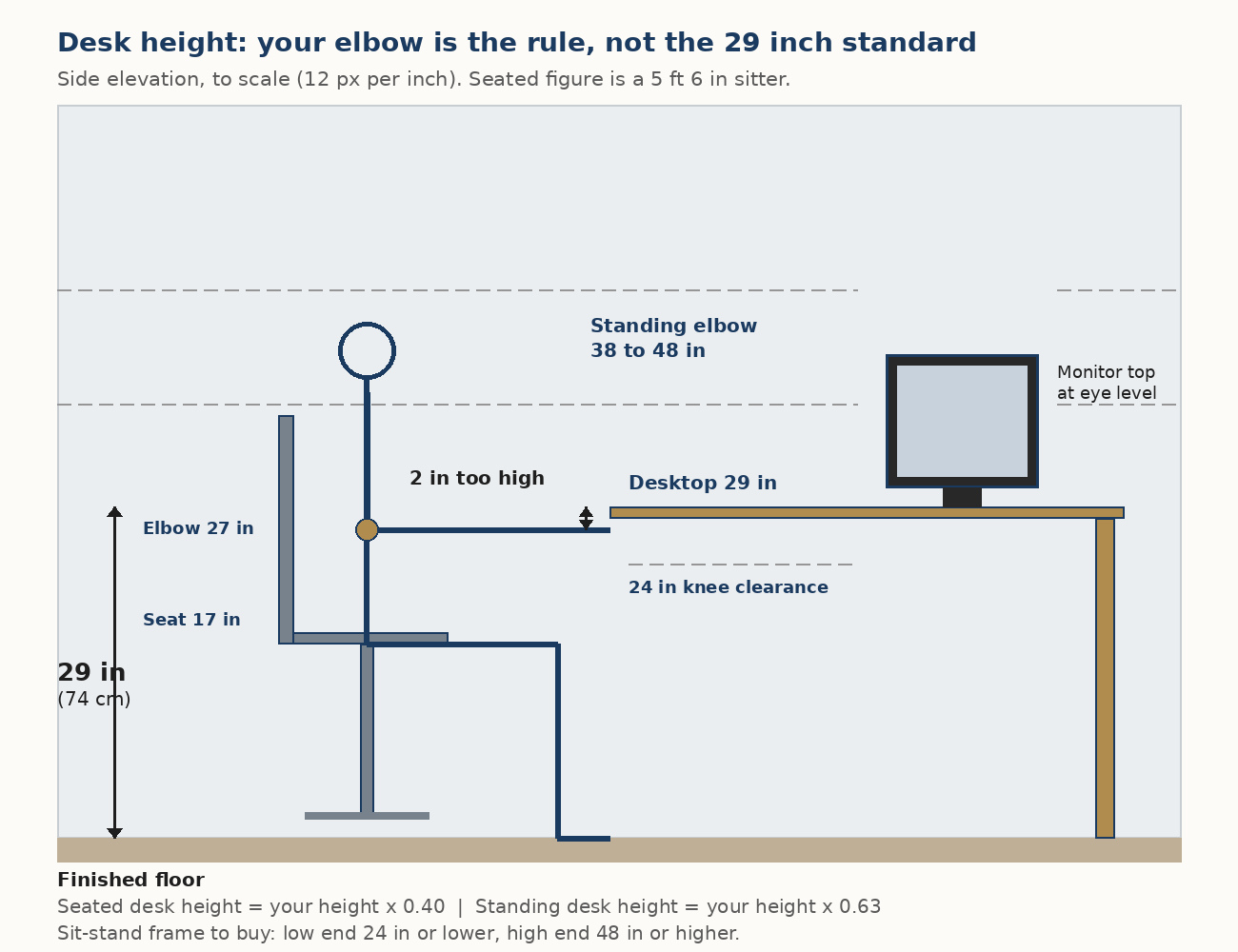
The standard desk height is 29 to 30 inches, and most fixed-height desks sit at 29 inches. That figure is a furniture manufacturing convention, not an ergonomic recommendation. WorkCocoon puts it plainly: the standard was set in the 1950s around the average adult male height of the era, about 5 feet 9 inches to 5 feet 10 inches, so a 29 to 30 inch desk puts the worksurface near elbow height for a person of that height sitting in a standard chair. The site's own desk sizes by type guide states the same 28 to 30 inch band with most fixed desks at 29 inches, and the same number appears in the guides from ErgoLivingSpace, Autonomous, and ThingThatsAre.
Read the at-a-glance table against that standard and the problem is visible. A 29 inch desk matches the 6 foot row exactly. At 5 feet 6 inches your elbow sits at 27 inches, so the standard desk is 2 inches too high. At 5 feet 3 inches your elbow sits at 25 inches, so it is 4 inches too high. At 5 feet it is 5 inches too high. Only the 6 foot to 6 foot 2 inch rows land on or near 29 inches, and only the 6 foot 4 inch row needs more than the standard. The standard fits about one height in the table and runs high for everyone shorter, which is most people.
Cornell's ergonomics lab, CUergo, puts a writing surface at 28 to 30 inches for most adults, which is the same band with the same blind spot: it describes the average adult, not your body. There is no official standard that fixes a single desk height. The ANSI/BIFMA X5.5 desk standard that appears on spec sheets tests strength, stability, and durability; it does not prescribe a height, so a desk can be BIFMA certified and still sit too high for you. Ergonomic guidance works with adjustable ranges instead, and the buying section below gives the range to look for.
Desk height by your height
The table is the answer for most readers, but the formula is worth running once, because it shows why the table says what it says and it covers heights between the rows.
Seated desk height is your height times 0.404, rounded to the nearest inch. A 5 foot 6 inch person is 66 inches tall: 66 times 0.404 equals 26.7, which rounds to 27 inches. A 6 foot person is 72 inches tall: 72 times 0.404 equals 29.1, which rounds to 29 inches, the standard. A 6 foot 4 inch person is 76 inches tall: 76 times 0.404 equals 30.7, which rounds to 31 inches. A 5 foot person is 60 inches tall: 60 times 0.404 equals 24.2, which rounds to 24 inches. The table uses the unrounded 0.404 formula, which is why it matches ErgoLivingSpace's published chart row for row.
Standing desk height is your height times 0.63. A 5 foot 10 inch person is 70 inches tall: 70 times 0.63 equals 44.1, which rounds to 44 inches. A 6 foot 4 inch person is 76 inches tall: 76 times 0.63 equals 47.9, which rounds to 48 inches. A 5 foot person is 60 inches tall: 60 times 0.63 equals 37.8, which rounds to 38 inches. Standing height runs from 38 inches at 5 feet to 48 inches at 6 feet 4 inches, a 10 inch span, while seated height runs from 24 to 31 inches, a 7 inch span. That is why a sit-stand desk needs a much wider range than a fixed desk: it must cover both spans, not just one.
Chair seat height is your height times 0.25. A 5 foot 6 inch person sits at about 17 inches: 66 times 0.25 equals 16.5, which the table rounds to 17. A 6 foot person sits at 18 inches: 72 times 0.25 equals 18. A 6 foot 4 inch person sits at 19 inches: 76 times 0.25 equals 19. The seat column is a starting point, not a prescription: two people at the same height with different leg-to-torso ratios need different seat heights, and the sit test in the chair section decides.
Other published tables differ from this one by 1 to 2 inches, and the difference is worth naming rather than hiding. Autonomous publishes its own chart with 25.0 inches seated for a 5 foot person and 29.2 inches for a 6 foot 4 inch person, against 24 and 31 here. The two tables use different estimation methods, so this guide does not average them. It prints one table, states the method behind it, and lets you check it against your own elbow measurement, which outranks any table.
Desk height for children
The table above starts at 5 feet, which leaves out homework desks. Children's sizes come from EN 1729, the European school furniture standard, which sizes by the child's height, not by age. The logic matches the adult rule: the desktop sits at seated elbow height, so each band steps up as the child grows.
| Age guide | Child height | Desk height | Chair seat height |
|---|---|---|---|
| 4 to 6 years | 3 ft 7 in to 4 ft (108 to 121 cm) | 21 in (53 cm) | 12 in (31 cm) |
| 6 to 8 years | 3 ft 11 in to 4 ft 8 in (119 to 142 cm) | 23 in (59 cm) | 14 in (35 cm) |
| 8 to 11 years | 4 ft 4 in to 5 ft 3 in (133 to 159 cm) | 25 in (64 cm) | 15 in (38 cm) |
| 11 to 14 years | 4 ft 9 in to 5 ft 9 in (146 to 177 cm) | 28 in (71 cm) | 17 in (43 cm) |
Size by height when your child falls between bands; children of the same age can differ by several inches. The check is the same elbow test used for adults: feet flat on the floor, elbows at about 90 degrees, forearms resting level on the top. An adjustable desk that drops to about 21 inches covers the span from a 4 year old up to the adult table.
How to measure your correct desk height
Four measurements, in this order. A tape measure and a second person help; a wall and a pencil work if you are alone.
- Measure the desk. Run a tape from the finished floor to the top surface at the front edge where your forearms rest, not at the back and not on a riser. Write the number down. If you use a keyboard tray, measure the tray surface instead.
- Measure your sitting elbow height. Sit in your chair with your feet flat on the floor, your thighs roughly level, and your shoulders relaxed. Bend your elbows to about 90 degrees so your forearms are parallel to the floor, and have someone measure from the floor to the underside of your forearm. That number is your correct seated desk height.
- Measure your standing elbow height. Stand straight in the shoes you wear at work, shoulders relaxed, elbows at 90 degrees, and measure floor to underside of forearm again. That number is your correct standing desk height.
- Compare. A desk within about half an inch of your elbow height fits. If the desk is higher, raise the chair and add a footrest, or fit a keyboard tray. If it is lower, add a riser for the keyboard and mouse, or raise the desk. The fixes section below works through both cases with the arithmetic.
Standing desk height
Standing desk height follows the same elbow rule, standing up. Stand with your shoulders relaxed and your elbows at 90 degrees, and set the surface to your standing elbow height: 38 inches at 5 feet, 44 inches at 5 feet 10 inches, 48 inches at 6 feet 4 inches. The most common standing-desk error is setting the surface too high, which pushes the shoulders up and bends the wrists, the same strain as a tall seated desk. Slightly too low is the safer error.
Two things change when you stand. First, the monitor must rise with you: the top of the screen stays at or just below eye level in both positions, so a monitor arm that follows you between sitting and standing is worth more than a fixed riser. Second, the rhythm matters more than the position. The 20-8-2 pattern, popularized by Cornell ergonomics professor Alan Hedge, is about 20 minutes seated, 8 minutes standing, and 2 minutes moving in each 30 minutes. It is habit guidance from one source, not a medical rule, and the point is alternation: static standing all day brings its own fatigue and joint costs.
A fixed-height desk cannot serve both positions. Seated height runs 24 to 31 inches and standing height runs 38 to 48 inches, and no single surface covers both. A standing desk converter that sits on your current desk and lifts the keyboard and monitor on demand is the no-commitment way to try standing; choose one with a separate keyboard deck so the keyboard lands at elbow height when raised.
Desk height, chair height, and monitor height: the system
Desk height is one of three numbers that must be set in relation to each other. Set them in this order: chair first, then desk, then monitor. A desk set correctly against the wrong chair height is still wrong, and a monitor set against the wrong desk height follows it down.
Start with the chair. Seat height follows the popliteal rule: the seat should sit at about your lower-leg length, so your feet rest flat on the floor and your knees bend near 90 degrees. The site's office chair dimensions guide gives the standard seat band as 16 to 21 inches, with starting points of 15 to 17 inches under 5 feet 3 inches, 17 to 19 inches from 5 feet 3 inches to 5 feet 11 inches, and 19 to 21 inches at 6 feet and over. Most adjustable chairs cover the full band with one gas cylinder, so the question is rarely whether the chair adjusts far enough. It is whether the middle of its range lands on your leg length.
Then run the elbow check, which ties the chair to the desk. Add roughly 10 inches to your seat height: the result should land at or just under your desktop height. An 18 inch seat gives elbows near 28 inches, 1 inch under a 29 inch desktop, which is the comfortable zone with forearms parallel to the floor. A 21 inch seat pushes elbows to about 31 inches, above the desktop, so the shoulders lift to type. If your elbows land above the desktop, lower the seat first and re-run the check before blaming the desk.
Then run the 28 inch rule, which decides whether the chair tucks under the desk. A standard desk is 29 inches tall, and a 1 inch top leaves the desk underside at 28 inches. Seat height plus armrest height must stay at or under 28 inches, or the armrests will not slide under the desk. An 18 inch seat with 7 inch armrests totals 25 inches and passes with 3 inches to spare. An 18 inch seat with 10 inch armrests totals 28 inches exactly and grazes. A 20 inch seat with 10 inch armrests totals 30 inches and fails by 2 inches, so the chair lives an inch or two out from the desk permanently and the reach to the keyboard stretches with it. Lower the seat until the sum passes, or drop the armrests if they adjust independently. Raising the desk is the last resort, and only height-adjustable desks allow it.
Thigh clearance is the second subtraction under the desk. Desk underside minus seat height is your thigh room: 28 minus 18 equals 10 inches at a common seat height, and 28 minus 21 equals 7 inches at the top of the band. Thighs run about 5 to 6 inches thick, so 10 inches passes with room and 7 inches passes but feels tight for thicker thighs. If your seat sits at the top of its range and your thighs graze the desk frame, the desk is too low for that seat height, not the other way around.
The monitor is set last and independently. The top of the screen sits at or just below eye level, so your gaze drops slightly to the center, and the screen sits 20 to 40 inches from your eyes, the OSHA computer workstation range the site's desk guide already states. A monitor arm reclaims the 8 to 10 inches a factory stand footprint eats on the desk, which on a 24 inch desk moves the screen back far enough to give the viewing distance of a 30 inch desk. A laptop cannot have its screen at eye level and its keyboard at elbow height at once, so raise the laptop on a stand and add an external keyboard and mouse.
Counter-height desks and drafting tables
A 36 inch desk is a counter-height desk, not a standard desk. It serves standing work and perch-stool work, the same band as a drafting table at 36 to 42 inches, and it is not a height to buy for seated computer work. At 36 inches it sits 5 inches above even the 6 foot 4 inch seated elbow height of 31 inches, and 12 inches below the same person's 48 inch standing elbow height, so it fits neither position for typing. It fits a perch stool, where you sit higher than a chair and lower than standing, and it fits tasks done standing for short stretches, like sketching, sorting, or working at a kitchen counter.
Do not let a 36 inch desk read as an alternative standard height. If a listing calls 36 inches a standard desk height, it is describing a counter-height or bar-height product, not an office desk. The standard for seated work stays 29 inches by convention and 24 to 31 inches by body.
What to buy: the sit-stand range that actually fits
An adjustable desk solves the height problem only if its range covers your full sit-stand window. Check three numbers before buying: the low end, the high end, and the stability at full extension.
The low end must reach at or below 24 inches, and the high end must reach at or above 48 inches. That window covers the seated elbow height of a 5 foot adult at the bottom and the standing elbow height of a 6 foot 4 inch adult at the top. The University of British Columbia purchasing guideline asks for nearly the same thing, a range from 22.6 inches or lower to 48.7 inches or higher, to cover the 5th to 95th percentile of adults, about 5 feet to 6 feet 4 inches. UBC also gives a fallback minimum low end of 25 inches, and tells buyers to avoid adjustable desks that do not go below 29 inches, since that is above seated elbow height for nearly all users.
The low end matters more than the top end, because it is the one manufacturers cut. Many popular frames stop at about 29 inches at the low end, which is the standard fixed height, not a seated height. Autonomous notes the problem against its own products: its Desk Core stops at 29.4 inches with the top on and its Desk Pro at 29.5 inches, so neither goes below the standard height. A 5 foot 6 inch sitter needs 27 inches, so a frame that stops at 29.4 inches sits 2.4 inches too high for seated work, and the keyboard tray becomes mandatory rather than optional. WorkCocoon puts the typical standing-desk range at about 27 to 47 inches, which reaches a 5 foot 6 inch sitter exactly and a 6 foot 2 inch stander at 47 inches, but leaves a 5 foot 3 inch sitter 2 inches short at the bottom and a 6 foot 4 inch stander 1 inch short at the top. Check the frame against your two numbers from the table, not against the average.
| What to check | The number | Why |
|---|---|---|
| Low end of the range | 24 in or lower (57 cm or lower) | Must reach the seated elbow height of a 5 ft adult |
| High end of the range | 48 in or higher (122 cm or higher) | Must reach the standing elbow height of a 6 ft 4 in adult |
| Your seated number | From the table, by your height | The frame must go at least 2 in below it for margin |
| Your standing number | From the table, by your height | The frame must go at least 2 in above it for margin |
| Stability at full extension | Test at your standing height | Many desks rate stable to 40 in and wobble above 44 in |
Memory presets are the feature that makes the range usable: manual adjustment every transition kills the sit-stand habit, and presets return the desk to your sitting and standing positions in one press. And check the height display against a tape once, because some controllers read the frame height without the desktop, which puts the display off by the thickness of the top.
Your desk is the wrong height: fixes that work
Most home-office desks are a fixed 29 to 30 inches and cannot be lowered. You do not need a new desk. You need to change the height of the surfaces you actually touch to match your elbow height. Which fix fits depends on which way the gap runs.
Desk too high: the common problem
A desk that is too high forces your arms to reach upward to the keyboard, raising the shoulders, creating trapezius tension, and compressing the wrist angle. It is the most common problem because the standard is 29 inches and most sitters need less.
Raise the chair and add a footrest. Worked example for a 5 foot 6 inch sitter at a 29 inch desk: your elbow height is 27 inches, so the desk is 2 inches too high. Your natural seat height is about 17 inches, and the seat-plus-10 rule says the seat for a 29 inch desk is 19 inches, because 29 minus 10 equals 19. Raise the chair 2 inches, from 17 to 19, and your elbows meet the desktop. Your feet now dangle 2 inches off the floor, so add a footrest about 2 inches high to keep them flat. Skip the footrest and the fix moves the problem to your legs and lower back.
Fit a keyboard tray. A tray mounted under the desktop drops the typing surface 2 to 4 inches to true elbow height without touching the desktop. For the same 5 foot 6 inch sitter, a 2 inch drop lands the keyboard at 27 inches, exactly the elbow height, and the monitor stays on the desktop where it belongs. The site's desk guide states the same credit the other way: a keyboard tray adds about 4 inches of effective adjustability if the frame range runs short. The tray fixes the keyboard, not the desktop, so it is the right fix when the monitor height is already correct and only the typing surface is wrong.
Replace the desk with an adjustable-height model. This is the permanent fix and the only one that also gives you standing height. Buy against the range in the section above, not against the standard.
Desk too low: the tall-user problem
A desk that is too low makes you reach down to the keyboard, rolling the shoulders forward and flexing the neck down. Over 8 hours that becomes cervical and thoracic strain. Worked example for a 6 foot 4 inch sitter at a 29 inch desk: your elbow height is 31 inches, so the desk is 2 inches too low. Desk risers, furniture feet extenders, add 2 to 4 inches at low cost and close the gap exactly. A monitor arm raises the screen independently of the desk, so use it for the monitor and the risers for the keyboard. If the gap is larger than 4 inches, or you also want standing height, an adjustable desk is the cleaner buy.
| Your problem | Best fix | Why |
|---|---|---|
| Desk 1 to 4 in too high, feet reach the floor when the chair is low enough | Keyboard tray under the desk | Drops the typing surface 2 to 4 in to elbow height without touching the desktop |
| Desk too high, but you like the desktop where it is | Raise the chair and add a footrest | Restores the elbow angle; the footrest stops feet dangling |
| Monitor too low, neck ache | Monitor arm or riser | Lifts the screen to eye level; an arm follows you between sitting and standing |
| Want to stand sometimes | Standing desk converter | Sits on your current desk and lifts to standing height on demand |
| Desk too low, tall user | Desk risers or leg extenders | Raise the whole desk 2 to 4 in cheaply |
| Starting from scratch, want it solved permanently | Electric adjustable-height desk | Dial in seated and standing heights exactly; save presets |
Desk height and legroom
Height is only half the fit under a desk. Legroom has its own minimums, and a desk at the right height with no room for your knees is still the wrong desk.
Knee clearance under the desk should be at least 24 inches wide and 24 inches tall, per the site's desk guide. A 30 inch desk with a 1 inch top leaves 29 inches of knee height, which clears the minimum easily. OSHA's computer workstation guidance gives an open leg clearance range of 20 to 28 inches under the desktop, and the 24 inch minimum sits inside it. Watch out for pedestal drawers on both sides: they eat the knee width, so check that at least 24 inches of clear width remains between them. Keep the CPU tower on the floor or on a side stand rather than under the desk where it steals legroom.
A drawer or a keyboard tray that eats into the clearance cancels the benefit of a lower surface, so measure the clearance with the tray installed, not with the desk empty. And the chair base is not a knee problem: a 27 inch base is wider than the 24 inch minimum knee opening, but the base sits on the floor, so it never competes with your knees. Pedestal drawers are the real knee-width limit, because they rise from the floor into the knee space.
Wheelchair and accessible desk height
The legroom minimums above assume an office chair; a wheelchair user works to a codified set of numbers. Under the 2010 ADA Standards, Section 902, an accessible work surface sits 28 to 34 inches above the floor. That band overlaps the standard 29 to 30 inch desk, so many fixed desks already pass on height. What usually fails is the space underneath.
Knee clearance under the surface must be at least 27 inches high, 30 inches wide and 19 inches deep, with a clear floor space of 30 by 48 inches in front for a forward approach. Pedestal drawers, modesty panels and low center drawers are the usual blockers: a desk can sit in the height band and still shut a wheelchair user out. An open-leg frame or wall-mounted top is the safer shape, and an adjustable desk parked inside the band serves wheelchair and standing users alike.
Fitting the desk in the room
The desk height is set. The room still has to hold the desk, the chair, and a walkway. The site's desk guide gives the room math: allow 33 to 36 inches behind the desk for the chair and getting in and out, plus 24 inches of walkway if anyone passes behind you. A 30 inch desk plus a 36 inch chair zone plus a 24 inch walkway needs 90 inches, or 7.5 feet, of room depth. Tape the footprint on the floor before you order: mark the desk rectangle plus the chair zone with painter's tape and sit in the space for a day. For the room itself, not just the desk zone, see the site's home office size guide.
Frequently asked questions
What is the standard desk height?
29 to 30 inches from the floor to the top of the worksurface, with most fixed-height desks at 29 inches. It is a manufacturing convention set around a person about 5 feet 9 inches to 6 feet tall, not an ergonomic recommendation. Your correct height is your seated elbow height, 24 to 31 inches by your height.
What desk height do I need for my height?
Multiply your height by 0.404 for sitting and by 0.63 for standing, then round to the nearest inch. A 5 foot 6 inch person needs about 27 inches seated and 42 inches standing. A 6 foot person needs about 29 inches seated and 45 inches standing. A 6 foot 4 inch person needs about 31 inches seated and 48 inches standing. The table at the top of this guide lists all eight heights.
How high should a desk be for a 5 foot 3 inch person?
About 25 inches seated and 40 inches standing. A standard 29 inch desk is 4 inches too high, so a keyboard tray or an adjustable desk makes a big difference. Raising the chair to meet the desk means a seat near 19 inches, about 3 inches above the natural 16 inches, so add a footrest about 3 inches high if you take that route.
How high should a standing desk be?
Set it to your standing elbow height: 38 inches at 5 feet, 44 inches at 5 feet 10 inches, 48 inches at 6 feet 4 inches. Keep your elbows at 90 degrees with relaxed shoulders, and raise the monitor separately so the top of the screen stays at eye level when you stand.
Is 29 inches too tall for a desk?
For most people, yes. A 29 inch surface fits someone around 6 feet tall, so anyone shorter ends up shrugging the shoulders or angling the wrists upward. Either lower the work surface, raise the chair and add a footrest, or fit a keyboard tray below the desktop.
Is 32 inches too high for a desk?
For most people, yes. A 32 inch surface suits users around 6 feet 2 inches to 6 feet 4 inches. If you are shorter, a 32 inch desk will push your shoulders up or make your feet dangle. Either lower the surface, add a keyboard tray, or raise the chair and add a footrest.
Is a 36 inch desk too high?
For seated computer work, yes. A 36 inch desk is a counter-height desk for standing and perch-stool work, the same band as a drafting table at 36 to 42 inches. It is not a standard desk height and it is not an alternative to 29 inches for sitting.
Is there a desk height calculator?
There is no desk height calculator on this site yet. The formula is the calculator's math: multiply your height in inches by 0.404 for sitting and by 0.63 for standing, then round to the nearest inch. That gives the same number a calculator would, and your own elbow measurement outranks both.
Sources
- ErgoLivingSpace's ideal desk height guide: seated desk height about height times 0.404, standing about height times 0.63, chair seat about height times 0.25, plus or minus 1 inch; the by-height table this guide follows; standard 29 to 30 inches suits only people around 6 feet; keyboard tray drops the typing surface 2 to 4 inches; monitor top at or just below eye level with gaze dropping 10 to 20 degrees to center; 20-8-2 pattern popularized by Cornell professor Alan Hedge.
- WorkCocoon's standard desk height guide: standard 29 to 30 inches, standardized in the 1950s around an average adult male of about 5 feet 9 inches to 5 feet 10 inches; typical standing-desk range about 27 to 47 inches; desk risers add 2 to 4 inches; keyboard tray as the fix for a desk 1 to 3 inches too tall.
- Autonomous's complete guide to ergonomic desk height: standard 29 to 30 inches as a furniture convention; Cornell CUergo writing surface 28 to 30 inches for most adults; UBC purchasing guideline range 22.6 inches or lower to 48.7 inches or higher for users 5 feet to 6 feet 4 inches, with a 25 inch fallback minimum low end and a warning against desks that do not go below 29 inches; ANSI/BIFMA X5.5 tests strength and stability, not height; OSHA open leg clearance 20 to 28 inches; Desk Core stops at 29.4 inches and Desk Pro at 29.5 inches; subtract 0.5 to 1 inch for a thick mechanical keyboard; desk within about half an inch of elbow height fits.
- ThingThatsAre's standard desk height guide: standard 29 to 30 inches corroboration and seated height range by user height.
- HomeSizeLab's desk dimensions guide: standard desk 28 to 30 inches tall with most fixed desks at 29 inches; knee clearance at least 24 inches wide and 24 inches tall; sit-stand desks typically 24 to 50 inches; keyboard tray adds about 4 inches of effective adjustability; drafting tables 36 to 42 inches; OSHA monitor viewing distance 20 to 40 inches; chair zone 33 to 36 inches and walkway 24 inches.
- HomeSizeLab's office chair dimensions guide: seat height 16 to 21 inches; seat starting points 15 to 17 inches under 5 feet 3 inches, 17 to 19 inches from 5 feet 3 inches to 5 feet 11 inches, 19 to 21 inches at 6 feet and over; seat plus armrest height at or under 28 inches; seat plus 10 inches elbow check; thigh clearance as desk underside minus seat height; armrest height 7 to 10 inches above the seat.
- HomeSizeLab's home office dimensions guide: room sizing for the desk zone, linked for the full room fit.
- 2010 ADA Standards for Accessible Design, Sections 306 and 902, as summarized in Stand Up Desk Store's ADA compliance guide: accessible work surfaces 28 to 34 inches above the floor; knee clearance at least 27 inches high and 30 inches wide, extending 19 inches deep under a work surface; clear floor space 30 by 48 inches for a forward approach.
- EN 1729 school furniture size marks, compiled in StandDeskLab's kids desk guide from the Rotherham BS EN 1729 buying guide: desk heights of 21 inches for ages 4 to 6, 23 inches for 6 to 8, 25 inches for 8 to 11, and 28 inches for 11 to 14, sized by the child's height.

2 Comments
Pingback: Desk Dimensions: 60 Inches for Dual Monitors (Size Chart)
Pingback: Workbench Dimensions: 72x24x36 Inches, Height by Task