



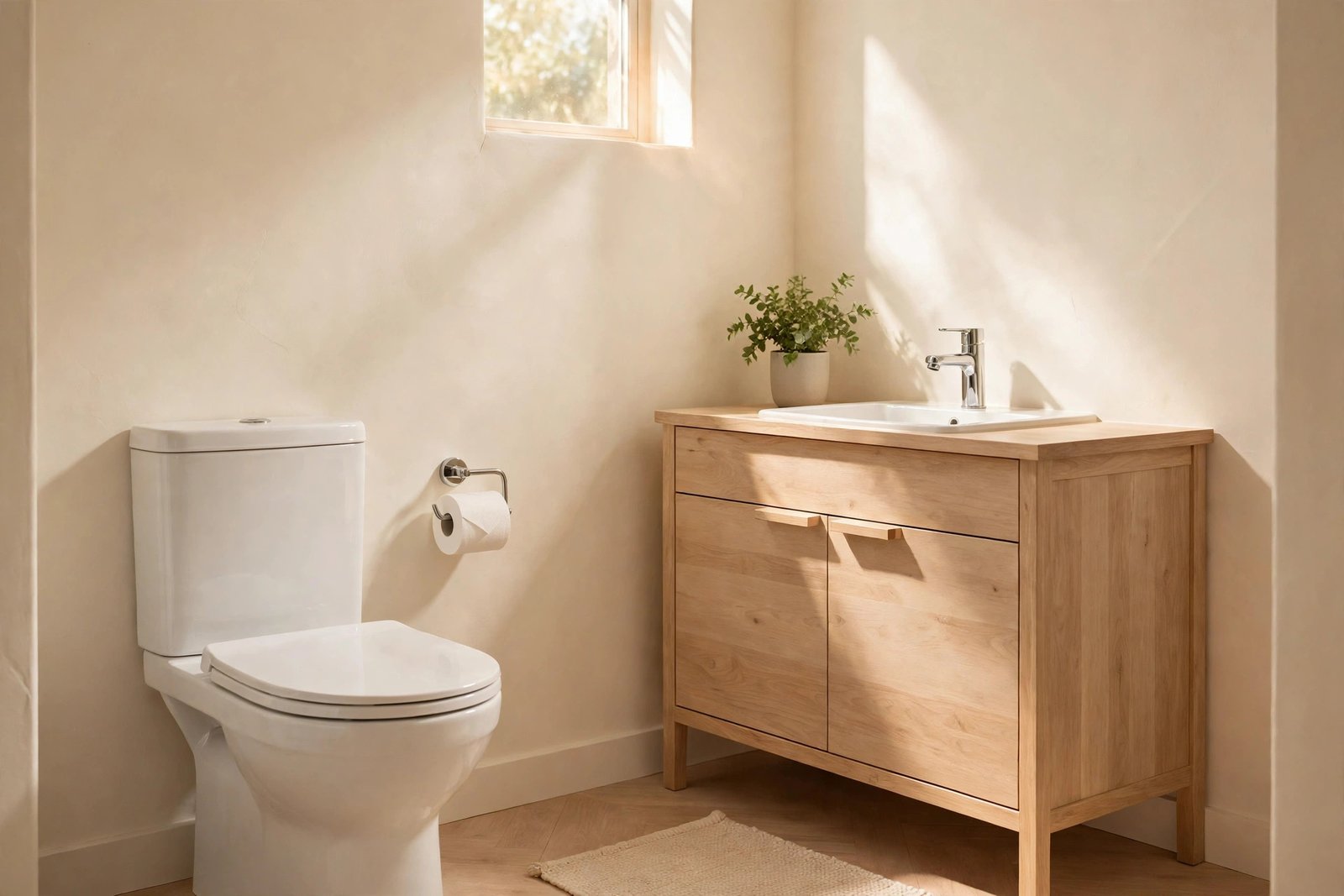
The standard toilet paper holder height is 26 inches from the finished floor to the center of the holder, with the center 8 to 12 inches in front of the front edge of the toilet bowl. That is the National Kitchen and Bath Association recommendation, and it works for both standard and comfort-height toilets. Measure from the finished floor after the tile is down, and mark the center of the holder, not the top of the roll.
Definition: toilet paper holder height is the vertical distance from the finished bathroom floor to the center of the holder spindle, paired with the horizontal distance from the front edge of the toilet bowl to the center of the holder. The two numbers work as a pair: the height sets the reach from a seated position, and the setback sets how far forward the hand travels.
How this guide measures things
This guide follows a few simple measuring conventions: all figures in inches, with centimeters in tables; “finished floor” means the floor after tile or flooring is down, never the subfloor; “center” means the center of the holder spindle, the point the roll turns on; and “in front of the bowl” is measured from the front edge of the toilet bowl to the center of the holder. Code figures and comfort figures are kept separate throughout, because a holder that passes an accessibility inspection can still feel awkward in a private home, and a comfortable home height is not automatically a code requirement. Measure finished surfaces, not framing: tile, baseboard, and wall finish all move the surfaces you measure from.
Standard toilet paper holder height at a glance
The table below is the planning chart for the whole guide. “Standard” means the National Kitchen and Bath Association (NKBA) Bathroom Planning Guidelines figure, the number designers use for homes. “ADA” means the 2010 ADA Standards for Accessible Design, Section 604.7, which governs accessible and public restrooms, not private homes.
| Measurement | Standard (NKBA, homes) | ADA (Section 604.7) | Notes |
|---|---|---|---|
| Height to center of holder | 26 in (66 cm) | No single center height; dispenser outlet 15 to 48 in (38 to 122 cm) | Measure from the finished floor, to the center |
| Distance in front of bowl | 8 to 12 in (20 to 30 cm) | 7 to 9 in (18 to 23 cm) to the centerline | Measured from the front edge of the bowl |
| Position relative to grab bar | Keep clear of the bar | Must not sit behind a grab bar | Coordinate the two together |
| Paper flow | Free-spinning roll | Must allow continuous paper flow | No controlled-delivery dispenser |
The overlap matters: a holder centered 8 to 9 inches in front of the bowl satisfies both the NKBA range and the ADA centerline range at once. That 8 to 9 inch band is the safest spot to aim for when a bathroom needs to work for everyone.
Why 26 inches works: the seat-height math
The 26 inch figure is not a round number picked for convenience. It is set by the height of the seat you sit on, and the subtraction shows why one number covers two toilet types.
A standard-height toilet seat sits 15 to 17 inches above the finished floor. A comfort-height seat sits 17 to 19 inches above the floor. Full seat heights and bowl depths are covered in our guide to toilet fixture size. Against those seats, the holder center lands here:
| Toilet type | Seat height | Holder center | Holder above the seat |
|---|---|---|---|
| Standard height | 15 to 17 in | 26 in | 9 to 11 in above the seat |
| Comfort height | 17 to 19 in | 26 in | 7 to 9 in above the seat |
Take the tallest seat in each class and the math is exact: 26 minus 17 equals 9 inches above a standard seat, and 26 minus 19 equals 7 inches above a comfort-height seat. That 7 to 9 inch band above the seat is the comfortable reach zone for a seated person: the hand drops slightly forward and down to the roll, with no twist back toward the wall and no stretch up to a holder mounted at shoulder height. A holder mounted at 30 inches or higher forces the shoulder up on every use. A holder mounted at 20 inches or lower puts the roll near knee level and forces a downward reach that is awkward for older users.
This is also why the NKBA figure does not change when you switch to a comfort-height toilet. The seat rises by 2 inches, the gap above the seat shrinks from 9 inches to 7 inches, and the reach stays comfortable. You do not need a different holder height for a different toilet.
How far in front of the toilet should the holder sit?
Height is only half the placement. The horizontal setback decides whether the roll is in front of your hand or behind your hip.
The NKBA recommends the center of the holder 8 to 12 inches in front of the front edge of the toilet bowl. The midpoint of that range is 10 inches, and it is the figure to use when nothing else constrains the wall: 8 plus 12 equals 20, and 20 divided by 2 equals 10. Measure from the front edge of the bowl, not from the tank or the wall, and measure to the center of the holder, not to the near edge of the roll.
| Position | Distance from bowl front edge | What it feels like |
|---|---|---|
| Too far back | Less than 8 in | The roll sits beside the hip; every reach twists backward |
| Standard range | 8 to 12 in | The roll sits just forward of the knee; a short forward reach |
| Sweet spot | 10 in (midpoint) | The roll is at the front of the thigh; the easiest reach |
| Too far forward | More than 12 in | The roll drifts toward the door or the vanity; a stretch to reach it |
The ADA setback is tighter: the dispenser centerline must sit 7 to 9 inches in front of the water closet. A holder at 8 to 9 inches in front of the bowl satisfies both rules, which is why the 8 to 9 inch band is the one to tape first when the bathroom must serve a wheelchair user or an older relative as well as the rest of the household.
One placement rule has no exception: never mount the holder behind the front edge of the bowl. A holder behind the bowl line forces a backward twist on every use, and it is the most common placement mistake in small bathrooms, where the side wall runs out before the holder does.
ADA toilet paper holder height: what Section 604.7 actually says
Most guides that mention ADA get this wrong, so here is the rule as written. Section 604.7 of the 2010 ADA Standards for Accessible Design says, in the standard’s own words, that toilet paper dispensers shall be 7 inches minimum and 9 inches maximum in front of the water closet measured to the centerline of the dispenser, that the outlet of the dispenser shall be 15 inches minimum and 48 inches maximum above the finish floor, that the dispenser shall not be located behind grab bars, and that dispensers shall not control delivery or block continuous paper flow.
Three things follow from the actual text that the simplified versions miss.
First, the ADA sets an outlet range, not a center height. The outlet is where the paper comes out of the dispenser, which sits below the center on most commercial units. The range is 15 to 48 inches above the finished floor, a 33 inch band (48 minus 15 equals 33). The 26 inch residential center height already sits inside that band, which is why a home holder mounted to the NKBA figure does not conflict with the ADA outlet rule.
Second, several popular guides print simplified ADA heights that do not appear in the standard at all. “19 to 26 inches” and “18 to 48 inches” both circulate as the ADA toilet paper holder height, and neither is in Section 604.7. The 19 inch figure comes from a different rule: in California’s building code, a dispenser mounted below a grab bar must have its outlet at least 19 inches above the floor. That is a state rule for a specific mounting position, not the federal ADA height. Do not use either simplification when you need the real rule; use the 15 to 48 inch outlet range and the 7 to 9 inch centerline setback.
Third, the ADA rule that most often decides a real installation is the grab-bar rule. The dispenser must not sit behind a grab bar, and where a holder goes above the side grab bar, the advisory note to Section 604.7 keeps the outlet at 48 inches maximum above the floor. In practice, that means the holder and the grab bar are planned together on the same wall drawing, not mounted one after the other. There is no separate grab-bar guide on this site yet; the one line to carry away is that the holder stays clear of the bar and the bar stays clear of the holder’s reach path.
For a private home, none of the ADA figures is a legal requirement. The NKBA 26 inch figure is the recommendation to build to. The ADA figures matter when the bathroom is designed for accessibility, when a home is being built for aging in place, or when the room must pass an accessibility inspection. In those cases, aim for the overlap: center at 26 inches high and 8 to 9 inches in front of the bowl, which meets the NKBA recommendation and sits inside the ADA outlet range and centerline range at the same time.
Toilet paper holder height diagram
The diagram below draws both numbers on one side view: the holder center 26 inches above the finished floor, and the center 10 inches in front of the bowl front edge, the midpoint of the 8 to 12 inch NKBA range. The ADA centerline band of 7 to 9 inches is noted in the box. The toilet is drawn at a 30 inch bowl depth and 17 inch seat height used in the seat-height math above.
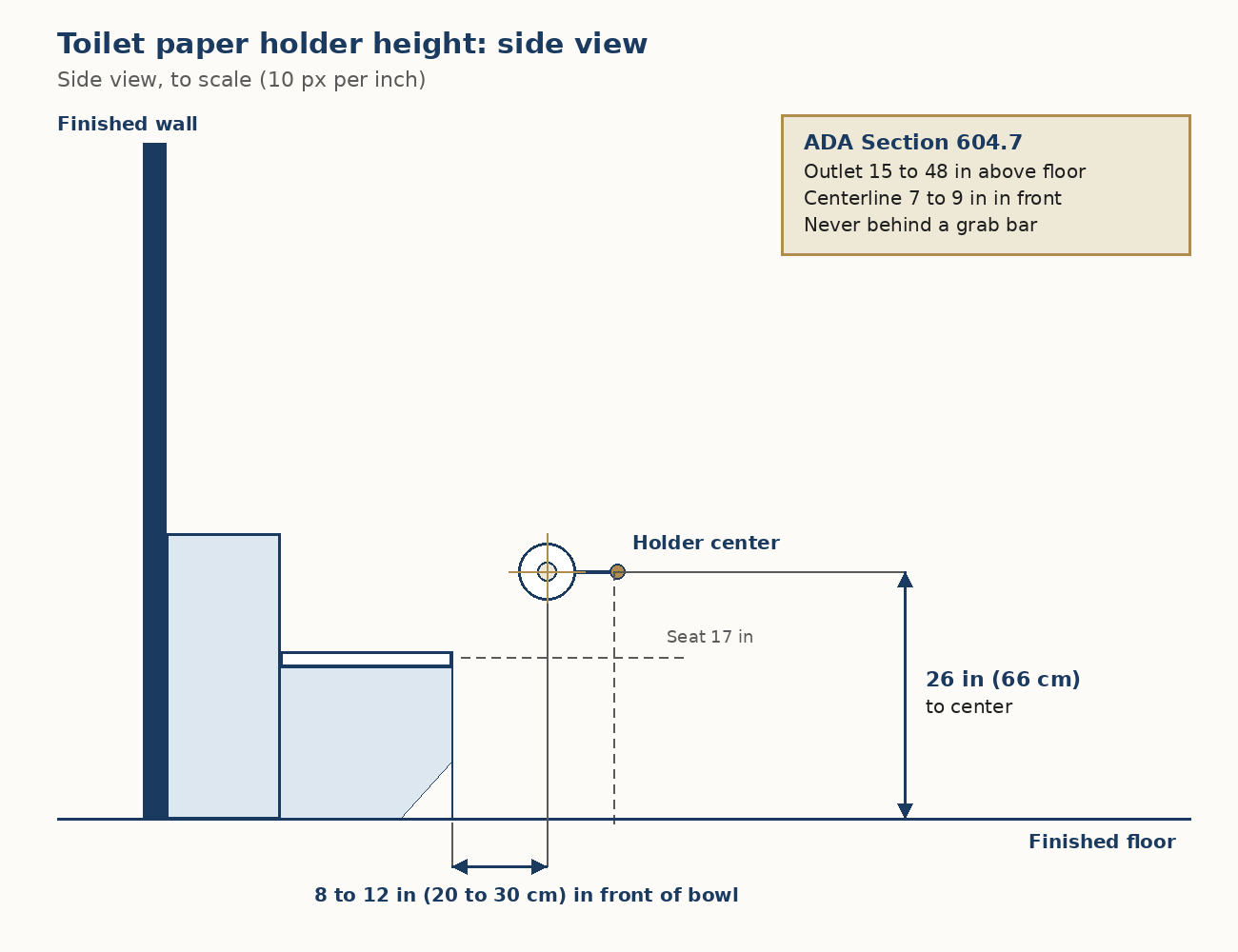
Read the drawing this way: the vertical dimension on the right is the height rule, the horizontal dimension under the floor line is the setback rule, and the seat line shows why 26 inches works, sitting 9 inches above a 17 inch standard seat. The roll is drawn as a circle because this is a side view: you are looking at the end of the roll, mounted on the side wall that faces you.
How to measure and install a toilet paper holder
Do the measuring seated, not standing. A height that looks right from standing eye level is almost always too high once you sit down.
- Sit on the toilet with your feet flat on the floor and your back against the tank. Hold a roll of toilet paper where your hand falls naturally, slightly forward and down from your hip. Have someone else mark that spot with a small piece of painter’s tape.
- Measure 26 inches straight up from the finished floor on the side wall and mark the center point. Measure from the tile, not from the subfloor under it, and use a level to keep the mark true.
- Measure forward from the front edge of the toilet bowl: 8 to 12 inches to the center of the holder, aiming for 10 inches, the midpoint. Mark where the two marks cross. That cross is the holder center.
- Check the spot against the rest of the wall. The holder must clear the vanity edge, the door swing, the baseboard, and any grab bar. If a grab bar will go on the same wall, plan both positions before drilling either.
- Tape the holder outline at the mark and sit-test it again. Tear a sheet from a roll held at the taped position. If the reach twists your back or lifts your shoulder, move the tape, not the drilled hole.
- Drill into a stud where you can. Where no stud lines up, use a toggle anchor rated for a pulling load, not a small plastic plug. A holder takes a sideways pull every time paper is torn, and a weak anchor works loose within months.
- Mount the holder level, load the roll so the paper feeds over the top, and check that it spins freely and tears cleanly with one hand. Paper that feeds from underneath drags against the wall and tears short.
Holder types: the same height, four mountings
The 26 inch center height applies to every holder type. What changes is how the holder gets there.
Wall-mounted. The standard holder: two small brackets screwed to the side wall, a spring spindle between them, the roll turning on the spindle. Mount the center of the spindle at 26 inches. This is the type the NKBA figure was written for, and it is the easiest to place exactly, because the brackets go wherever the marks say.
Recessed. The holder sits in a niche cut into the wall cavity, so the roll is flush with the wall face instead of sticking out into the room. The roll center still goes at 26 inches, and the setback is still measured to the center of the roll. A recessed holder needs a stud bay clear of plumbing and wiring, so check what runs inside the wall before cutting. It is the best option when the side wall is tight against the bowl, because it buys back the inches the roll would otherwise project into the room.
Freestanding. A floor-standing holder with a weighted base, no drilling at all. The roll height is fixed by the unit, so check the unit’s roll center against the 26 inch figure before buying: hold a tape measure to the display model and compare. A freestanding unit also solves the setback problem in a bathroom with no usable side wall, because you place the base 8 to 12 inches in front of the bowl and move it when it is in the way.
Vanity-mounted. The holder screws to the side panel of the vanity, used when the vanity stands close beside the toilet and there is no open wall. The roll center still goes at 26 inches where the panel allows it. Full vanity sizing, including the counter and cabinet heights that decide whether a side-panel mount works, lives in our guide to bathroom vanity dimensions. If the panel is too short to carry the bracket at 26 inches, use a recessed or freestanding holder instead of forcing the mount low.
Small bathrooms: when 8 to 12 inches will not fit
In a tight bathroom the side wall often ends before the 8 to 12 inch setback does. The vanity, the door, or a jog in the wall can leave less than 8 inches of wall in front of the bowl. Three moves fix that without breaking the height rule.
First, recess the holder. A recessed unit keeps the roll center at 26 inches and puts the roll inside the wall, so the setback is measured to a roll that no longer projects into the room. Second, mount on the vanity side panel if the vanity stands within reach of the seated position. Third, use a freestanding holder and place its base where the wall cannot go.
What not to do is mount the holder behind the bowl front edge to save wall space. A holder behind the bowl is worse than a holder slightly closer than 8 inches: the twist it forces is the exact discomfort the setback rule exists to prevent. If the only wall is behind the bowl line, the holder does not belong on that wall at all.
The other accessory that shares this wall is the towel bar. The matching towel bar height for the same bathroom is 48 inches to the center, well above the holder, so the two never compete for the same stretch of wall. Plan them together: holder low and forward by the bowl, towel bar high and clear of the door swing.
Mistakes that get the height wrong
Measuring from the subfloor. Tile and underlayment add height after the subfloor is down. A holder marked at 26 inches from the subfloor ends up lower than 26 inches from the finished floor once tile goes in. Always measure from the finished surface.
Measuring to the top of the holder. The rule is to the center of the spindle, not to the top of the bracket or the top of the roll. A bracket is several inches tall, so a holder mounted with its top at 26 inches has its center several inches lower, and the roll drags near the knee.
Mounting behind the bowl. Covered above, but it bears repeating because it is the most common error: the holder goes in front of the bowl front edge, 8 to 12 inches, never behind it.
Trusting a simplified ADA number. If a guide tells you the ADA toilet paper holder height is 19 to 26 inches or 18 to 48 inches, it is repeating a simplification that is not in Section 604.7. The standard gives an outlet range of 15 to 48 inches and a centerline setback of 7 to 9 inches. Quote those.
Drilling with no anchor. A holder screwed into bare drywall with a small plastic plug pulls out under the sideways tug of tearing paper. Hit a stud or use a proper toggle anchor.
Mounting behind or above a grab bar without checking. In an accessible bathroom the dispenser must not sit behind a grab bar, and the outlet must stay within the 15 to 48 inch range. Plan the bar and the holder on the same drawing.
Frequently asked questions
What is the standard toilet paper holder height?
The standard toilet paper holder height is 26 inches from the finished floor to the center of the holder. That is the National Kitchen and Bath Association recommendation, corroborated by bathroom remodeling and design guides. Measure to the center of the spindle, after the tile is down.
How far in front of the toilet should a toilet paper holder be?
The center of the holder should sit 8 to 12 inches in front of the front edge of the toilet bowl, measured to the center of the holder. The midpoint, 10 inches, is the easiest reach. In an accessible bathroom the setback tightens to 7 to 9 inches to the centerline, per ADA Section 604.7.
What is the ADA height for a toilet paper holder?
The ADA does not set a single center height. Section 604.7 requires the dispenser outlet 15 to 48 inches above the finished floor, the centerline 7 to 9 inches in front of the water closet, no placement behind a grab bar, and continuous paper flow. A home holder centered at 26 inches and 8 to 9 inches in front of the bowl sits inside both the outlet range and the centerline range.
Should the holder be higher for a comfort-height toilet?
No. The 26 inch center works for both toilet types. The math: 26 minus 17 equals 9 inches above a standard 17 inch seat, and 26 minus 19 equals 7 inches above a comfort-height 19 inch seat. Both gaps sit in the comfortable reach zone, so the holder height stays the same when the toilet gets taller.
Can I mount a toilet paper holder on the vanity?
Yes, when the vanity stands close beside the toilet. Screw the bracket to the vanity side panel with the roll center at 26 inches. If the side panel is too short to carry the bracket at that height, use a recessed holder or a freestanding unit instead of mounting the holder low.
How high should a toilet paper holder be for children?
There is no published residential standard for a child’s toilet paper holder height, so do not copy a number from a commercial children’s restroom rule into a home bathroom. For a children’s bathroom, seat the child on the toilet, tape-test a lower center position, and drill only after the child can reach the roll without standing or twisting. In a shared family bathroom, keep the 26 inch standard, since adults use the room most and the child grows into the height within a few years.
Sources
- LilyAnn Cabinets, toilet paper holder, towel bar and grab bar heights guide
- Hunker, standard height of toilet paper holders
- EngineerFix, how high should a toilet paper holder be
- The Cleaning Station, toilet paper holder guide on height, installation and placement
- Boise Bath, bathroom accessory heights mounting guide
- Corada, 2010 ADA Standards Section 604 water closets and toilet compartments, full text of Section 604.7
- Cornell Law Institute, analysis and commentary on the 2010 ADA Standards for Accessible Design, confirming the 7 to 9 inch centerline and 15 to 48 inch outlet figures

2 Comments
Pingback: Towel Bar Height: 48 Inches to the Center (Standard Rule)
Pingback: Toilet Dimensions: Size Chart + 12 Inch Rough-In Rule