



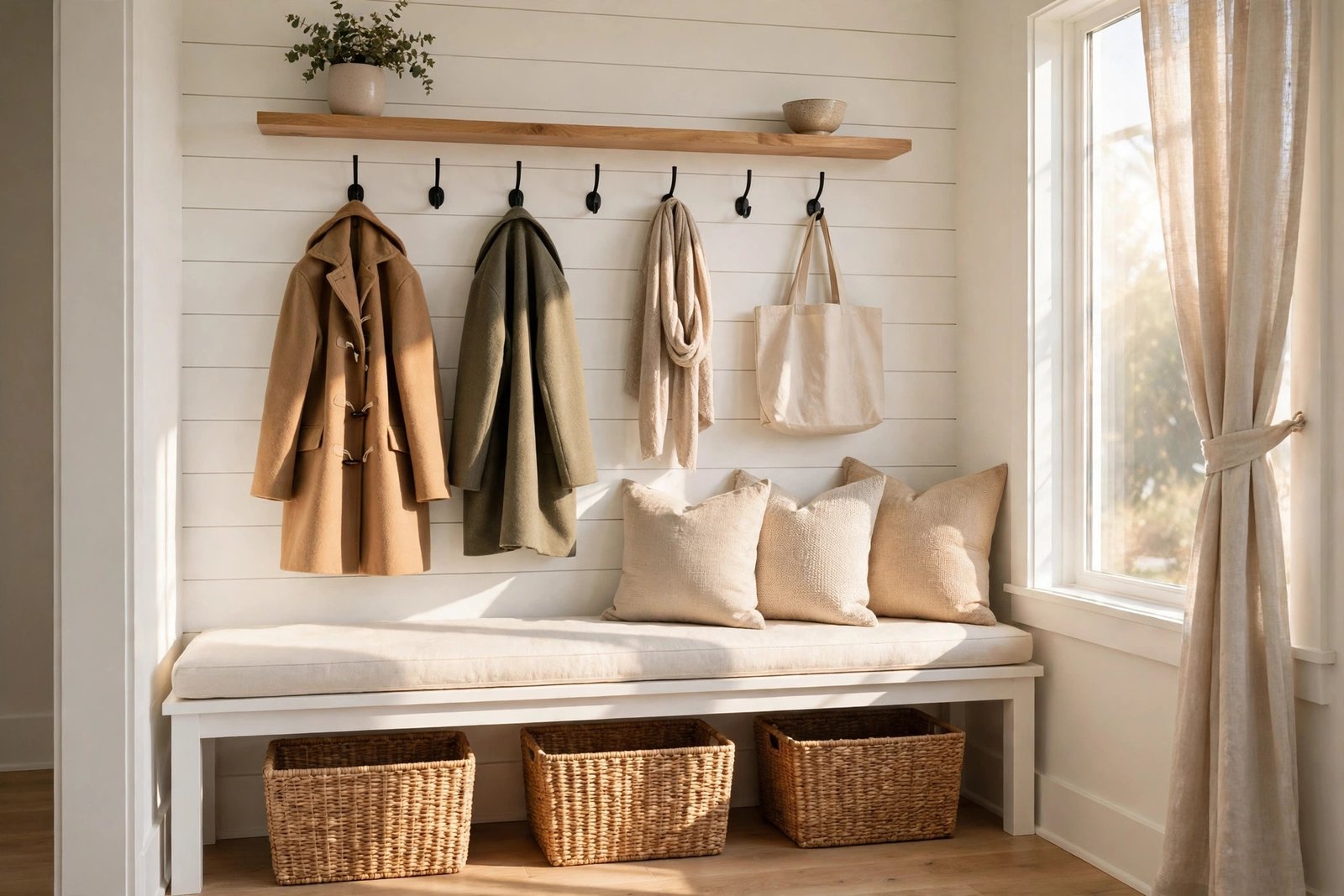
The standard coat hook height is 60 to 66 inches from the finished floor to the center of the hook. Mount at 66 inches where a bench sits below the hooks and at 60 inches where there is no bench, because a long coat hung on a 60 inch hook drapes over an 18 inch bench. Children get their own row at 42 to 48 inches, and an accessible hook sits at 44 inches, never above 48.
Definition: coat hook height is the vertical distance from the finished floor to the center of the hook, measured in inches. The center of the hook is the reference point. A hook is a curved piece of hardware, so measuring to its top or its tip gives a different number, and every figure in this guide uses the center unless the text says otherwise.
How this guide measures a coat hook
Every size in this guide is the hook's finished measurement, in inches with centimeters in the tables, measured from the finished floor, not an unfinished subfloor. If the flooring goes in later, add its finished thickness to the layout now, or the final floor-to-hook measurement will come up short. Measure to the center of the hook, where the coat loop or hanger actually rests, not to the top of the mounting plate and not to the tip of the curve. One EngineerFix guide measures 60 to 68 inches to the top of the hook; the 2 inch gap between that range and the 60 to 66 inch range is the hook itself, which is why the reference point matters and why this guide states it up front. Where sources disagree, this guide prints the consensus figure as the standard, names the outlier, and says which one to use. The height, the spacing, the kids row, the accessible row, and the hook-versus-rod comparison each get their own section, because each one is a different mounting decision.
Coat hook height at a glance
| Hook row | Height from floor | Serves | Hang above an 18 in bench |
|---|---|---|---|
| Adult, no bench | 60 in (152 cm) | Shorter adults, shorter coats | 42 in of hang |
| Adult, over a bench | 66 in (168 cm) | Most adults, most coats | 48 in of hang |
| Kids, school-age | 42 to 48 in (107 to 122 cm) | Children | 24 to 30 in of hang |
| Kids, toddlers | 36 in (91 cm) | Toddlers | 18 in of hang |
| Accessible | 44 in typical (112 cm), 48 in max (122 cm) | Wheelchair users, limited reach | 26 in of hang |
| Long-coat row | 72 in (183 cm) | Long overcoats, tall adults | 54 in of hang |
What is the standard coat hook height?
The standard coat hook height is 60 to 66 inches from the finished floor to the center of the hook. reThink Access, EngineerFix, ShunVogue, and HomeDecorBliss all land in the same band: reThink Access puts the standard at 60 to 66 inches based on standard human dimensions from shoulder to eye height, EngineerFix gives the same 60 to 66 inch range to the center of the hook, ShunVogue gives 60 inches for adults inside a 48 to 66 inch spread, and HomeDecorBliss gives 5 feet, or 60 inches, as the rule of thumb. The range is a range for a reason. Hooks at the lower end, around 60 inches, suit average-height adults and most standard jackets. Moving toward 66 inches benefits taller households and longer coats, because the extra inches are hang length, not reach: a hook at 66 inches still sits at shoulder height for most adults, so it costs nothing to reach and buys 6 inches of clearance below the coat.
The single number most guides print, 60 inches, is the bottom of the range, not the whole answer. It is the right number where nothing sits below the hooks. Where a bench sits below them, 60 inches is the wrong number, and the next section shows why with the coat's own length.
The 66-inch bench rule: the split that decides the height
A coat hook is not placed by eye. It is placed by the bench, because a coat hanging from a hook must clear the seat below it. The site's own mudroom dimensions guide states the rule this article builds on: the lowest coat hooks sit about 48 inches above the bench top, which on the standard 18 inch bench gives 18 plus 48 equals 66 inches from the floor. That lands exactly at the top of the 60 to 66 inch adult range, and it is the planning figure for every mudroom bench wall: 66 inches where a bench sits below the hooks, 60 inches where there is no bench.
The reason is the coat, and the coat's length is a number the coat closet dimensions guide already establishes: a long overcoat runs 44 to 52 inches from hanger to hem. Hang that coat on a hook and the hem lands at the hook height minus the coat length. On a 66 inch hook the hem lands 14 to 22 inches off the floor, because 66 minus 52 equals 14 and 66 minus 44 equals 22. On a 60 inch hook the hem lands 8 to 16 inches off the floor, because 60 minus 52 equals 8 and 60 minus 44 equals 16.
Run the test with a mid-length 48 inch coat, the coat most households actually hang. On a 66 inch hook its hem lands at 18 inches, exactly level with the top of an 18 inch bench: 66 minus 48 equals 18. It clears the bench with nothing to spare and nothing wasted, and a bag set on the bench slides underneath it. On a 60 inch hook the same coat's hem lands at 12 inches, which is 6 inches below the bench top: 60 minus 48 equals 12, and 18 minus 12 equals 6. The coat drapes across the bench, covers whatever sits on it, and picks up whatever the bench collects. The diagram in this guide draws both cases side by side so the 6 inch difference is visible, not just arithmetic.
The guides that get this wrong all make the same mistake: they subtract the bench from 60 inches and stop. ShunVogue and HomeDecorBliss both print that method. Measure the bench, subtract it from 60 inches, and hang the hooks that high above the bench. A 20 inch bench gives hooks 40 inches above it, which is 60 inches from the floor. The method treats 60 inches as the only standard and never asks how long the coat is. On an 18 inch bench it leaves 42 inches of hang, because 60 minus 18 equals 42, and any coat longer than 42 inches touches the bench. A mid-length 48 inch coat is 6 inches too long for it. The mudroom pillar's method starts from the coat instead: 48 inches of hang above the bench, which is what a mid-length coat needs, and the hook height follows from it.
Use 60 inches only where the split says to: no bench below the hooks, short coats only, or shorter adults who reach 60 inches more comfortably. The mudroom pillar keeps a 60 inch lower adult row for exactly those cases, alongside the 66 inch standard row. A hook at 60 inches works for shorter coats, and a hook at 66 inches works for most coats. Print both, and choose by what hangs on the hook and what sits below it.

Coat hook height for kids: 42 to 48 inches
Children need their own row, not a compromise height. EngineerFix puts school-age children at 42 to 48 inches from the floor and toddlers at 36 inches, HomeDecorBliss gives the same 42 inch kid-friendly figure, and ShunVogue agrees at 42 inches. The mudroom pillar lists kids hooks at 48 inches, which is the top of the school-age range and the figure to build to: a hook at 48 inches gives 30 inches of hang above an 18 inch bench, because 48 minus 18 equals 30, which fits a short child's jacket and leaves the bench usable for sitting. A toddler row at 36 inches gives 18 inches of hang above the bench, enough for a small jacket and nothing else, which is all a toddler hangs.
Two rows solve the mixed-age problem without a second bench. Put the adult row at 66 inches and the kids row at 48 inches, staggered so the rows do not share the same stud bay, and keep the kids row to the end of the bench nearest the door so children are not reaching across seated adults. That is the mudroom pillar's own layout, and it works because the rows serve different people: an adult reaching for a coat at 66 inches never competes with a child reaching for one at 48 inches. Do not split the difference at 54 or 57 inches. A single compromise row is too high for a child and too low for a long adult coat, so it serves nobody well.
ADA coat hook height: 44 inches typical, 48 inches maximum
The accessible numbers come from the 2010 ADA Standards, section 308, the reach range. reThink Access, EngineerFix, and Hunker all state the same figures: a coat hook provided in an accessible space must sit within a reach range of 15 inches minimum to 48 inches maximum above the finished floor, and the hook typically placed for accessible use sits at 44 inches to the centerline. Hunker calls 44 inches the optimum height for a rack accessible to everyone including people in wheelchairs. Treat 44 inches as the typical accessible figure and 48 inches as the maximum. The 48 inch figure is a ceiling, not a target, and 15 inches is not a mounting height: it is the bottom of the reach range, and a hook mounted there would drag every coat on the floor.
Two code nuances matter, and the sources agree on both. First, coat hooks are not required in accessible spaces, but where they are provided at least one must comply. reThink Access states it plainly for toilet rooms, and the same principle applies wherever a hook is provided in an accessible space: one compliant hook is the requirement, not a whole wall of them. Second, the reach range tightens where the reach passes over an obstruction. reThink Access notes that where the high forward reach passes over an obstruction deeper than 20 inches, the maximum drops to 44 inches, which is another reason 44 inches is the safe typical figure rather than 48. These are planning figures, not a code ruling: confirm the requirement that applies to the project with the local code, and test the height with the actual user before drilling.
How far apart should coat hooks be: 6 to 10 inches
Space hooks 6 to 10 inches apart, center to center, so coats do not bunch into one mass. EngineerFix gives 6 to 9 inches as the starting range, and the mudroom pillar prints 6 to 10 inches, which is the figure this guide uses. Use 8 inches as the standard and 10 inches where winter parkas are the daily coat. EngineerFix adds the reason the top of the range exists: heavy winter coats such as parkas and thick wool jackets need 10 to 12 inches to hang freely without compressing each other, so treat the 10 inch figure above as the floor of that range, not a cap, while light jackets, hats, and scarves can sit at 6 inches. A row that holds only keys, dog leashes, and caps can sit tighter still, at 5 to 6 inches, but keep that row separate: a coat row spaced for keys is a coat row that bunches.
The spacing decides how many hooks a wall holds, and the wall math is the same per-person math the mudroom pillar uses. At 8 inch spacing, a 96 inch bench wall for four people holds 96 divided by 8 equals 12 hooks, or three per person, which covers a coat, a bag, and a spare. At 6 inch spacing the same wall holds 16 hooks, but thick winter coats overlap and the middle hooks become hard to use. At 10 inch spacing it holds about 9 hooks, because 96 divided by 10 equals 9.6, so the parkas hang cleanly and the wall holds fewer of them. The bay width is the planning number, not the hook count: the mudroom pillar gives each person 24 inches of wall, and at 6 to 10 inch spacing that bay holds 2 to 4 hooks, because 24 divided by 6 equals 4, 24 divided by 8 equals 3, and 24 divided by 10 equals 2.4, which rounds down to 2. Plan the bays first, then divide each bay by the spacing.
Tighter than 6 inches bunches bulky coats and wastes the middle hooks. Wider than 10 inches wastes wall that a family of four needs for its daily coats. The 8 inch standard is the middle of the range for the same reason 66 inches is the middle of the height range: it is the figure that survives the most coats.
Coat hook vs closet rod: the 66-inch meeting point
A hook and a rod are different fixtures that happen to meet at the same number. The coat closet dimensions guide puts the coat closet rod at 66 to 70 inches to the center, and the closet rod height guide puts a single adult rod at 66 inches. The hook range tops out at the same 66 inches. They agree because they serve the same coat: a long overcoat runs 44 to 52 inches, and both fixtures need enough drop below them to keep the hem off the floor. On a rod at 68 inches the hem lands 16 to 24 inches off the floor, because 68 minus 52 equals 16 and 68 minus 44 equals 24. On a hook at 66 inches the hem lands 14 to 22 inches off the floor. The 2 inch difference is the hanger: a coat on a rod hangs from a hanger hook that drops a couple of inches below the rod, while a coat on a wall hook hangs from its own loop at the hook's center.
The rod figure and the hook figure are not interchangeable. A rod holds hangers and needs 66 to 70 inches because the whole closet is built around the hanging drop plus boots below. A hook holds one coat by its loop and tops out at 66 inches because anything higher is out of comfortable reach for most adults. The two agree at 66 inches, which is why 66 inches is this article's over-bench planning figure and the closet rod's starting figure at the same time. If the question is how high the rod goes, the closet guides answer it. If the question is how high the hook goes, this one does.
The vertical stack: hooks, shelf, and keyholder
A mudroom wall is a vertical stack, and every element has a floor height. The mudroom pillar's stack, re-read for this guide, runs: bench seat at 18 inches, kids hooks at 48 inches, adult hooks at 60 to 66 inches, overhead shelf at 72 to 78 inches, top cabinet or shelf at 78 to 84 inches, and a standard 8 foot ceiling at 96 inches. The shelf sits 6 to 12 inches above the hooks, because 72 minus 66 equals 6 and 78 minus 66 equals 12, which is enough for a hat or a small bag but tight for a tall backpack, so backpacks belong on the hooks, not the shelf. The pillar also lists a 72 inch long-coat row for long overcoats and tall adults, which gives 54 inches of hang above the bench, because 72 minus 18 equals 54: the row for households whose daily coat is longer than 48 inches.
Two small fixtures share the wall and follow their own numbers. A keyholder sits at 48 inches, per HomeDecorBliss, because keys need no hang length at all, and 48 inches is the same height as the kids hook row, so put the keyholder where it does not steal a coat hook's spacing. A hook on the back of a door sits 4 inches from the top of the door, per HomeDecorBliss, which keeps the hanging item clear of the door frame and within adult reach. Neither figure belongs in the coat-hook range, and neither should be used to set it: a keyholder at 48 inches is not a coat hook at 48 inches, and a door hook measured from the top of the door is not a wall hook measured from the floor.
How to measure and mount coat hooks
Measure before ordering hardware, in this order:
- Measure the longest coat on its loop or hanger, from the hook point to the hem, in inches. The longest coat sets the hang length, not the average jacket.
- Measure the bench height. An 18 inch bench plus 48 inches of hang gives a 66 inch hook. No bench below the hooks gives a 60 inch hook. Write the chosen height on the wall in pencil before drilling anything.
- Check the reach for every regular user. Everyone who will use the hooks should be able to lift a coat on and off without standing on tiptoe or stretching overhead. Set the kids row by the shortest child who uses it daily.
- Mark the hook centers at 8 inches apart, center to center, 6 inches for light items only and 10 inches where parkas are the daily coat. Mark every center with a pencil dot and check the spacing with a tape before drilling.
- Find the studs with an electronic stud finder. Studs are typically 16 or 24 inches apart, and screwing into a stud is the preferred mount for anything that will hold heavy coats. Where the mark does not land on a stud, use a toggle bolt or molly bolt, which Hunker calls the strongest wall-anchor option for a coat rack.
- Level the rail or the row, drive 3 inch wood screws into the studs, mount the hooks, and load gradually. Hang the heaviest coat first and watch for movement before loading the full row.
Coat hook height vs mudroom dimensions: the fixture and the room
A coat hook and a mudroom are sized by different questions. Room sizing (the 54 inch wall rule, 18 inches of bench plus 36 inches of aisle, the bench length per person, and the room-size subtraction) belongs to the mudroom dimensions guide. This guide covers the fixture itself: the hook height, the spacing, the kids row, and the accessible row. The room numbers appear here only as the comparison inputs the hook math needs: the 18 inch bench, the 24 inch bay, and the 72 to 78 inch shelf. The shoes under that same bench wall belong to the rack: the shoe rack dimensions guide sizes it at 13 inches deep.
Frequently asked questions
What is the standard coat hook height?
60 to 66 inches from the finished floor to the center of the hook. Mount at 66 inches where a bench sits below the hooks and at 60 inches where there is no bench.
How high should coat hooks be above a bench?
48 inches above the bench top, which on a standard 18 inch bench is 66 inches from the floor. A mid-length 48 inch coat hung there has its hem exactly level with the bench top.
What is the ADA height for a coat hook?
An accessible hook typically sits at 44 inches to the centerline, within the 15 to 48 inch reach range. 48 inches is the maximum, never the target. Hooks are not required in accessible spaces, but where provided at least one must comply.
How far apart should coat hooks be?
6 to 10 inches apart, center to center, with 8 inches the standard. Use 10 inches where winter parkas are the daily coat, and 6 inches only for light jackets, hats, and scarves.
How high should coat hooks be for kids?
42 to 48 inches for school-age children and 36 inches for toddlers, as a second row below the adult row at 66 inches. Do not use one compromise height for both.
Is a coat hook the same height as a closet rod?
No. A coat closet rod sits at 66 to 70 inches and a single adult closet rod at 66 inches, while a coat hook sits at 60 to 66 inches. The two meet at 66 inches because they serve the same coat length, but a rod holds hangers and a hook holds one coat by its loop.
Sources
- reThink Access's requirements for accessible and standard heights of coat hooks: ADA reach range 15 to 48 inches, accessible hook typically placed at 44 inches to the centerline, standard hook 60 to 66 inches, hooks not required in accessible toilet rooms but at least one must comply where provided, forward reach over an obstruction deeper than 20 inches capped at 44 inches.
- EngineerFix's guide to how high a coat rack should be: standard 60 to 66 inches to the center of the hook, kids 36 inches, ADA maximum 48 inches and minimum 15 inches, clearance measured from the top of furniture below the rack.
- EngineerFix's guide to how far apart coat hooks should be spaced: spacing 6 to 9 inches center to center, bulky winter coats 10 to 12 inches, light items 5 to 6 inches, adult height 60 to 68 inches to the top of the hook, kids 42 to 48 inches, toddlers 36 inches, ADA maximum 48 inches.
- ShunVogue's coat hook height guide: 60 inches for adults, 42 inches for kids, bench 18 to 20 inches, 48 to 66 inch spread, hooks 40 inches above a 20 inch bench by subtracting the bench from 60 inches, two-level setup at 48 and 60 inches, studs typically 16 or 24 inches apart.
- HomeDecorBliss's guide to hanging entryway hooks: 60 inches standard, 42 inches for kids, ADA maximum 48 inches, hooks 40 inches above a 20 inch bench by subtracting the bench from 60 inches, spacing 4 to 6 inches, keyholder at 48 inches, door hooks 4 inches from the top of the door.
- Hunker's guide to mounting a wall coat rack: ADA maximum 48 inches and minimum 15 inches, optimum accessible height about 44 inches from the finished floor, stud mounting, toggle or molly bolts where there is no stud, 3 inch wood screws.
- HomeSizeLab's mudroom dimensions guide: 18 inch bench plus 36 inch aisle equals the 54 inch wall rule, 24 inches of wall per person, adult hooks 60 to 66 inches, kids hooks 48 inches, 48 inches of hang above the bench equals 66 inches from the floor, spacing 6 to 10 inches, 96 inch wall at 8 inch spacing holds 12 hooks, shelf 72 to 78 inches, long-coat hooks 72 inches.
- HomeSizeLab's coat closet dimensions guide: standard closet 24 inches deep by 36 inches wide, rod 66 to 70 inches to the center, long overcoat 44 to 52 inches, hem 16 to 24 inches off the floor on a 68 inch rod, tall boots 14 to 18 inches, thick coat about 4 inches of rod space.
- HomeSizeLab's closet rod height guide: single adult rod 66 inches to the centerline, double rod 40 and 80 inches, accessible fixed rod up to 48 inches, child rod 30 to 48 inches.

3 Comments
Pingback: Mudroom Dimensions: Size Chart + 54-Inch Wall Rule
Pingback: Shoe Rack Dimensions: 13 Inches Deep, 7 Inches Per Shelf
Pingback: Coat Closet Dimensions: 24 in Deep, 36 in Wide (Chart)